General articles are free for 24 hours after publish.
Cambodia and ILO Collaborate to Strengthen Fair Labor in the Gig Economy
Cambodia's Ministry of Labor and Vocational Training and the ILO co-chaired a national seminar on decent work in the gig economy. Participants shared opportunities and challenges of the digital economy, aiming to inform future policy-making and strengthen labor conditions and social protection.
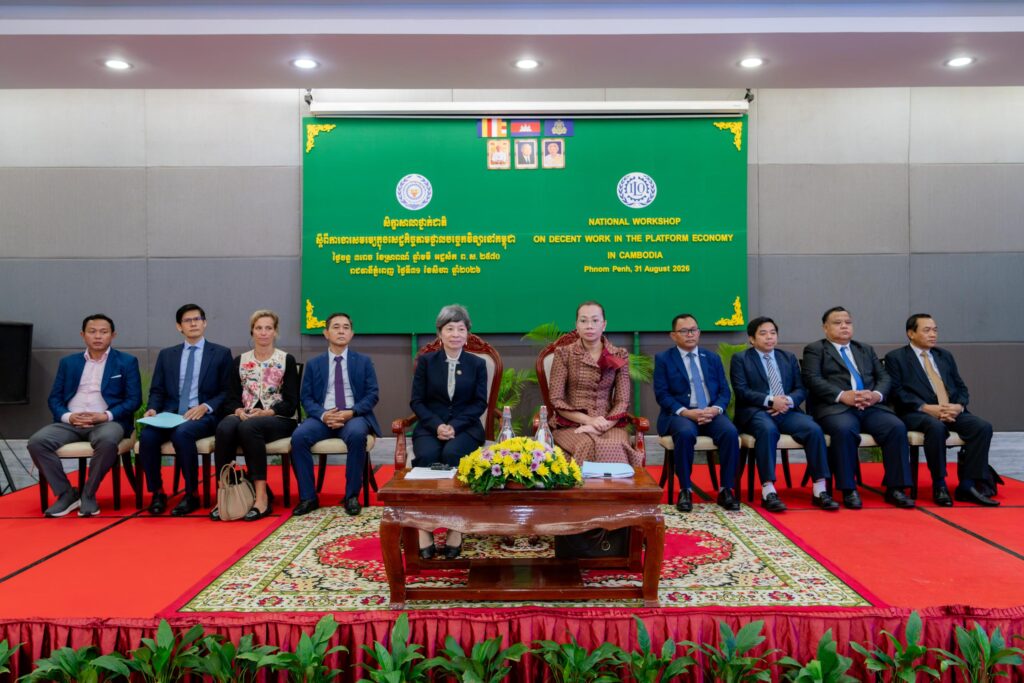
Cambodia's Ministry of Labor and Vocational Training and the International Labour Organization (ILO) co-chaired the "National Seminar on Decent Work in the Technology-Based Platform Economy" on the afternoon of August 31, 2026, at the Cambodiana Hotel in Phnom Penh. The seminar was attended by representatives from ministries, institutions, trade unions, employer organizations, worker organizations, technology platform operators, experts, and other relevant stakeholders. The seminar aims to strengthen understanding of the opportunities and challenges in Cambodia's technology-based platform economy. It will examine the working conditions and social security coverage of platform workers, as well as delve into new international labor standards, existing legal frameworks and policies in Cambodia, and the experiences of regional countries. This information will serve as input for setting priorities and discussing future policies. Ms. Suvann Vanna Rath, Secretary of State of the Ministry of Labor and Vocational Training, representing Mr. Heng Sour, Minister of Labor and Vocational Training, emphasized that the topic is crucial and responds to the rapid evolution of the digital economy and the world of work. She noted that while the growth of technology platforms creates new opportunities, it also brings challenges that require balanced study, assessment, and response. The discussion also provided an opportunity for stakeholders to share experiences and identify challenges in new forms of work. She stressed that embracing innovation and promoting decent work are not conflicting goals but require maintaining a balance between economic development, competitiveness, and ensuring appropriate protection for workers. Policy choices must be based on Cambodia's economic and social context, labor market structure, business characteristics, and implementation capacity, in consultation with stakeholders. This aligns with the "Pentagonal Strategy-Phase I" and the "2024-2028 Strategic Plan for the Development of the Labor, Social Security, and Vocational Training Sectors." Ms. Xiaoyan Qian, Director of the ILO Office for Thailand, Cambodia, and Laos, highly commended the participation of stakeholders and Cambodia's attention to promoting decent work in the technology-based platform economy. She affirmed ILO's continued cooperation and technical support. The seminar is expected to provide input for setting priorities and studying policy options to ensure Cambodia's response to current and future forms of work is balanced, inclusive, and sustainable.
Original source
Kampuchea Thmey Local