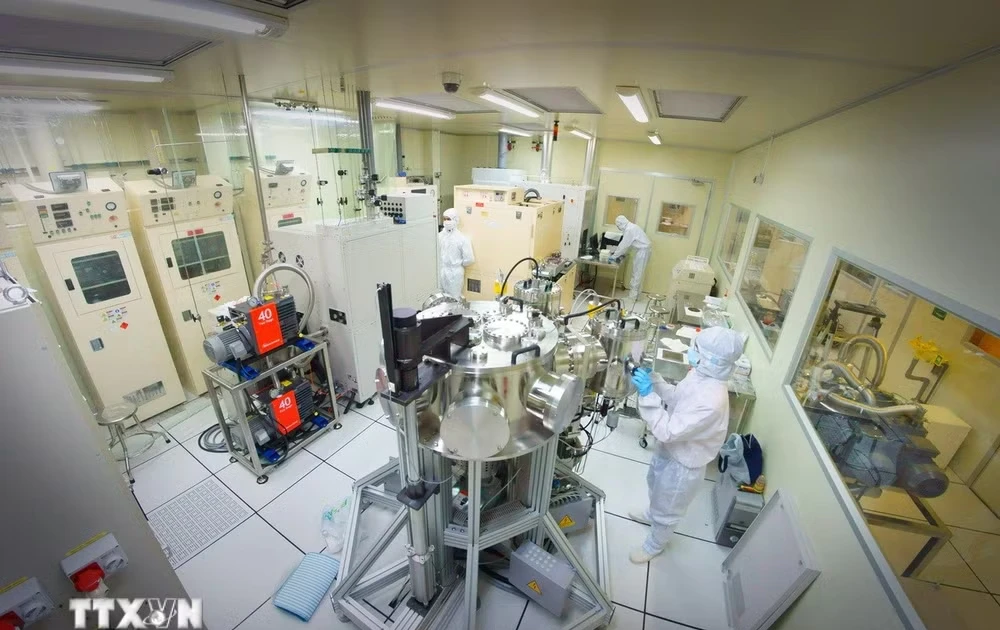
Vietnam Accelerates Growth Through Science, Technology, and Digitalization Push
Technology
2026年8月3日
7
VietnamPlus English
Relations
🇻🇳Vietnam🇨🇳China

General articles are free for 24 hours after publish.

Vietnam Accelerates Growth Through Science, Technology, and Digitalization Push

Share
AI Summary

Vietnam is prioritizing scientific and technological development and digital transformation as key drivers for economic growth, intensifying investments in AI, semiconductors, and quantum technology. The nation aims to escape the middle-income trap and secure a position in high-value segments of global supply chains.

Vietnam is prioritizing scientific and technological development and digital transformation as key drivers for its next phase of economic growth. The nation is intensifying investments and talent development in advanced fields such as artificial intelligence (AI), semiconductors, and quantum technology, aiming to escape the middle-income trap. According to PwC’s Global M&A Industry Trends: 2026 Mid-Year Outlook, the total value of global M&A transactions this year could reach approximately $4 trillion USD, driven by large-scale deals and growing investment in AI-related infrastructure. Vietnam seeks to leverage this trend by advancing its scientific and technological capabilities to move beyond low-value segments. Dr. Le Xuan Sang, Deputy Director of the Institute of Vietnam and World Economy, emphasized that scientific and technological development is the sole path to breaking out of the middle-income trap, stating that without it, Vietnam will remain stuck in low-value segments. Digital transformation is central to Vietnam's growth strategy. July marked an important milestone with a series of new policies, strategies, and technical standards introduced to support the Law on Digital Transformation and speed up implementation nationwide. Vietnam has so far deployed more than 40,000 5G base transceiver stations (BTSs), providing coverage for about 92% of the population, making it one of the world's fastest countries in this regard. By comparison, many advanced economies typically take two to three years to extend 5G coverage to more than 80% of their populations. Digital environment enhancements, including registering residence, applying for an e-Visa, obtaining an electronic identity account, and completing administrative procedures online, have made it easier for many foreigners to enter, live, and work in Vietnam. Vietnam's ultimate goal in the semiconductor industry is not merely to establish a presence but to gradually master high-value, knowledge-intensive segments of the value chain, becoming a key link in the global semiconductor supply chain. This would provide a launchpad for strengthening the country's competitiveness in artificial intelligence, electronics, and the digital economy. Furthermore, initiatives in quantum technology are underway. Quantum Year 2026, held under the theme "Quantum Connectivity – Mastering Technology – Breakthrough Development," centers on four pillars: science, technology, education and training, and innovation ecosystem development. Ho Chi Minh City, as a leading center for science, technology, and innovation, is proactively building capacity for the quantum computing era, with a strong focus on developing talents to seize arising technological opportunities. These efforts are part of Vietnam's strategy to maintain and accelerate economic growth under its one-party system. Attracting foreign investment requires a transparent and stable legal environment with outstanding incentives, and there are plans to develop the marine economy into a key driver of Vietnam's ambition for double-digit economic growth. Collaborations with Huawei and SEMI Southeast Asia highlight concrete steps towards technology transfer and innovation promotion, with Deputy Prime Minister Ho Quoc Dung commending the association for supporting Vietnam's advancement in science, technology, innovation, and digital transformation. Vietnam's contribution to international science and technology is also growing. Students from Vietnamese universities are participating in international science competitions, selected from hundreds of applicants worldwide. A delegation from the Vietnam Academy of Science and Technology (VAST) held meetings with leading research institutions and international organizations in Austria, including the International Institute for Applied Systems Analysis (IIASA) and the International Atomic Energy Agency (IAEA). These collaborations further signify the deepening international engagement in science and technology. These initiatives reflect Vietnam's determination to transition from a mere manufacturing hub to a more advanced, knowledge-intensive economy. Investment in digitalization and science and technology will be crucial for Vietnam's future competitiveness and sustainable growth. Source: VietnamPlus English

0

Original source

VietnamPlus English

原文を読む