Europe's Complex Dance with China: From Trade Friction to Global Order Challenge
Diplomacy
2026年7月20日
5
The Diplomat Indonesia

General articles are free for 24 hours after publish.

Europe's Complex Dance with China: From Trade Friction to Global Order Challenge

Share
AI Summary

The EU is increasingly viewing China not just as an economic partner, but as a "systemic rival" challenging the global order, driven by widening trade deficits and disputes over IP and tech standards. This shift impacts the EU's economic model and international influence.

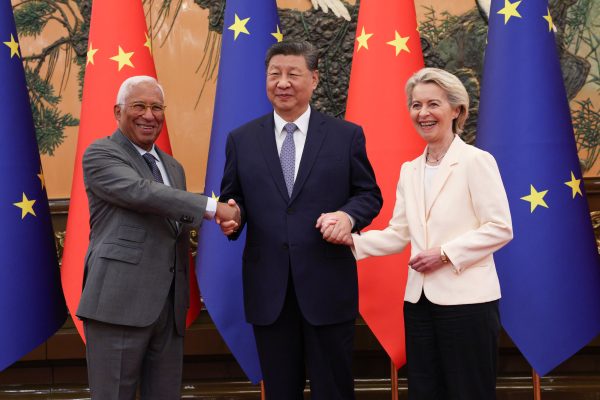
Read The Diplomat, Know The Asia-Pacific Brussels no longer sees China only as an economic actor. It sees China as a challenge to the organization of global order itself. From left to right: António Costa (president of the European Council), Xi Jinping (president of the People’s Republic of China), and Ursula von der Leyen (president of the European Commission) at the China-EU Summit in Beijing, July 24, 2025. When EU Trade Commissioner Maroš Šefčovič met Chinese Commerce Minister Wang Wentao in Brussels on June 29, the encounter could easily be read as another episode in Europe’s growing anxiety over Chinese economic pressure. In 2025, China’s goods trade surplus with the EU reached roughly 360 billion euros, and by early 2026 the imbalance was still widening. Šefčovič himself warned after the Brussels talks that rising Chinese exports to Europe, combined with shrinking European market share in China, were “not sustainable.” Yet the meeting also revealed why Europe’s China debate is about more than trade. The new EU-China consultation mechanism was not limited to market access or the bilateral trade deficit. According to the European Commission, both sides also discussed export controls, intellectual property rights, and WTO reform. The disagreement, then, is not only technical trade issues, but about who gets to define the rules under which interdependence operates. This is why China’s rise produces a kind of anxiety that cannot be explained through power politics alone. Europe has long understood itself not merely as a participant in global governance, but as one of its principal authors. This can be seen through the EU’s 2016 Global Strategy, where it defines its international role through democracy, human rights, multilateralism, international law, and the defense of a rules-based global order. China unsettles Europe because it increasingly contests the rules, values, and hierarchies through which Europe has understood its own place in the international order. The tension was codified in the European Commission’s 2019 EU-China Strategic Outlook, which described China simultaneously as a cooperation partner, an economic competitor, and a “systemic rival” promoting alternative models of governance. The phrase matters because it shows that Brussels no longer sees China only as an economic actor. It sees China as a challenge to the organization of global order itself. Economically, China is no longer only a market or manufacturing base, but a competitor in sectors Europe considers essential to its future: electric vehicles, machinery, chemicals, steel, batteries, and clean-tech supply chains. Germany illustrates this shift most sharply. In 2025, German goods exports to China fell to their lowest level in a decade, while German car exports to China had fallen by 66 percent compared with 2022. This is not simply a German problem. It strikes at the heart of the European economic model: if Europe loses industrial capacity and technological leverage in key sectors, its ability to defend a rules-based order becomes weaker in practice, even if the language of that order remains intact. This is why “de-risking” has become such an important formula for Brussels. In her 2023 speech on EU-China relations, European Commission President Ursula von der Leyen argued that decoupling from China was neither viable nor in Europe’s interest. Instead, she framed Europe’s approach as one of reducing risk while preserving engagement. The phrase captures Europe’s dilemma: it cannot sever economic ties with China, but it can no longer treat interdependence as politically neutral. The disagreement is also diplomatic and normative. China is no longer simply adapting to existing institutions but increasingly seeking to shape the terms of global governance whether through BRICS, WTO reform debates, export controls, technological standards, or AI governance. Politically, China offers many states a form of partnership that does not rely on the same moral vocabulary Europe often attaches to its external relations. Beijing’s language of sovereignty, non-interference, development, and opposition to “hegemonism and power politics” has long been central to Chinese diplomacy. Chinese Foreign Minister Wang Yi has repeatedly used this vocabulary to present China as a defender of international justice against Western dominance. The Global South is central to this conversation. It is not simply a diplomatic constituency or a convenient counterweight to the West; it is increasingly the arena in which new practices of development, infrastructure, finance, technology, and global governance are being tested. The 2024 FOCAC Beijing Action Plan is one example. FOCAC 2024 marked a shift away from large infrastructure deals alone and toward “small yet beautiful” projects, governance exchange, and a broader form of Chinese normative power. However, this political opening contains a paradox. As China becomes more powerful and more central to global governance, it must confront a difficult question: can a state expand its rule-making power without becoming the kind of hierarchical force it once criticized? Anti-hegemonic language does not automatically prevent hegemonic practice. A country can oppose Western dominance and still create new dependencies; it can claim to democratize global governance while concentrating influence around its own institutions, financing structures, technological standards, and diplomatic preferences. The risk of domination today is not in its old territorial form, but a hierarchy that emerges when access to infrastructure, finance, technology, markets, and standards becomes dependent on one increasingly powerful actor. For Europe, this makes the China question even more complicated. If Europe treats China only as a strategic competitor, it risks ignoring the genuine dissatisfaction many countries feel toward the Western-led order. Yet if it treats the Global South merely as a battlefield for influence, it reproduces precisely the paternalism that has weakened its credibility. Europe has tried to respond through its own connectivity and infrastructure agenda, particularly the Global Gateway. But the challenge is not only to offer an alternative to China; it is to make Europe’s offer coherent, material, and credible to countries that do not want to choose between rival blocs. The result is a European debate marked by contradiction. Europe wants cooperation with China on climate, trade, development, and global stability. It also wants protection from dependency, coercion, and technological vulnerability. It wants to defend the rules-based order, but it must also face the fact that many outside the West see that order as selective, unequal, or historically compromised. It wants to remain open, but not naïve; principled, but not powerless; autonomous, but not isolated. This is why Europe’s China policy is so difficult to define. The problem is not simply that member states have

0

Original source

The Diplomat Indonesia

原文を読む