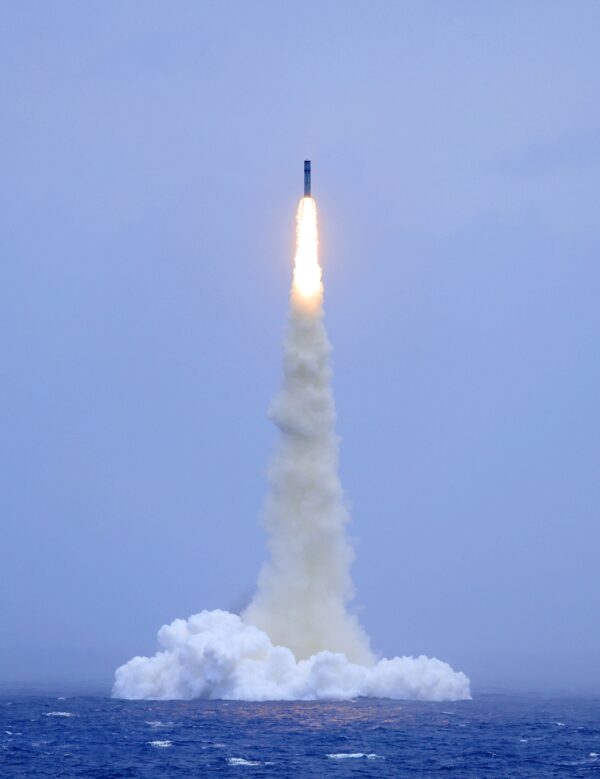
China Sends Message to Pacific With Submarine-Launched Ballistic Missile Test on Day of Australian Alliance Signing
Diplomacy
2026年7月7日
6
The Diplomat Indonesia

China Sends Message to Pacific With Submarine-Launched Ballistic Missile Test on Day of Australian Alliance Signing

AI サマリー

China conducted a submarine-launched ballistic missile (SLBM) test, timed on the same day Australia and Fiji signed a new defense alliance. This timing strongly suggests a political intent to check regional alliance building, in addition to a display of military power.

On July 6, a People's Liberation Army (PLA) Navy nuclear-powered submarine launched a submarine-launched ballistic missile (SLBM) carrying a training warhead into the Pacific Ocean. This marks China's second intercontinental ballistic missile (ICBM) launch into the Pacific region, following a 2024 test of a land-based ICBM by the PLA Rocket Force. As with the 2024 test, Beijing did not publicly disclose detailed information about the operation. The submarine's location, missile type, and flight path remain unknown, making it difficult for external observers to assess the current development of the PLA's nuclear strike capabilities. Although the specifics of the PLA's missile launch are unclear, Beijing did notify select countries in advance, offering clues about its intent. Before the SLBM was fired, China informed countries including Australia, New Zealand, Papua New Guinea (PNG), and Japan through diplomatic channels. Several of these governments stated they were informed mere hours in advance. On the same day as China's SLBM launch, the leaders of Australia and Fiji signed a mutual defense treaty in Suva, Fiji. The fact that the countries notified in advance all maintain close ties with Australia, combined with Beijing's decision to conduct the military operation during a major Australian diplomatic agenda, suggests that China's purpose was not merely a straightforward display of military power. While bilateral tensions between Australia and China have eased since 2022, and trade relations have largely recovered, Australia has continued to build up its defense capabilities in response to potential threats. Beijing has increasingly used military actions to signal its position to Australia. In early 2025, the PLAN sent ships to circumnavigate Australia, conducting live-fire exercises in the Tasman Sea without advance warning. Therefore, China's choice to launch a missile on the same day Australia concluded a new alliance carried political intent in addition to demonstrating military strength. As one of the world's top three nuclear powers, China possesses a large nuclear arsenal and a nuclear triad strike capability. Given the need to maintain open communication channels and avoid miscalculation, Beijing usually provides advance notification to countries located along or near the missile's projected flight path when conducting ICBM exercises. For instance, during its 2024 missile test, Beijing notified the United States, France, Australia, and New Zealand in advance. Ahead of this latest missile test, however, only Australia, New Zealand, PNG, and Japan publicly stated that they had received advance notification from Beijing. Because China likewise did not release a complete list of countries it notified in advance, whether Beijing notified the United States remains open to speculation. A State Department statement declined to address the question. This ambiguity also helps sharpen the political signal that China sought to convey. The missile launch took place on the same day that Australia and Fiji signed the Ocean of Peace Alliance, also known as the Veitacini Treaty. The treaty's legal status is akin to the Pukpuk Treaty signed by Australia and PNG in October 2025, emphasizing that in the event of an armed attack, both sides will act in accordance with their domestic procedures to address common threats. This makes Fiji Australia's fourth ally and expands Canberra's influence in the South Pacific. At the level of an individual event, Australia's establishment of an alliance relationship with a single Pacific Island country would hardly be sufficient reason for China to respond with military action. However, Beijing likely wants to prevent Australia from continuing to build security relationships through formal treaties. This may be partially driving the PLA's harder-line approach. Under the principle of non-interference in other countries' domestic affairs, Beijing cannot directly use its diplomatic system to demand that Pacific Island countries refrain from establishing security relationships with Australia. At the same time, however, China also needs to signal to the South Pacific that its regional influence remains intact. Therefore, by launching a missile on the same day Australia established a new alliance relationship, China used military action to warn Pacific Island countries of the risks of building security relationships with Australia, thereby expressing its diplomatic position through military means. In addition to signaling its intent to the broader South Pacific region, China also directed its message toward countries that have deepened their defense ties with Australia in recent years. New Zealand, PNG, and Japan – the countries known to have received advanced warning from Beijing – all share a common feature: each has achieved a breakthrough in its defense relationship with Australia in recent years. Papua New Guinea signed a treaty in October 2025, becoming Australia's third ally. In March 2026, Australia and New Zealand stated at the ANZMIN 2+2 meeting that they would advance the Anzac 2035 Vision to strengthen interoperability between their militaries. In August 2025, Australia awarded Japan its first major defense sale, selecting the Mogami class for a $14 billion program to acquire 11 new frigates. All three countries have upgraded their cooperation and relations with Australia within a short period. From Beijing's perspective, these are among the relationships that need to be disrupted. Australia, Australia's allies, and Pacific Island countries all formed part of the intended audience for China's political signaling. Because this audience was both large in number and geographically dispersed, stretching from the East China Sea to the South Pacific, Beijing needed to strike a balance between clearly conveying its intent and relying on a single instrument. Unlike the PLAN's drill in the Tasman Sea in February 2025, Beijing's objective this time was to deter Australia's allies, rather than Australia alone. Conducting an operation like the Tasman Sea drill would not only have made it difficult for Beijing to communicate its intent clearly but also risked further encouraging cooperation between Australia and its allies. At the same time, China's missile launch also signals its intent to raise the level of escalation. Beijing has repeatedly used missiles in the past to express its position. After then-U.S. House Speaker Nancy Pelosi's visit to Taiwan in August 2022, for example, the PLA conducted extensive missile exercises around Taiwan, some of which saw missiles fly over Taiwan and land within Japan's Exclusive Economic Zone (EEZ). This demonstrated Beijing's willingness to use missile capabilities to signal its resolve and to intimidate adversaries.

多角的分析

経済的影響

中国による今回のSLBM発射は、直接的な経済的影響は限定的であると考えられる。しかし、地域における地政学的緊張の高まりは、投資家のリスク回避姿勢を強め、特に南太平洋地域の経済開発やインフラ投資に影響を与える可能性がある。オーストラリアや日本など、中国からの通知を受けた国々は、経済的な結びつきも深いため、今後の両国関係の動向が貿易や投資の安定性に影響を及ぼす可能性がある。

投資家心理

今回のミサイル発射は、投資家にとって南太平洋地域の安全保障リスクの上昇を示唆する。特に、オーストラリア、ニュージーランド、日本といった、中国が牽制の対象としている国々との防衛協力が進む中で、地政学的な不確実性が増す。これは、これらの国々および地域への直接投資や、サプライチェーンの安定性に対する懸念を高める要因となり得る。投資家は、今後の中国の地域への軍事的・政治的アプローチを注視し、ポートフォリオのリスク管理を強化する必要があるだろう。

社会的影響

今回の中国のミサイル発射は、太平洋地域における軍事的な緊張を高め、地域住民の安全保障に対する不安を増大させる可能性がある。特に、オーストラリアと新たな防衛同盟を結んだフィジーのような太平洋島嶼国では、地域大国間のパワーバランスの変化を肌で感じることになる。また、中国が「非干渉」を原則としながらも、軍事行動で自国の影響力を示そうとする姿勢は、地域諸国の主権や外交的選択の自由に対する懸念を生む可能性がある。SNSなどを通じて、この出来事が地域住民の間でどのように受け止められ、議論されるかも注目される。

市民の声

今回の中国のミサイル発射は、直接インドネシアの市民生活に影響を与えるものではないが、地域全体の安全保障環境の変化として認識される。特に、インドネシアは南シナ海問題など、中国との間で複雑な関係を抱えており、太平洋地域での中国の軍事的プレゼンスの増大は、間接的にインドネシアの外交政策や安全保障戦略に影響を与える可能性がある。市民は、このような国際情勢の変化を注視し、政府の対応に関心を寄せるだろう。また、長距離のミサイル発射実験は、地域における緊張を高めることで、物流コストの上昇などを通じて間接的に物価に影響を与える可能性も否定できない。

背景・歴史的文脈

中国は近年、軍事力の近代化と地域への影響力拡大を加速させている。特に、南シナ海における人工島建設や、台湾周辺での軍事演習など、周辺地域で強硬な姿勢を示してきた。今回のSLBM発射は、これらの動きと連動し、太平洋地域における米国の同盟国であるオーストラリアの防衛協力強化に対する牽制と見られる。2025年に予定されていたオーストラリアとPNGの防衛協定(Pukpuk Treaty)や、オーストラリアと日本間の防衛装備品売却契約(2025年8月)、そして今回のオーストラリアとフィジー間の同盟(Veitacini Treaty)といった一連の動きは、中国にとって地域における戦略的優位性を脅かすものと映っていると考えられる。

原文ソース

The Diplomat Indonesia

原文を読む