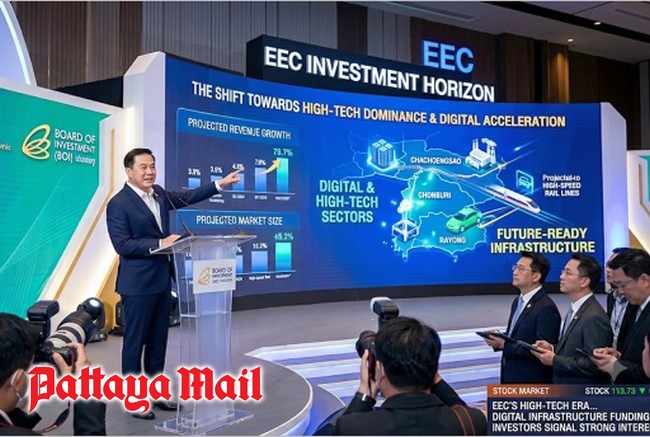
Thailand's EEC Investment Horizon Shifts Towards High-Tech Dominance and Digital Acceleration
Technology
2026年7月9日
5
Pattaya Mail
Relations
🇹🇭Thailand🌐United Nations / ASEAN

Thailand's EEC Investment Horizon Shifts Towards High-Tech Dominance and Digital Acceleration

AI サマリー

Thailand's Eastern Economic Corridor (EEC) is shifting its strategy from infrastructure focus to becoming a growth engine for high-tech manufacturing and digital infrastructure. Investments in AI, data centers, and EVs are accelerating, attracting international capital towards a 2.2 trillion baht target.

PATTAYA, Thailand – The narrative surrounding Thailand’s Eastern Economic Corridor (EEC) has fundamentally shifted. The region is undergoing a major structural transition from high-level policy blueprints to aggressive project execution. While global investors once viewed the corridor as an ambitious infrastructure initiative, the current economic reality shows it has become a key engine of growth for high-technology manufacturing and digital infrastructure in Southeast Asia. The government has sharpened its strategic focus on advanced green manufacturing and next-generation industries. With an ambitious cumulative investment target of 2.2 trillion baht across five priority sectors by the end of this year, the EEC is attracting substantial international capital inflows. This momentum is being driven by the rapid adoption of artificial intelligence (AI), expanding hyperscale data centres, and the continued evolution of the regional electric vehicle (EV) ecosystem. (adsbygoogle = window.adsbygoogle || []).push({}); The AI and hyperscale data centre boom The digital infrastructure sector has emerged as the clear frontrunner for foreign direct investment. Industry revenue is expanding at an exceptional pace as hyperscale data centre operators establish major hubs to serve surging demand across the ASEAN region. Chonburi has become the preferred destination for smart electronics and digital platforms, thanks to its advanced digital connectivity and strategic location. Market projections indicate that data centre investment within the EEC will experience a compound annual growth rate (CAGR) of 59 percent over the next several years. The expansion is expected to be so rapid that the region could surpass the Greater Bangkok metropolitan area in data centre capacity. However, this unprecedented growth is placing increasing pressure on power generation and distribution, prompting authorities to accelerate upgrades to smart grid infrastructure and expand renewable energy integration to ensure a reliable electricity supply. (function(w,q){w[q]=w[q]||[];w[q].push(["_mgc.load"]})(window,"_mgq"); EV Hub 2.0 and the Chinese automotive influx Thailand has long been known as the “Detroit of the East,” but the country’s industrial strategy is now focused firmly on the electric vehicle ecosystem. The emphasis has moved beyond vehicle assembly to high-value battery manufacturing, including the production of battery cells, modules and packs. Rayong has strengthened its position as the country’s industrial heartland for EV production and component manufacturing, supported by advanced smart industrial estates that integrate 5G automation, artificial intelligence and edge computing. This transformation is creating significant opportunities throughout the supply chain, particularly for small and medium-sized foreign component manufacturers. Recent trade analysis indicates that international auto parts suppliers are increasingly interested in establishing local production facilities to support the large Chinese and other multinational manufacturers already operating in the region. At the same time, Thai industry groups are urging domestic manufacturers to modernise their technology and pursue joint ventures to remain competitive. Victor’s take on the realities of the industrial corridor On the positive side, the surge of investment in data centres and advanced EV manufacturing demonstrates that Thailand’s regulatory framework and strategic location continue to appeal to global technology companies. Initiatives such as the Thailand FastPass programme and streamlined digital work permit systems show the government’s commitment to reducing bureaucracy for major investors. However, companies must also contend with growing challenges. Key infrastructure projects, including high-speed rail links and major seaport expansions, continue to face implementation delays, requiring businesses to develop alternative logistics strategies in the meantime. In addition, local communities are becoming increasingly vocal about the environmental impact of rapid industrialisation, making land development more complex than in the past. Success in the EEC now depends on far more than reading government investment brochures. Investors need a detailed understanding of local infrastructure constraints, utility capacity, supply chain bottlenecks and regulatory realities to translate investment plans into successful long-term operations.

多角的分析

経済的影響

タイのEECは、従来の製造業からハイテク・デジタル産業へと重点を移すことで、経済構造の高度化を図っている。特にデータセンターへの投資急増は、ASEAN地域全体のデジタル化進展と連動しており、タイを地域ハブとして確立する戦略的意義が大きい。しかし、急激な電力需要増はインフラへの負担となり、持続可能な成長のためには再生可能エネルギーへの転換と電力網の強化が喫緊の課題である。EV産業へのシフトは、サプライチェーンの再編と高付加価値化を促し、タイ経済の競争力向上に寄与すると考えられる。

投資家心理

海外からの直接投資(FDI)は、タイのEECが持つ戦略的位置、整備されたデジタルインフラ、そして政府の投資誘致策によって引き続き魅力的である。特にデータセンターとEV関連分野は、高い成長率と将来性が期待され、投資家にとって魅力的なセクターとなっている。一方で、インフラプロジェクトの遅延や環境規制の強化は、投資リスクとなり得る。投資家は、これらのリスクを綿密に評価し、現地の規制やサプライチェーンの状況を深く理解する必要がある。政府の迅速なインフラ整備と規制緩和が、さらなる投資を呼び込む鍵となるだろう。

社会的影響

EECの急速な工業化は、地域社会に雇用機会をもたらす一方で、環境への影響やインフラへの負荷という課題も生じさせている。特にデータセンターの電力消費増は、水資源や電力供給への懸念を引き起こし、地域住民の生活に影響を与える可能性がある。また、インフラプロジェクトの遅延は、地域経済や住民の利便性に影響を及ぼす。政府は、経済発展と地域社会の持続可能性のバランスを取りながら、環境保護と住民との対話を重視した開発を進めることが求められている。タイのZ世代は、こうした変化をSNSなどを通じて注視し、持続可能な社会への関心を高めている可能性がある。

市民の声

タイ国民、特にEEC周辺地域に住む人々にとって、この戦略転換は雇用機会の増加や経済活性化という恩恵をもたらす可能性がある。しかし、急速な工業化に伴う環境問題(電力消費増、廃棄物処理など)や、インフラ開発の遅延による生活への影響も懸念される。特に、データセンターの拡大は、地域によっては電力不足や環境負荷の増大を招く可能性があり、住民の生活の質に直接影響を与える。政府は、経済成長の恩恵を国民全体に公平に分配し、環境保護への配慮を怠らない姿勢を示すことが、社会的な安定を保つ上で重要となる。

背景・歴史的文脈

タイの東部経済回廊(EEC)構想は、2016年に当時の軍事政権下で発表された。当初は、既存のタイ東部沿岸地域(チョンブリ、ラヨーン、チャチュンサオ県)を、従来の自動車・電子機器産業に代わる新たな産業ハブとして発展させることを目指していた。特に、インフラ整備(高速鉄道、港湾、空港)と投資インセンティブの提供を通じて、外国からの直接投資を誘致することが柱であった。近年、世界的なデジタル化の進展と、気候変動対策としてのEVシフトの流れを受け、タイ政府はEECの重点分野をハイテク製造業、特にAI、データセンター、EV関連産業へと戦略的にシフトさせている。これは、タイがASEAN地域におけるデジタル経済とクリーンエネルギー産業の中心地となることを目指す、より進んだ段階と言える。

原文ソース

Pattaya Mail

原文を読む