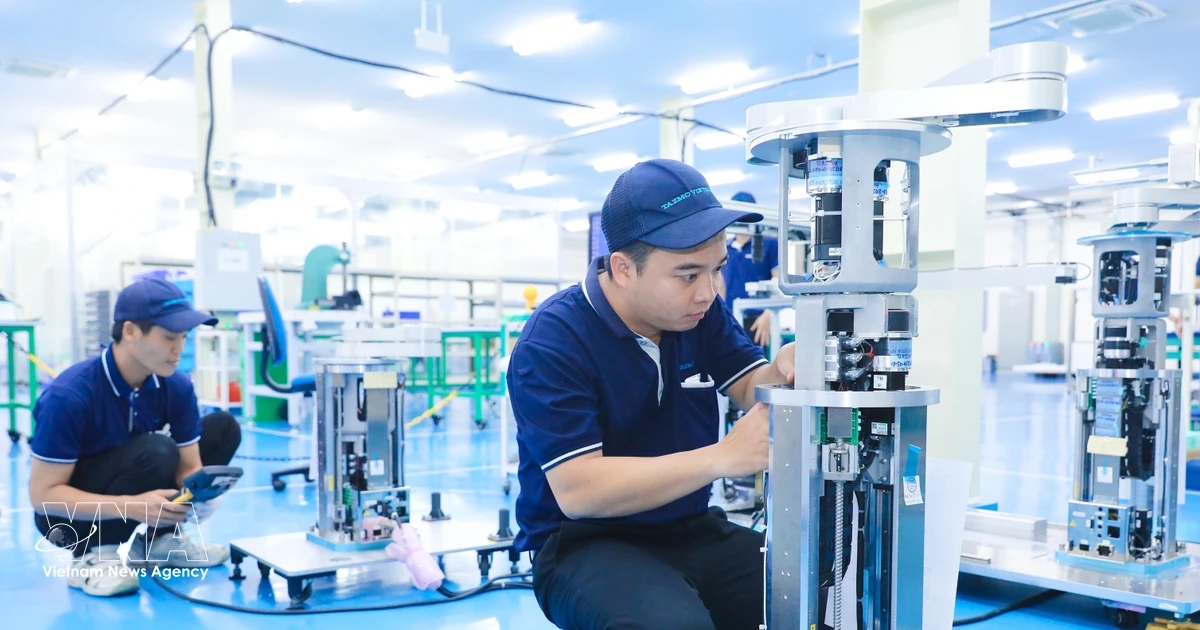
Vietnam Seeks Enhanced International Cooperation in Science, Technology, and Innovation
Vietnam is exploring international cooperation opportunities in science and technology, particularly in semiconductors and AI. The country is focusing on human resource development and the adoption/development of advanced technologies, aiming to transition to an innovation-driven growth model.
Vietnam is actively exploring international cooperation opportunities in science and technology, particularly in the fields of semiconductors and artificial intelligence (AI). This endeavor is part of the country's broader strategy to transition from a traditional labor-intensive and resource-dependent economy to a model driven by productivity, knowledge, science and technology, innovation, and digital transformation. Samsung Electronics identifying Vietnam as a key market for high-tech human resource development underscores the focus on these sectors. Currently, Vietnam boasts approximately 60 chip design companies, around 7,000 chip design engineers, and 166 universities offering semiconductor-related training programs. The demand for chip prototyping is estimated to reach around 30,000 chips. Hoseo University in South Korea is transforming itself into a specialized hub for semiconductors and AI, while seeking to expand cooperation with Vietnamese universities and colleges. Dr. Ta Anh Phuong, CEO of Seinetime, a French technology start-up, emphasizes that Vietnam's strategic technology goods should aim for global relevance and strive for strategic indispensability, making them products that international corporations actively seek to integrate into their operations. Deputy Prime Minister Ho Quoc Dung expressed his hope that Professor Tran Thanh Van, the Rencontres du Vietnam Association, and ICISE would continue to serve as bridges between Vietnam and the international scientific community, attracting leading researchers and making practical contributions to the country's scientific and technological progress. Participants are receiving fundamental and advanced training in particle physics and neutrino science through lectures covering neutrino physics, the Standard Model, particle and radiation detectors, reactor neutrino experiments, high-energy neutrino astronomy, supernova neutrinos, and major international projects such as Super-Kamiokande, T2K, and Hyper-Kamiokande. Experts said an efficient data market will ensure that data flows to sectors where it generates the greatest economic value, thereby improving the economy's overall efficiency. Academic queries account for 17% of all prompts submitted by Vietnamese users, well above the regional average of 11%, cementing Vietnam’s position as the region’s top adopter of AI for education. Under the newly issued resolution, citizens have the right to control the use of their personal data, access digital services, and receive legal protection in the digital environment. Vietnam's growth model, long fueled by low-cost labor, resource extraction, contract manufacturing, expanded investment, and capital accumulation, has run out of road. The country now needs a sweeping reform agenda to shift from extensive growth to a model driven by productivity, knowledge, science and technology, innovation, and digital transformation. A year after adopting the two-tier local administration model, Bu Gia Map, a remote border commune in the southern city of Dong Nai with a significant ethnic minority community, has experienced notable improvements in public administration, making digital public services more accessible to residents and boosting governance efficiency. In the first quarter of 2026, more than 6.9 million accounts were exposed, double the figure recorded in the same period last years. Stolen personal data has frequently been exploited in sophisticated online scams, particularly impersonation schemes targeting victims through fake relatives or acquaintances. Through a series of display areas, visitors can explore notable scientific and technological achievements of the People's Public Security Force in safeguarding national security in cyberspace. The exhibition also provides information on common forms of online fraud and cyber scams, along with practical guidance on how to identify and prevent them. The initiative aims to establish and perfect mechanisms and policies to encourage greater participation from enterprises, organizations, training institutions, and individuals in developing civil cryptography technology. According to the State Agency for Technology and Innovation under the Ministry of Science and Technology, Vietnam is now home to nearly 4,000 start-ups and enterprises operating in the fields of science, technology, and innovation, supported by a workforce of more than 30,000 highly skilled professionals. VINATOM is targeting not just research strength but strategic national entity status, accompanying the country in building a modern nuclear industry. The decree, which took effect on July 1, gives priority to investment in high-tech R&D, including research into innovative and core technologies; efforts to decode, master, and improve high technologies; and the application, testing, and refinement of advanced technologies. Eighteen months after the launch of Resolution 57, a national AI ecosystem is gradually taking shape, bringing together institutions, data resources, computing infrastructure, technology enterprises, human resources, and application markets. With strong leadership from the Party and the State, together with the determination of ministries, sectors, and localities, Vietnam will achieve important initial milestones in strategic technology development within this year. Vietnam’s challenge is not merely to train more engineers or scientists, but to cultivate a generation capable of mastering, improving, and eventually creating core technologies. The PM stressed that ministers must take direct responsibility for the implementation of assigned tasks and ensure the quality and progress of database development. PM Le Minh Hung stressed that the national digital architecture framework should provide a unified, shared, and interoperable architecture for the entire political system, from the central to grassroots levels, while connecting government systems with citizens and businesses. Inforadar noted that Vietnam has progressively streamlined its regulatory framework to clear institutional bottlenecks while putting in place mechanisms designed to spur innovation and technology adoption. The process has also pivoted from a resource-heavy approach to one focused on practical results, with stricter monitoring of projects’ progress. Copyright, VietnamPlus, Vietnam News Agency (VNA) Editor-in-chief, Mr. Tran Tien Duan.
多角的分析
ベトナム経済は、従来の労働力と資源に依存した成長モデルから、イノベーションと知識集約型モデルへの転換を急いでいる。半導体やAI分野への国際協力強化は、この構造転換を加速させるための重要な一手である。特に、人材育成と先端技術の導入は、付加価値の高い産業へのシフトを促し、長期的な経済成長の持続可能性を高める上で不可欠となる。データ市場の効率化やデジタルインフラ整備も、生産性向上に寄与すると考えられる。
ベトナムの科学技術分野、特に半導体とAIへの投資機会は、政府の強力な後押しと国際協力の拡大により、今後増加する可能性がある。しかし、投資家は、技術力のある人材の育成と、それらが国際競争力を持つ製品・サービスに結びつくかどうかの見極めが重要となる。また、データプライバシーやサイバーセキュリティに関する規制の動向も注視する必要がある。政府が掲げるイノベーション主導型成長への移行が、具体的な成果に繋がるかどうかが、投資判断の鍵となるだろう。
ベトナムでは、AIの教育分野での活用が進む一方で、個人データの保護やデジタル環境での法的保護の強化が求められている。地方の行政サービスにおけるデジタル化の進展は、国民への利便性向上に繋がる。しかし、サイバー犯罪や個人情報流出のリスクも増大しており、国民一人ひとりが情報リテラシーを高め、対策を講じる必要性が増している。科学技術の発展は、国民生活の質の向上に貢献する可能性があるが、同時に新たな課題も生じさせている。
ベトナム国民にとって、科学技術、特にAIや半導体分野の発展は、教育機会の拡大や、より高度なデジタルサービスへのアクセス向上といった恩恵をもたらす可能性がある。しかし、個人データの保護やオンライン詐欺への対策は、日常生活における重要な懸念事項となっている。地方に住む人々にとっても、行政サービスのデジタル化は利便性を高めるが、デジタルデバイド(情報格差)の解消も引き続き課題である。国民は、技術の恩恵を享受する一方で、それに伴うリスクにも注意を払う必要がある。
背景・歴史的文脈
ベトナムは、1986年のドイモイ(刷新)政策以降、市場経済化を進め、目覚ましい経済成長を遂げてきた。当初は安価な労働力と天然資源を基盤としていたが、近年、高付加価値産業への転換とイノベーション主導型経済への移行を目指している。特に、中国との経済的結びつきが強い一方で、地政学的なリスクを分散するため、米国や日本、韓国などとの関係強化を図っている。半導体やAIといった先端技術分野への注力は、こうした経済構造改革と外交戦略の両面から推進されている。政府は、科学技術・イノベーション分野への投資を奨励し、国際的な研究機関や企業との連携を深めることで、技術的自立と国際競争力の向上を目指している。
原文ソース
VietnamPlus English