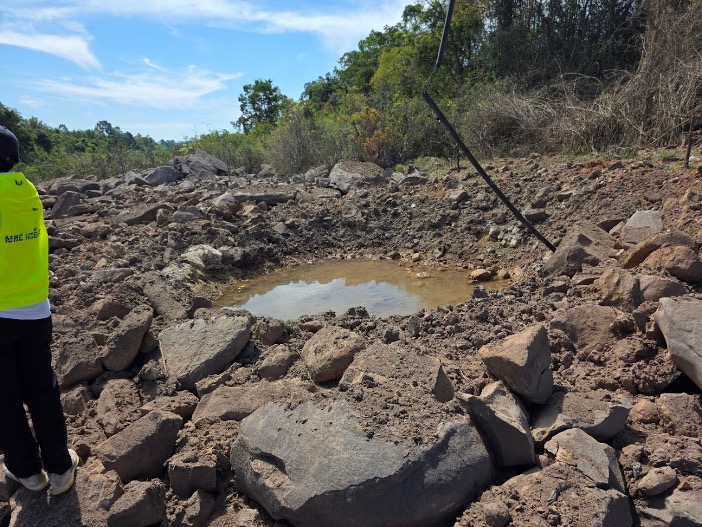
Me Teuk Bridge Destroyed by Thai Airstrikes, Becomes Site of Historical Memory
Cambodia's Me Teuk Bridge, also known as Victory Bridge, was destroyed in December 2025 by Thai airstrikes. The bridge, a strategic point since the Khmer Rouge era, highlights the lingering scars of past conflicts. Debate is ongoing whether to rebuild it or preserve it as a historical testament.
Pursat province’s Me Teuk Bridge, also known as Victory Bridge, was destroyed on December 13, 2025, when it was struck by seven 230-kilogramme bombs dropped by Thai fighter jets, during the second round of last year’s border clashes. Heng Ratana, director-general of the Cambodian Mine Action Centre (CMAC), posted images of the bridge, located on National Road 55 in Eakpheap village, in Veal Veng district’s Thma Da commune. He included images of the casings of several MK-82 bombs, which were found in the river below the bridge. The bridge was completed in 2018 by Chinese company CRBC, with Chinese government funding, according to the Ministry of Public Works and Transport. Long Dany, director of the Veal Veng Reconciliation Center of the Documentation Center of Cambodia (DC-Cam), has compiled a historic record of the bridge. He recounted that after the fall of the Khmer Rouge regime in 1979, Khmer Rouge leader Pol Pot, along with other senior cadres, fled to the Thma Da border area near the Me Teuk stream. He established several units, including offices for senior leaders, military divisions, medical units, and villages and rice fields for the families of soldiers stationed in various combat zones, including at Samlot-Koh Kong, Northwest-Phnom Penh and Southwest-Phnom Penh. Here, he reorganised his forces to wage a resistance against the Vietnamese troops and the forces of the People’s Republic of Kampuchea. Along the Thma Da border, from Samlot to Koh Kong, Pol Pot, Ta Mok, and other Khmer Rouge leaders established two divisions: Division 2 and Division 3. In 1982 or 1983, Pol Pot initiated the construction of a stone bridge, which was completed in late 1983 or early 1984. Upon its completion, Pol Pot named it the “Spean Phdachnha Chhneah”, or “determination to win” bridge. Oun Yang, who held a senior position within the Khmer Rouge ranks in the area, explained that the purpose of the bridge was to facilitate the transportation of food and ammunition to their troops, who were conducting guerrilla warfare. In late 1984 or early 1985, Pol Pot ordered his troops to destroy the bridge after Vietnam deployed a large number of troops to the Me Teuk stream. The bridge was cut to prevent Vietnamese and People’s Republic of Kampuchea forces from transporting weapons across the stream to attack Khmer Rouge positions. In early 1985, Vietnamese and People’s Republic of Kampuchea forces captured the site of the bridge, along with several other locations along the Cambodia-Thailand border. they established a base in the “Ptah Prampi” (House 7) area and renamed the bridge “Spean Chey Chumneas” (Victory Bridge), a name that remains to this day. According to former Khmer Rouge soldier Mai Sarum, the “House 7” location was named after a physical observation: When Vietnamese troops first reached the Me Teuk stream in 1979, they saw seven huts situated on the eastern side of the stream, and thus called the location “House 7”. When Vietnamese troops withdrew from Cambodia in 1989, Khmer Rouge forces retook the site of the bridge and th surrounding area. They held it until they integrated with the Royal Government under the Win-Win Policy of 1998. In 2000, the government established Thma Da Commune, consisting of three villages: Eakpheap, Santepheap and Sangkum Thmey. According to Dany, during the second round of armed clashes between Cambodian and Thai forces in December 2025, the Thai air force used F-16 fighter jets to bomb the Thma Da Hotel, a school, and the Victory Bridge, destroying both the old steel bridge and the new concrete one. “The destruction of Victory Bridge was a malicious act by Thai soldiers to destroy national road infrastructure used by citizens for their daily livelihoods and by national and international tourists visiting the natural beauty of the mountains and forests of Pursat and Koh Kong,” he claimed. Kin Phea, director-general of the International Relations Institute of the Royal Academy of Cambodia, suggested that the bridge not be repaired. “This bridge should not be rebuilt; it should be kept for future generations of Khmers to remember the cruel and barbaric aggression of the Siamese ‘jungle bandits’ against our territory,” he said. “The Royal Government should examine the possibility of building a new bridge to replace the old one destroyed by the Siamese invaders,” he added.
多角的分析
メテク橋の破壊は、地域経済に直接的な打撃を与えた。国道55号線はポル・ポト州とココン州を結ぶ重要な物流ルートであり、橋の機能停止は物資輸送の遅延やコスト増を招く。特に、近隣の観光業や農業への影響は無視できない。中国からの投資で建設されたインフラが、地政学的な緊張の標的となり破壊された事実は、対外投資におけるインフラリスクの顕在化を示唆している。
今回の事件は、カンボジアにおけるインフラ投資のリスクを再認識させる。特に、中国が推進する一帯一路構想の一環として建設されたインフラが、近隣諸国との国境紛争の標的となる可能性は、投資家にとって懸念材料である。将来的な再建の可能性や、その際の安全保障上の配慮が、投資判断に影響を与えるだろう。また、タイとの関係悪化が、経済関係全体に波及しないか注視が必要である。
メテク橋の破壊は、地域住民の日常生活に直接的な影響を与える。橋は人々の移動手段であり、経済活動の基盤であるため、その喪失は生活の困難化を招く。また、この橋の歴史的背景、特にクメール・ルージュ時代にまで遡るその役割は、カンボジア国民、とりわけ若い世代に、過去の悲劇と平和の尊さを教える教材となりうる。破壊された橋を記憶の遺産として残すか、再建して利便性を回復するかという議論は、過去と未来、そして平和への向き合い方を問うている。
メテク橋の破壊は、ポル・ポト州の市民の生活に大きな影響を与えています。橋は、地域間の移動だけでなく、物資の輸送や経済活動の要でした。これが失われたことで、移動が困難になり、物価の上昇も懸念されます。また、この橋が過去の紛争の歴史と深く結びついていることを考えると、破壊された橋を見るたびに、市民は平和の尊さと、紛争の悲劇を改めて思い知らされることになります。再建されるのか、それとも歴史の証人として残されるのか、市民は今後の政府の決定に注目しています。
背景・歴史的文脈
メテク橋(ビクトリーブリッジ)の破壊は、カンボジアの複雑な歴史と地政学的な状況を反映している。1970年代後半のクメール・ルージュ政権崩壊後、ポル・ポト派はタイ国境地帯に逃れ、抵抗運動を続けた。この地域は、当時から戦略的要衝であり、両陣営による争奪の舞台となった。1980年代初頭には、ポル・ポト派が橋を建設し、軍事目的で利用したが、後にベトナム軍の進攻を阻止するために破壊した。その後、橋は「ビクトリーブリッジ」と名を変え、1998年の「ウィン・ウィン・ポリシー」による内戦終結後も、カンボジア・タイ間の国境紛争の火種となり続けた。2025年の破壊は、この地域の歴史的な緊張関係が、最新の軍事技術によって再び表面化したことを示している。
原文ソース
Phnom Penh Post