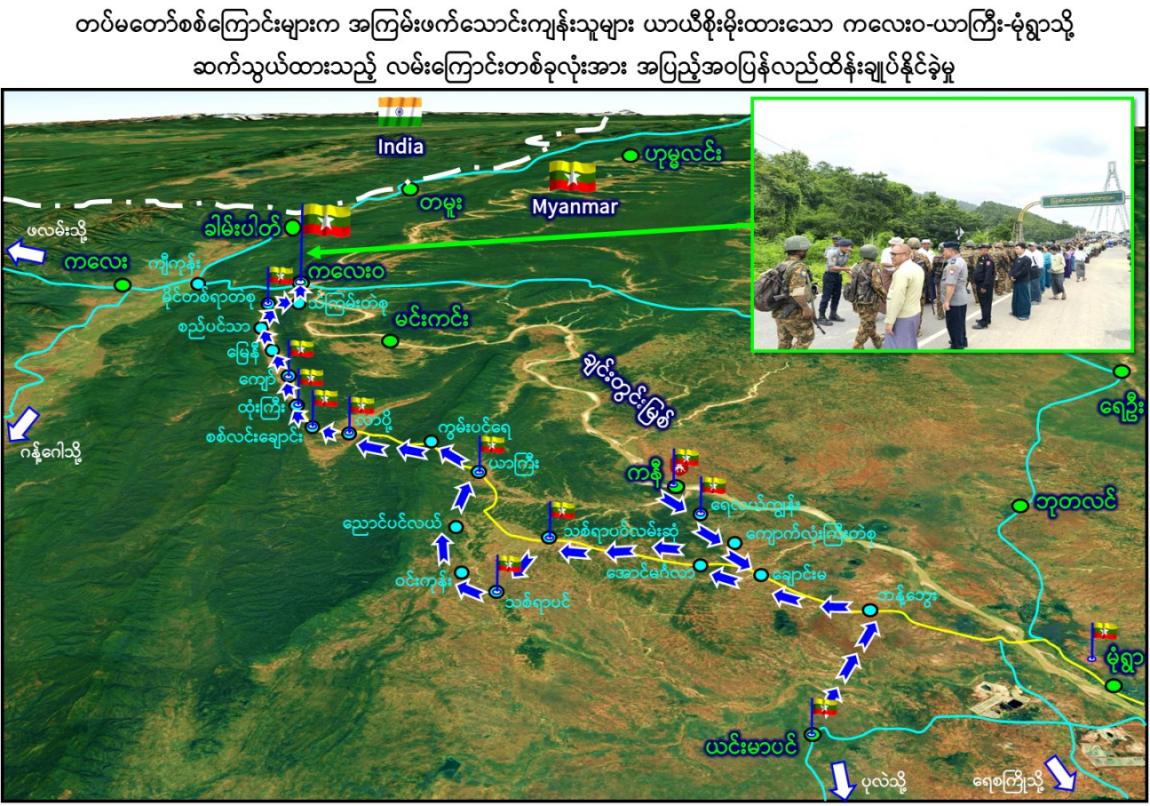
Military columns fully re-control the Kalewa-Yajee-Monywa route temporarily controlled by terrorists
The flow of goods between India and Myanmar and regional goods transportation will be able to be used again. Military columns have been working since June 2 to regain control and open the Kalewa-Yajee-Monywa road section
The flow of goods between India and Myanmar and regional goods transportation will be able to be used again. Military columns have been working since June 2 to regain control and open the Kalewa-Yajee-Monywa road section, which is a very important border trade route for the flow of goods between India and Myanmar, passing through Kalewa-Monywa and connecting to Mandalay city in central Myanmar, which was temporarily controlled by terrorists. It is reported that the road section was fully re-controlled and opened on July 7. In order to regain control and open the Kalewa-Yajee-Monywa road section, military columns carried out necessary preparations and troop formations, and carried out regional security operations by dividing into columns. As a result, Ye Lell Chun village was re-controlled on June 2, Kyauk Lone Gyi Tet Su village on June 3, Chaung Ma village and Aung Mingalar village on June 6, Thit Yarpin junction on June 7, Thit Yarpin village on June 8, Win Kon village on June 9, Nyaung Pin Lel village on June 11, Yajee village on June 13, Kun Pin Ye and Lapo village on June 15 and June 18 respectively, Sit Lin Chaung village on June 21, and Htone Gyi village on June 22. On June 23, they reached Kyaw village and, in cooperation with local security forces, carried out mine clearance operations on the road section between Lapo village and Kyaw village to ensure the safety of local residents. Subsequently, military columns carried out regional security operations at an accelerated pace, re-controlling Myay Ni village on July 1, Si Pin village on July 2, Myay Tan Tet Su village on July 3, and The Gyi Tet Su village on July 6. On the evening of July 7, they were able to join forces with security personnel in Kalewa and regain full control of the entire Kalewa-Yajee-Monywa communication route temporarily controlled by terrorists. As a result, it is now possible to travel to Kalewa-Kale-Phalam-Hakha-Thantlang, Kalewa-Kale-Tiddim-Tonzang-Kyikhar, and Kalewa-Monywa-Myinmu-Sagaing-Mandalay. It is reported that cargo vehicles and travelers will be able to pass through as usual. Furthermore, it is reported that the flow of goods between India and Myanmar and regional goods transportation will be able to be used again without difficulty. On July 7, military columns arriving in Kalewa city were welcomed with Aung Thabyay flowers and garlands by departmental officials and local residents. During the regional security operations along the route, military columns engaged in clashes with terrorist joint groups, seizing terrorist bodies, weapons, ammunition, and related materials, as well as villages used as military camps. It is reported that the terrorist joint groups retreated with heavy casualties. The Kalewa-Yajee-Monywa road section is 115 miles long and is a nylon asphalt road. It is a very important border trade route for the flow of goods between India and Myanmar, connecting directly to the Monywa-Mandalay road via the Tamu-Kalewa road, thus saving time and providing a fast and smooth communication route for the flow of goods. Terrorists forcibly threatened local residents in the villages in the area, established camps, engaged in various destructive activities, and blocked the communication route. As a result, there was no flow of goods, leading to high prices and difficulties in exporting and selling local products. Furthermore, goods could not reach their destinations easily and quickly through the border trade routes, causing significant losses and damages to the socio-economic lives of the people in all aspects. In addition, they collected tolls from cargo vehicles and passenger vehicles traveling along the route, engaged in kidnapping, ransom, murder, arson and destruction of vehicles, illegal smuggling of valuable national resources and timber, and illegal transportation of restricted goods for their own benefit. As a result of their temporary control and blockade, the state's tax revenue suffered significant losses, and the public lived in great fear and insecurity without safety and peace. Military columns have fully re-controlled the Kalewa-Yajee-Monywa road section, which is important for the flow of goods between India and Myanmar and regional goods transportation. As a result, regional goods transportation will be fast and smooth, and the regions that depend on this route will develop further. It is also reported that the travel time between Kalewa and Monywa will be shortened. Furthermore, local residents will be able to regain their safe and peaceful lives and resume their own businesses. It is also reported that the education sector for school-aged children, the healthcare sector for local residents, and the socio-economic development sector will be rebuilt. Military columns will continue to work with the participation of local residents to clear mines laid by terrorist joint groups along the route and in villages, and to carry out necessary repairs to roads and bridges destroyed by terrorists so that they can be used normally. They are also continuing to carry out necessary regional security operations to ensure that local residents can live in peace and security.
多角的分析
直接の経済ニュースではありませんが、治安と司法の信頼は地域経済の土台です。職場での暴力や未成年者保護への不安が強まると、夜間営業、観光、雇用、地域サービス業のリスク認識が高まります。
投資家目線では、個別事件よりも法執行の予見可能性が焦点です。加害者への対応が曖昧になれば、ローカルビジネスの統治リスクや従業員保護の弱さとして評価されやすくなります。
インドとミャンマー両国の物品の流通、および地域内の物品輸送が再び可能になる見込みです。 テロリストに一時的に支配されていた、インドとミャンマー…という事実は、地域の人々にとって抽象的な人権論ではなく、働く場所や夜間の移動をどこまで信用できるかという問題です。Eleven Mediaの報道は、軍と当局の対応を継続して見せる必要があります。
市民にとっては、自分や家族が被害に遭った時に公正な手続きへアクセスできるのかが最大の関心です。地域団体が声を上げることで、事件の風化を防ぎ、被害者側の孤立を和らげる意味があります。
背景・歴史的文脈
このニュースは、ミャンマーの地域社会で法の支配と弱者保護がどこまで機能しているかを映す事案です。暴力事件そのものに加え、女性団体や市民社会が司法手続きを求めて声を上げている点が重要です。軍政下では警察・司法への信頼が揺らぎやすく、個別事件が地域の不安や統治への不信に直結します。
原文ソース
Eleven Media