General articles are free for 24 hours after publish.
US Tariffs Loom Over Thai Exports, But AI Investment Surge Offers Hope
The US plans to impose tariffs of 10%-12.5% on major trading partners, with Thailand facing the higher rate, raising export concerns. However, a surge in AI investments in Thailand offers a potential offset.
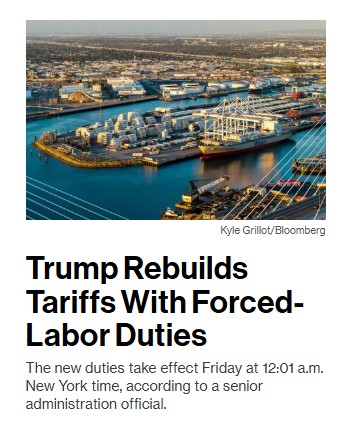
Thailand is bracing for potential economic headwinds as the United States announced new import tariffs on major trading partners. President Donald Trump's administration plans to impose tariffs ranging from 10% to 12.5% on goods from key economies, with Thailand expected to face the higher rate, alongside countries like Vietnam, Singapore, China, Japan, and South Korea. The Philippines, Malaysia, Cambodia, and Indonesia will be subject to a 10% tariff. These measures stem from a US investigation into allegations that some trading partners failed to prevent forced labor, which Washington claims has harmed American workers. Despite the looming tariff threat, Thailand is experiencing a significant surge in investment, particularly in the artificial intelligence (AI) and digital infrastructure sectors. The Thailand Board of Investment (BoI) reported that foreign investment applications in the first half of 2026 reached 1.37 trillion baht (approximately $40.6 billion), an 80% increase year-on-year. Data centers, cloud services, and AI infrastructure applications alone accounted for a staggering $33 billion in pledges, representing over three-quarters of total foreign investment. Singapore led the inflow of foreign direct investment (FDI), followed by the United Kingdom, China, Taiwan, and Japan, signaling a structural shift in Thailand's economy towards high-tech industries. Furthermore, the country has seen a parallel boom in clean energy and advanced electronics initiatives to support the heavy power and resource requirements of next-generation data centers. BoI officials note that investor confidence remains exceptionally high despite lingering global economic headwinds, including geopolitical tensions and supply chain shifts. The newly approved projects are projected to generate over 82,000 jobs for Thai workers and significantly boost the nation's annual export capabilities. However, energy prices remain a concern. Rising tensions in the Middle East have pushed oil prices above $100 per barrel, leading to anticipated higher fuel costs in Thailand. The government has approved a temporary 2.40 baht per liter cut in ex-refinery prices for three diesel grades, effective until August 15, funded by oil refiners' excess gains to ease the cost of living and reduce pressure on the Oil Fuel Fund. Gasoline retailers, however, have kept diesel prices unchanged at the pump as of July 24. Electricity tariffs will also see a stable Fuel Tariff (Ft) of 16.23 satang per unit for the September-December 2026 period. This is maintained through the Electricity Generating Authority of Thailand absorbing accumulated costs totaling 31.268 billion baht on behalf of electricity users, and the regulator applying clawback funds equivalent to 25.04 satang per unit. The Finance Ministry is also proposing to ease eligibility rules for the 2026 State Welfare Card scheme, exempting owners of low-value older vehicles, working-age students in non-formal education, and directors or shareholders of social and community enterprises that operate on a non-profit basis. As Thailand navigates these economic crosscurrents, the impact of the US tariffs on its export sector versus the robust growth in AI investments will be a critical factor in shaping its economic trajectory. The Ministry of Commerce is set to announce June export figures and the first-half 2026 export performance, with full-year export growth expected at 8%, though risks remain from US tariff measures and global trade tensions.
Original source
Thai Enquirer