General articles are free for 24 hours after publish.
China-Led WAICO: Indonesia's Role and Implications
Indonesia has joined the China-led World AI Cooperation Organization (WAICO), seen as part of Beijing's strategy to expand its AI influence by engaging Global South nations. The organization, notably absent major Western democracies, is analyzed as a move towards China-centric AI hegemony.
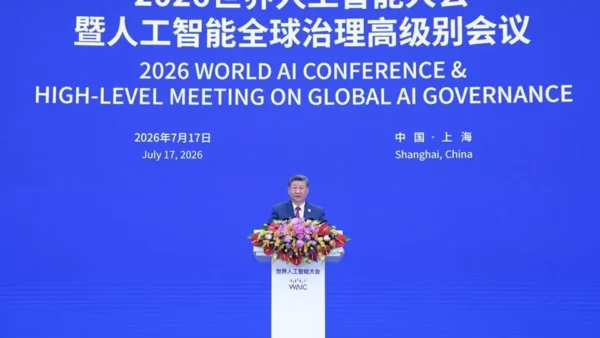
The World AI Cooperation Organization (WAICO) was founded in Shanghai this July, with founding members including Russia, Brazil, South Africa, Indonesia, Malaysia, and Pakistan, virtually all BRICS members except India, plus a number of other Global South countries, with no major Western democracies among its members. China positions it as an “intergovernmental organization” and claims to aim for the “beneficial, safe, and fair” development of AI. From the perspective of Chinese culture, the deeply rooted Confucian culture emphasizes moral correctness and face-saving, and is centered on family culture. From the perspective of the Chinese regime, China is very clear about what kind of “correct” language to use to legitimize its actions. Looking at the 2026 World AI Conference (WAIC), China tells you it wants global cooperation, AI regulation and world prosperity. However, the manifestation of family culture is often: “I tell everyone I’m promoting the common good, but what I really want is to make my family prosperous and for me to become a leader.” Because of resource monopolies, long-term wars historically, and internal struggles, Chinese leaders have a deep-seated insecurity. Therefore, they believe that only by seizing power and controlling others can they secure their own safety. As a result, this nation finds it difficult to cooperate with others. WAICO’s abbreviation differs from the United Nations’ World AI Organization (WAIO) by only one character. Those familiar with Chinese culture know that names always have special symbolic significance for China. So I think China’s WAICO agenda is to gradually establish a China-led AI hegemonic empire. The WAICO strategy aims to build an organization of non-Western democratic systems led by China and to co-opt specific regimes. One of its strategic objectives is to connect regimes isolated by the international community, such as Russia, Cuba, and Myanmar, and to influence and control their political situations through financial aid and AI technology. China provides “unconditional aid” through the Belt and Road Initiative, mobilizing vast amounts of national wealth and resources to support partner countries. This model will also appear in WAICO, with the strategic goal of maintaining relations with Global South countries to gain diplomatic leverage and extend China’s sphere of influence. China can exert influence in distant regions through AI technology and infrastructure, potentially even involving destructive activities. To gain legitimacy for its global expansion, China attempts to package the organization’s purpose as benefiting impoverished countries and the world, portraying Western countermeasures as hegemonic suppression. China then seizes the narrative through social media platforms like TikTok and YouTube, making young people and the middle class in Western democracies believe that the CCP is a victim of suppression and a true peace advocate, thus tearing Western societies apart and weakening democratic countries from within (a strategic tactic that China excels at). From Xi Jinping’s speech at the World Artificial Intelligence Conference (WAIC), we can analyze the main goal of WAICO’s establishment, anti-monopoly and anti-injustice, is essentially China’s effort to build its own AI hegemony by uniting with Global South countries to break through Western technological blockades. This is China’s core objective. All the other nice-sounding words China utters, such as equality, openness, and mutual benefit, have already been said during China’s Belt and Road Initiative. Instead of listening to what the Chinese say, it’s better to observe their actions. The United States’ Pax Silica, on the other hand, is a typical democratic capitalist initiative, emphasizing cooperation and supply chain security, and deepening economic partnerships among democratic countries. After all, for democratic countries, mutually beneficial economic cooperation under international free trade creates the greatest national interest. Although current narratives often equate the U.S. with hegemony, democratic countries are fundamentally different from authoritarian states. Private enterprises and entrepreneurs remain a significant force in democratic societies, and democratic elections give citizens a certain degree of voice. Alliances among democratic countries are still built on trust, technological cooperation, and shared values, which is drastically different from the absolute dominance of authoritarian hegemony and its opposition to free trade. If we continue to simply portray China and the United States as two superpowers vying for hegemony, we are likely to fall into the linguistic trap set by China. This kind of argument misleads people into portraying China and the United States as similar countries. However, the United States is a democratic country and China is a dictatorship, and they are fundamentally different in nature. WAICO can be seen as China’s AI version of the Belt and Road Initiative. Both follow similar paths, and one of their strategic objectives is to connect non-democratic regimes like Russia and Cuba that are not integrated into the international community. Their shared goal is to counter U.S. pressure and establish opposing camps in international geopolitics, using WAICO as an organizational tool for China to extend its sphere of influence. The Belt and Road Initiative’s strategic objective is to build an “axis of evil” against Western democratic values through monetary diplomacy and alliances with authoritarian regimes. This same strategic objective is also reflected in WAICO. The difference lies in the inclusion of China’s advantageous AI capabilities, shifting the competitive landscape beyond the manufacturing and high-tech industries where China has historically struggled against the West. Source: The Diplomat Indonesia
Original source
The Diplomat Indonesia