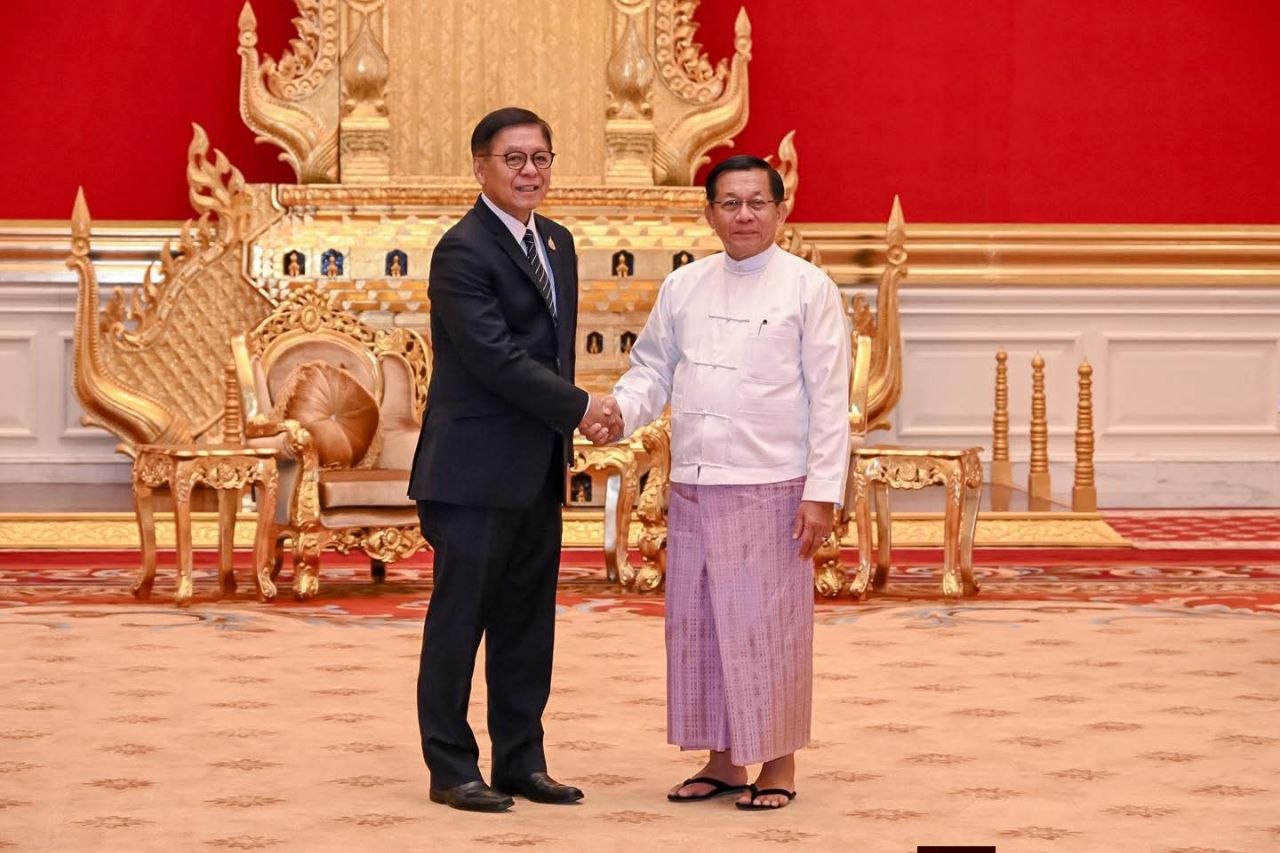
Min Aung Hlaing to visit Bangkok for talks with Thai Prime Minister
In a major diplomatic development signaling a shift in Southeast Asian regional engagement, Myanmar regime leader Min Aung Hlaing is set to meet with Thai Prime Minister Anutin Charnvirakul in Bangkok Aug. 6-7. The visit
This article requires PRO
This article is outside the free access window or is a special report. PRO unlocks it and the full archive.
Related articles
- Thai PM to discuss river pollution during regime leader Min Aung Hlaing’s visit to Bangkok
The Thai prime minister said today that he would raise the ongoing toxic contamination in a river in northern Thailand with the Myanmar regime leader during his official visit early next month. Prime Minister Anutin Charnvirakul said Thailand would seek cooperation directly from Min Aung Hlaing, who will be on an official visit to Bangkok on August 3-4, as the issue concerns both countries. Thailand will use the upcoming visit to press for Myanmar’s full cooperation in addressing toxic contamination in the Kok River, Anutin said, adding, “The matter between neighbouring countries should first be discussed and resolved between ourselves… This will not be just a ceremonial visit involving a banquet or an inspection of the guard of honour.” “We will hold substantive discussions on issues that are beneficial to both countries,” Anutin insisted. He added that Myanmar regime Foreign Minister Tin Maung Swe met him last week, when Thailand conveyed its concerns ahead of Min Aung Hlaing’s visit. The Kok River, the source of which is in Myanmar’s Shan State before flowing through Thailand’s Chiang Rai Province, has become the focus of growing concern after repeated tests detected elevated levels of arsenic and other heavy metals. Thai civil networks and local and foreign researchers believe the contamination is linked to upstream gold and rare earth mining operations in Myanmar, many of which are backed by Chinese investors. The issue has sparked a series of public protests in Thailand. On July 6, environmental groups and local residents marched to the Chinese Consulate-General in Chiang Mai to demand action over what they described as cross-border pollution from mining operations in Myanmar. Two days later, activists gathered outside the Chinese Embassy in Bangkok, urging Beijing to help address the alleged environmental impacts of Chinese-backed mining projects and calling for greater protection of communities along the Kok, Sai, Ruak and Mekong rivers. Anutin added that the two sides would also discuss other cross-border issues, including agricultural burning, efforts to combat the production of illicit drugs and other matters of mutual concern. Meanwhile, Foreign Minister Sihasak Phuangketkeow said during the ASEAN Foreign Ministers’ Meeting in Manila that Min Aung Hlaing’s upcoming visit to Thailand is part of a dual-track approach. “There are pressing bilateral issues we have to deal with, issues of … transnational crime, scams and the issue of drugs,” he said, adding that the approach did not mean abandoning ASEAN’s long-standing five-point peace plan. Myanmar’s senior regime officials, including Min Aung Hlaing, have been formally excluded from ASEAN’s major meetings since he seized power in a 2021 coup that toppled Aung San Suu Kyi’s democratically elected government. Myanmar is being represented by its regime foreign affairs permanent secretary at the ongoing Manila meeting. According to AFP, Sihasak also said he has asked his ASEAN counterparts to think about “how we measure progress” at a recent meeting in Bangkok with Myanmar regime Foreign Minister Tin Maung Swe. “If the government in Myanmar provides access [to Suu Kyi] for the ASEAN special envoy, is that a measure of progress? If there’s some reduction of violence, let’s say along the Thai-Myanmar border … is that progress?