General articles are free for 24 hours after publish.
Don’t legitimize Myanmar’s generals 38 years after
Benedict Rogers for UCA News The people of Myanmar mark the 38th anniversary of one of the bloodiest crackdowns by the military dictatorship on peaceful pro-democracy demonstrators in the country’s history. The tragedy i
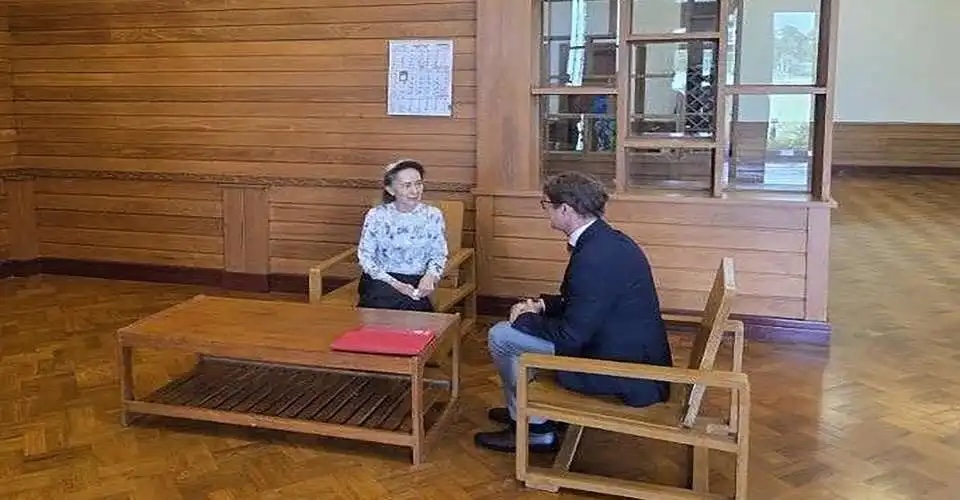
Benedict Rogers for UCA News The people of Myanmar mark the 38th anniversary of one of the bloodiest crackdowns by the military dictatorship on peaceful pro-democracy demonstrators in the country’s history. The tragedy is that almost four decades on, after a brief respite of democratic rule, the military’s brutal repression has only intensified, with its current dictator Min Aung Hlaing exceeding the inhumanity and criminality of his predecessors. What is ironic is that some in the international community appear to be beginning yet another cycle of engagement and legitimisation of this regime, at the expense of democracy and human rights. Min Aung Hlaing’s visit to Thailand this week is an alarming sign that some in the region are ready to recognise him as a president, despite the fact that he achieved that status by an illegal coup and a sham election in which all his opponents were jailed or banned, much of the population was disenfranchised, and the so-called “parliament” that resulted is an illegitimate puppet body stacked with the military’s stooges. It is also curious timing that Myanmar’s 81-year-old jailed democracy leader Aung San Suu Kyi has spent the past five years in prison and almost no news about her well-being has been revealed for almost three years — until this week, when photographs of her meeting with the head of the International Committee of the Red Cross (ICRC) were made public. Suu Kyi’s son, Kim Aris, has been campaigning for Myanmar’s regime to provide “proof of life.” The lack of contact or information led to concerns about her health. This week’s photographs with the ICRC provide welcome reassurance that she is still alive. But they also illustrate two other points: one is that international pressure works, and the other is that she — and all 14,000 or more political prisoners also detained — should be freed. Among other political prisoners who should not be forgotten is Dr. Linn Htut, the elected Chief Minister of Shan State and a participant in the 1988 democracy movement. Soldiers seized him at 3 a.m. on Feb. 1, 2021 as they carried out their illegal coup, held him in secret detention, tortured him, and later sentenced him to 20 years on fabricated corruption and electoral charges. He remains in Tharyarwaddy Prison, where his health conditions, including diabetes, arrhythmia, and high blood pressure, place him at grave risk of dying. In more than five years, his family has been granted only one 15-minute visit, conducted under strict military surveillance, with every word closely monitored. His son, Sai, an artist, has spent those five years fighting for his release. After repeatedly risking his life to evade arrest and eventually escape Myanmar, he has been advocating for his father in the corridors of power around the world. The United Nations Working Group on Arbitrary Detention found Dr Linn Htut’s imprisonment arbitrary under four categories and called for his immediate release. More than a year after that ruling, he remains behind bars. His case exposes the central failure of the international response: international law has spoken, the evidence is clear, yet the junta still pays no price for its defiance. Pressure that secures proof of life must now become pressure for release, for Dr Linn Htut and for every political prisoner whose family is still fighting to be heard. Let’s return to where all this started. On Aug 8, 1988 — known ever since as “8888” — thousands of people peacefully protesting were gunned down by Myanmar’s military. The carnage was horrific. It was by no means the first time the army fired on Myanmar’s people, nor the first time the people stood up to dictatorship — indeed, throughout that year, since mid-March, students and other citizens took to the streets, and many times were met with beatings, batons, and bullets. But 8888 is the iconic date marking the worst of the violence. Pro-democracy demonstrator Khin Ohmar told me when I interviewed her for my book, Burma: A Nation at the Crossroads, that she had gone to the General Hospital that day and — in her words — “it was full of blood — everywhere.” That year was the birth of Myanmar’s democracy movement and the first entrance onto the political stage of Suu Kyi, the daughter of the revered independence leader Aung San, who was assassinated together with six members of his interim cabinet on July 19, 1947, shortly before Myanmar gained independence. On Aug 26, 1988, just months after returning to Myanmar to care for her mother who had suffered a stroke, she addressed an estimated half a million people at the Shwedagon Pagoda, and the following month, the National League for Democracy (NLD) was established. In the 1990 elections, she and the NLD won by a landslide, but the generals rejected the results, imprisoned the victors, and intensified their grip on power. Suu Kyi spent cumulatively almost 15 years under house arrest, from 1989 until 2010, with short periods of release in between. When her British husband, Michael Aris, was diagnosed with prostate cancer and died in March 1999, the military regime denied him a final visit with her and refused to allow her to attend his funeral. In 2010, she was finally freed and, a year later, entered into a dialogue with the generals which ultimately led to a decade of political reform, limited democratisation, an opening of the country and her appointment in 2015 as de facto head of a new civilian-led and democratically-elected government, though sharing power with the military. The military junta had drafted a constitution specifically written to prevent her from running for president, excluding any candidate who was married to a foreigner, so she served instead in the de facto role of “State Counsellor”. Some decisions she took in government are contentious and — in the case of Myanmar’s Rohingya and other ethnic and religious minorities — profoundly painful. Nevertheless, in 2020, the NLD won an overwhelming new mandate, and Suu Kyi was poised to begin her second term as Myanmar’s State Counsellor. All that changed on Feb. 1, 2021, when the commander-in-chief of Myanmar’s armed forces, Min Aung Hlaing, embarked on a coup d’etat and plunged the country into a new era of military rule, economic collapse, civil war, and humanitarian and human rights crisis. Five-and-a-half years on from the coup and 38 years on from the birth of Myanmar’s democracy movement, the international community is faced with a renewed challenge to which it has hitherto failed to pay enough attention — the deadliest conflict in Asia. As Kim Aris rightly says, the ICRC visit to his mother “may be a first step, but it must not be the last.” Proving she is still alive is better than the uncertainty that went before. But the next step must be to release her and all political prisoners in Myanmar. On top of this, if the regime is to deserve any engagement from the international community, it must stop bo
Original source
DVB