General articles are free for 24 hours after publish.
Two Hanoi Suburban Communes Selected for Socialist Model Pilot
Hanoi has selected two communes, Phuc Thinh and Thu Lam, located at the northern gateway and formed after administrative unit rearrangement, to pilot the 'socialist commune/ward model.' Both communes are experiencing rapid urbanization and have developed infrastructure.
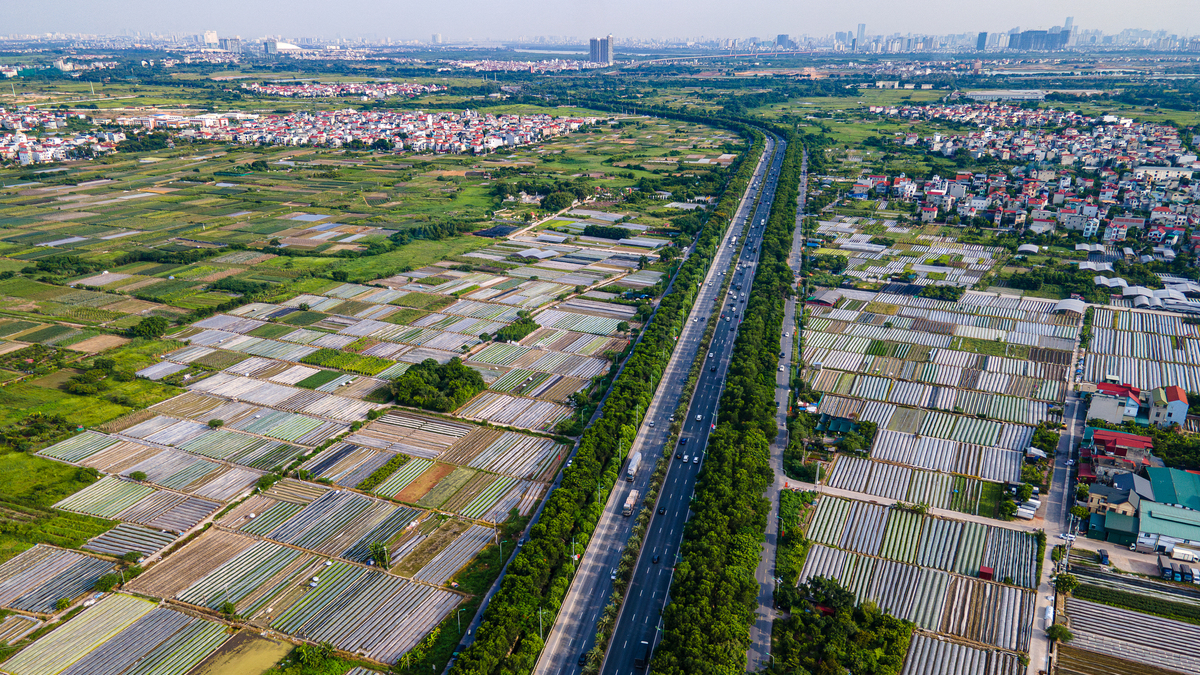
Hanoi has selected two communes, Phuc Thinh and Thu Lam, located at the northern gateway of the city and formed after administrative unit rearrangement, as pilot sites for the 'socialist commune/ward model.' These communes are among the 126 communes/wards newly established following Hanoi's administrative unit consolidation. They are characterized by rapid urbanization, developed transportation infrastructure, and high population density. The two adjacent communes cover a total area of 86.53 square kilometers, with a population of nearly 198,700 and an average annual income of approximately 90 million VND per person. Phuc Thinh Commune, established by merging several former communes and part of the old Dong Anh town, spans 42.68 square kilometers and has over 90,000 residents. Situated at Hanoi's northern gateway, it borders the Red River and is close to Noi Bai International Airport. Its favorable location provides convenient access to major routes like National Highway 3, National Highway 23, the Hanoi-Thai Nguyen Expressway, and the Nhat Tan-Noi Bai axis. The Nhat Tan-Noi Bai axis is designated as the development core for Phuc Thinh and a key dynamic axis connecting the capital's center with Noi Bai Airport and northern provinces. Since its establishment, Phuc Thinh has become a dynamic economic area in northern Hanoi, hosting 1,597 businesses and over 2,200 business households. Urbanization has driven an economic shift away from agriculture towards industry, construction, and trade-services. The commune features two industrial clusters, Nguyen Khe and Dong Anh, covering about 96 hectares, which attract numerous enterprises in mechanics, construction materials, and supporting industries, providing stable employment. Phuc Thinh's economy comprises 38.1% trade-services, 33.9% industry-construction, and 28% agriculture. Despite rapid urbanization, agriculture remains a strength, with high-tech and urban farming models. The Van Noi wholesale market serves as a major agricultural product hub, supplying vegetables and fruits to Hanoi and surrounding areas. Thu Lam Commune, also formed from mergers, covers 43.84 square kilometers with over 102,000 residents. Located in northeastern Hanoi, it benefits from connectivity via the Hanoi-Thai Nguyen Expressway, National Highway 3, Provincial Road 179, and the expanded Ring Road 3, acting as a gateway between the capital and Bac Ninh province and other northern localities. While less connected to Hanoi's center and Noi Bai Airport compared to Phuc Thinh, its connectivity is expected to improve with the completion of the Tu Lien Bridge and associated roads, reducing travel time. Thu Lam's economic structure is dominated by industry-construction (53%), followed by trade-services (34.8%), and agriculture-fisheries (12.2%). Traditional woodworking villages in Van Ha and Lien Ha produce decorative wood products and furniture for the domestic market, creating significant local employment. Agriculture and fisheries are transitioning towards modernization, emphasizing mechanization and technology to boost productivity and value while reducing manual labor reliance. Both communes are focusing on digitizing administrative services, enhancing transparency, and improving efficiency, prioritizing resident and business satisfaction. The pilot implementation of this 'socialist commune/ward model' is seen as part of the Vietnamese Communist Party's broader initiative to strengthen national governance and socio-economic development.
Original source
VnExpress