General articles are free for 24 hours after publish.
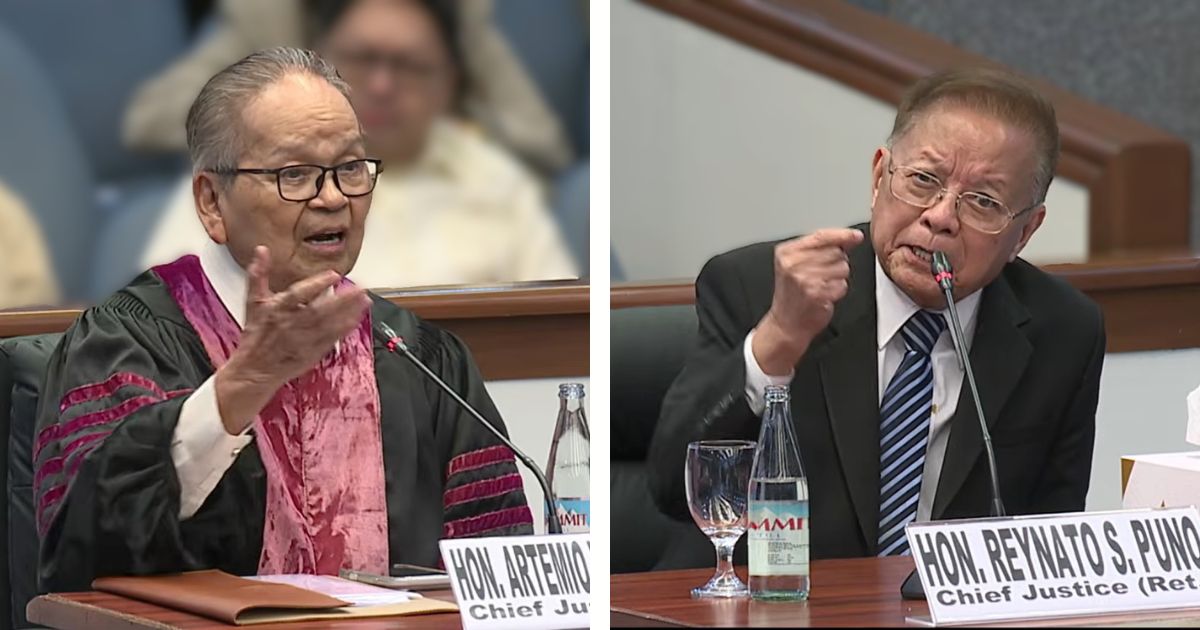
Impeachment court has sole power to decide conviction threshold -- ex-chief justices
Former Supreme Court Chief Justices stated that the Senate impeachment court has the sole authority to determine the voting threshold for conviction in the impeachment trial of the Philippine Vice President. They emphasized that the Senate is the 'sole judge' of impeachment cases based on the Constitution.
The Senate impeachment court has the sole authority to determine the voting threshold needed to convict Vice President Sara Duterte, former Supreme Court Chief Justices Reynato Puno and Artemio Panganiban said Wednesday. The retired magistrates made the statements as amici curiae (friends of the court) in response to a question from Senator-judge Erwin Tulfo on whether the Senate impeachment court could legally determine the voting threshold for conviction during Day 26 of Duterte's impeachment trial. Puno said the Senate impeachment court operates independently of the Supreme Court and derives its authority directly from the Constitution. "That is why I explained the Senate impeachment court is not under the Supreme Court. If the Constitution wanted the Supreme Court to decide on impeachment cases, then the Senate impeachment court should have been listed under Article VIII of the Constitution on the Judiciary, not Article XI, which is Accountability of Public Officers," Puno said. "What does that mean? The impeachment court is given the sole power to try and decide all cases of impeachment, so from stage one to the last stage. That is the power given to the Senate impeachment court," he added. The issue over the voting threshold was raised because at least four of the 24 senators have not been participating in the impeachment proceedings, prompting questions on whether it would be fair to use all 24 senators as the denominator in determining the two-thirds threshold for conviction. Panganiban agreed that the Constitution explicitly gives the Senate the sole power to decide impeachment cases. "You (the Senate impeachment court) are an independent, free court. The Constitution said the Senate shall be the sole judge to try and decide impeachment cases. What the Constitution requires is for you, as elected representatives of the people, to make the decision. Not the Supreme Court," Panganiban said. He said the Constitution clearly vests the Senate, sitting as an impeachment court, with the authority to decide impeachment cases. "If our Constitution wanted the Supreme Court to decide on impeachment cases, then it should not have designated you as the Senate impeachment court. The Constitution says that the Senate shall make the decision on impeachment cases," Panganiban added. At the start of the proceedings on July 6, the Senate impeachment court's presiding officer, Senate President Francis Escudero, ruled that the voting threshold for conviction should be 16 votes, or two-thirds of the Senate's 24 members. Asked by Senate President Sherwin Gatchalian whether Escudero's ruling was already set in stone, Panganiban said it was an initial ruling that could still be changed. "The presiding officer can change his earlier position after hearing us. If he changes his opinion after being convinced, there would be no need for a vote," Panganiban said. Gatchalian then jokingly asked what would happen if Escudero remained "stubborn" in his position. Puno said Escudero's ruling was only temporary and could still be changed. "That ruling is what we call a temporary ruling. The presiding officer can change his mind and change his ruling. In the same manner, you can now vote and later on you might change your mind. It is different from a final decision of conviction or acquittal. That is final. But everything else would be tentative," Puno said. Escudero responded that the issue was not about being stubborn but about being circumspect. "This is not about being stubborn. As Chief Justice Panganiban said, math is exact in the abstract but not in reality. If I change my position, someone will still appeal it and we will still have to vote on it in the end," Escudero said. He said a vote on the threshold would therefore be unavoidable. "So we cannot avoid a vote, whatever my decision on this matter. That is what will happen in reality," Escudero said. — MCG, GMA News
Original source
GMA News Philippines