Thailand's Stance on Prasat Khnar Contradicts International Law, Cambodia Argues
Security
2026年7月1日
5
Phnom Penh Post
Relations
🇰🇭Cambodia🇹🇭Thailand

Thailand's Stance on Prasat Khnar Contradicts International Law, Cambodia Argues

AI サマリー

Thailand has issued a statement rejecting Cambodia's position on the sovereignty of Prasat Khnar. Cambodia argues that Thailand's stance contradicts international law and attempts to legitimize territorial control through military occupation. The border dispute centers on the boundary established by the 1904 and 1907 treaties.

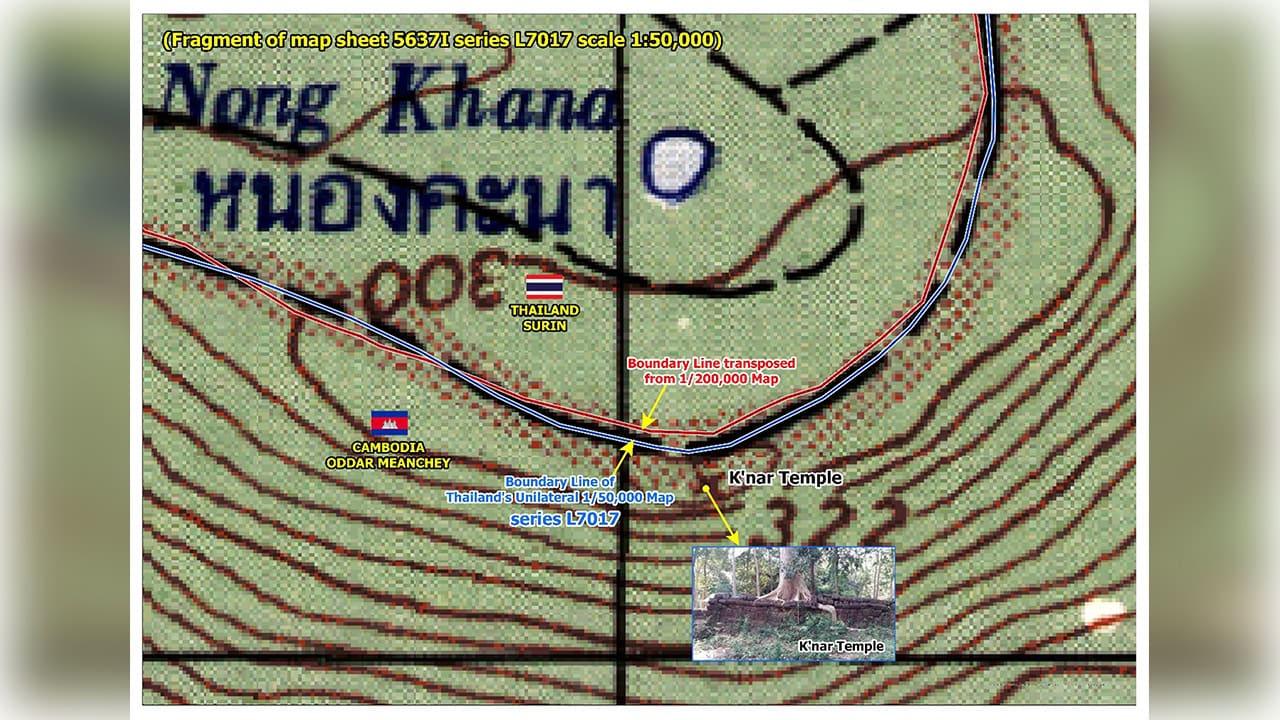
Thailand's latest statement rejecting Cambodia's position on Prasat Khnar presents itself as a defence of international law. It urges reliance on bilateral mechanisms, dismisses Cambodia’s position as a “unilateral claim” and argues that maps alone cannot determine sovereignty. At first glance, the statement appears measured and legally balanced. Upon closer examination, however, it advances a proposition that international law has consistently rejected for generations. The real question is whether an internationally established treaty boundary can be displaced through prolonged unilateral military control while the controlling State simultaneously insists that sovereignty remains legally unresolved. International law answers that question in the negative. The most striking feature of Thailand’s statement is its internal contradiction. On the one hand, Thailand insists that sovereignty over Prasat Khnar has yet to be determined and must await future bilateral mechanisms, joint surveys and boundary demarcation. On the other hand, it openly states that Thailand exercises security control over the area, administers access to the monument, manages the surrounding territory and rejects Cambodia’s description of the situation as occupation. These two positions cannot comfortably coexist. A State cannot argue that sovereignty remains legally unresolved while simultaneously exercising the powers ordinarily associated with sovereign authority. Cambodia’s position has repeatedly been described as a “unilateral claim”. That characterisation fundamentally misunderstands Cambodia’s legal position. Cambodia maintains that the international boundary was established by the 1904 and 1907 Franco–Siamese Treaties and implemented through the work of the Mixed Boundary Commission, including the official 1:200,000 boundary maps prepared pursuant to those treaties. Cambodia therefore relies on an existing legal boundary — not a newly asserted one. Thailand’s statement repeatedly suggests that Cambodia relies merely upon its own interpretation of maps. That description is incomplete. The 1:200,000 maps were not simply Cambodian maps. They formed part of the implementation of the treaty boundary, were communicated to Siamese authorities, were used for decades without formal objection, and later became significant evidence before the International Court of Justice in the Temple of Preah Vihear Case and reaffirmed during the Request for Interpretation of the Judgment in the Temple of Preah Vihear Case. Thailand also argues that sovereignty cannot be determined until joint surveys and boundary demarcation are completed. That argument reverses one of the most fundamental principles of international boundary law. Delimitation and demarcation are not the same. A treaty establishes the legal boundary. Demarcation merely marks that already established boundary on the ground. If sovereignty depended upon the completion of physical demarcation, countless international boundaries throughout the world would remain legally uncertain decades after the relevant treaties entered into force. That is not how international law operates. Thailand’s statement also overlooks another significant fact. It argues that Cambodia relies upon unilateral map interpretation while remaining silent about Thailand’s own unilaterally produced 1:50,000 Series L7017 map. Cambodia has consistently maintained that the L7017 map has no legal force because it was produced unilaterally and therefore cannot alter an international boundary established by treaty. Yet according to Cambodia’s State Secretariat of Border Affairs, even Thailand’s own L7017 map places Prasat Khnar within Cambodian territory. This fact is legally and logically significant. Cambodia does not rely upon the L7017 map to establish sovereignty. The treaties already perform that function. The importance of the L7017 map is different. It demonstrates that even Thailand’s own cartographic representation does not support the conclusion advanced in its recent statement. If Thailand’s own map places Prasat Khnar inside Cambodia, then the dispute can no longer be portrayed as merely Cambodia’s unilateral interpretation versus Thailand’s. The contradiction exists within Thailand’s own position. Perhaps the most revealing sentence in Thailand’s statement is its assertion that security measures are being carried out in territory “under its control”. Those words deserve careful legal attention. Control is a factual circumstance. Sovereignty is a legal entitlement. International law has long distinguished between the two. If physical control alone could generate lawful title, every military occupation in history would become a potential source of sovereignty. The prohibition against acquiring territory through the threat or use of force would become meaningless. The modern international legal order was built precisely to prevent such outcomes. No State may improve its legal position through unilateral military control over territory whose legal status has already been determined by treaty. Thailand also argues that Cambodia must provide evidence regarding the reported damage to the staircase leading to Prasat Khnar. If there is disagreement over the facts, an independent and impartial investigation would serve the interests of both countries. But the staircase is not the central legal issue. The more fundamental question is why one State is exercising exclusive governmental authority over an ancient Khmer monument that Cambodia maintains lies within an internationally established treaty boundary. Thailand’s own statement unintentionally illustrates the contradiction. It says sovereignty is unresolved. Yet it controls access. It deploys security forces. It administers the site. It manages activities in the surrounding area. These are not the actions of a neutral party awaiting legal determination. They are the actions of a State exercising governmental authority while maintaining that sovereignty somehow remains undecided. Equally notable is what Thailand’s statement does not explain. It does not explain why the 1904 and 1907 Treaties should cease to determine the frontier. It does not explain how treaty maps relied upon for decades suddenly lose their legal significance. It does not explain how prolonged unilateral control can lawfully replace an internationally established boundary. Those omissions lie at the heart of the dispute. Ultimately, this disagreement is not about whose narrative proves more persuasive. It concerns whether international boundaries established by treaty continue to have legal meaning. If treaty boundaries may be suspended whenever one State exercises prolonged unilateral control, then no international frontier is truly secure. If military administration can gradually replace treaty law, the stability of international boundaries everywhere is placed at risk. Cambodia is not asking the international community to recogn

多角的分析

経済的影響

このニュースは直接的な経済的影響を報じていないが、国境紛争は観光業や地域経済に不確実性をもたらす可能性がある。特に、プレア・クナール遺跡のような歴史的遺産へのアクセスが制限される場合、観光収入の減少につながりかねない。また、両国間の貿易や投資にも影響を与えうる。

投資家心理

投資家にとって、国境紛争は地政学的リスクとして警戒される。タイとカンボジア間の緊張は、両国または地域への投資判断において、リスク要因として考慮されるだろう。特に、インフラ開発や観光関連事業への投資は、紛争の長期化やエスカレーションによって影響を受ける可能性がある。

社会的影響

プレア・クナール遺跡は、カンボジアの歴史的・文化的アイデンティティの一部をなすものである。タイによる軍事的な支配と、主権未解決という主張は、カンボジア国民の感情を刺激し、ナショナリズムを高める可能性がある。また、国境地帯に居住する住民の生活や移動の自由にも影響が及ぶ懸念がある。

市民の声

カンボジア市民にとって、プレア・クナール遺跡は祖国の歴史と誇りの象徴である。タイによる実効支配は、主権侵害と受け止められかねず、国民の強い反発を招く可能性がある。また、国境周辺に住む人々は、治安の悪化や移動の制限といった直接的な影響を受けることも考えられる。

背景・歴史的文脈

カンボジアとタイの国境問題は、長年にわたり存在してきた。特に、フランス植民地時代の条約に基づく境界線は、両国で解釈が分かれる地域がある。プレア・クナール遺跡(タイ名:プレア・ヴィヒアール寺院)を巡る紛争は、2008年にユネスコ世界遺産に登録されたことを契機に再燃し、2011年には国際司法裁判所(ICJ)が、登録された寺院本体の領有権はカンボジアにあるとの判断を示した。しかし、周辺地域における国境線の確定は依然として課題となっている。タイが主張するL7017地図は、カンボジアが主張する条約に基づく境界線とは異なる地域を示しているとされる。

原文ソース

Phnom Penh Post

原文を読む