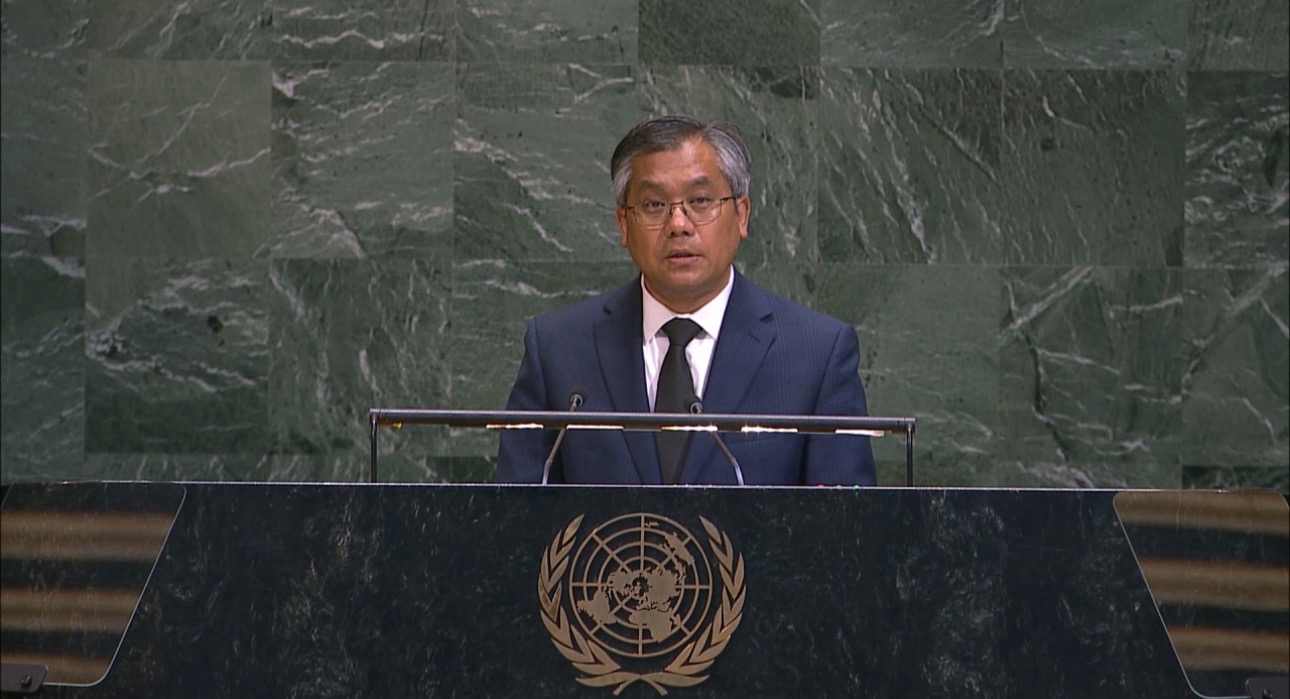
Myanmar UN Envoy urges decisive R2P action, reports surge in military atrocities
Security
2026年7月7日
2
DVB
Relations
🇲🇲Myanmar🌐United Nations / ASEAN

Myanmar UN Envoy urges decisive R2P action, reports surge in military atrocities

AI サマリー

In a stinging address before the U.N. General Assembly, Myanmar’s Permanent Representative to the U.N. Kyaw Moe Tun called on the international community to urgently invoke the “Responsibility to Protect” (R2P) doctrine

In a stinging address before the U.N. General Assembly, Myanmar’s Permanent Representative to the U.N. Kyaw Moe Tun called on the international community to urgently invoke the “Responsibility to Protect” (R2P) doctrine to halt what he described as a system-wide campaign of mass atrocities by the military. Speaking on July 6 during a plenary debate on R2P and the prevention of genocide and war crimes, Kyaw Moe Tun warned that international inaction has fostered complete impunity for the military regime, leaving millions of civilians vulnerable to devastating violence. A staggering human toll Ambassador Kyaw Moe Tun presented updated, grim metrics detailing the scale of the crisis since the Myanmar military coup on Feb. 1, 2021. According to the data cited in his address: Fatalities: More than 8,100 people have been killed by the military. Displacement: Over 3.7 million people have been forced from their homes and remain internally displaced. Escalating Violence: Between April 20 and June 30, 2026—a period of just 70 days—the military intensified its campaign, launching 1,147 aerial attacks and conducting 20 massacres against civilians. “Realities on the ground demonstrate the complete inadequacy of current measures,” Kyaw Moe Tun stated, referencing the shortcomings of diplomatic frameworks like the Association of Southeast Asian Nations (ASEAN) Five-Point Consensus peace plan and U.N. Security Council Resolution 2669. “Implementation of the R2P by the international community is clearly long overdue to save the lives of the people of Myanmar and their future.” Demands for legal accountability and sanctions Ambassador Kyaw Moe Tun pushed for concrete international legal mechanisms to penalize regime leaders in Naypyidaw, specifically highlighting the International Criminal Court (ICC). He urged the ICC to fast-track the Prosecutor’s application for an arrest warrant against regime leader Min Aung Hlaing, who was inaugurated by a pro-military parliament on April 10, for crimes against humanity. Kyaw Moe Tun reminded the assembly that the shadow National Unity Government (NUG) had formally accepted the ICC’s jurisdiction back in July 2021 to address the domestic accountability gap. He also noted that democratic forces are coordinating via the Steering Council for the Emergence of a Federal Democratic Union (SCEF) to establish a comprehensive framework for transitional justice. To cripple the military’s operational capacity, the Ambassador demanded that the U.N. Security Council pass a follow-up resolution under Chapter VII, which allows for enforcement measures. He explicitly called for an immediate global cessation of the flow of arms, weapons, jet fuel, and dual-use technologies to the regime. A warning against international complicity The address concluded with an emotional and pointed warning to foreign governments currently engaging or normalizing ties with the regime in Naypyidaw, which has rebranded itself after concludng elections labeled a “sham” by the U.N. and several western countries on Jan. 25. “I wish to demand that any country should not be complicit in the military junta’s ongoing atrocities by having unwarranted engagements with them,” stated Kyaw Moe Tun. “It will be in the history of Myanmar, and the people of Myanmar will always remember them bitterly and painfully.” With the International Court of Justice (ICJ) still deliberating on the landmark The Gambia v. Myanmar genocide case, the Ambassador emphasized that the international community can no longer afford to remain a bystander to the ongoing destruction of Myanmar’s democratic future. The post Myanmar UN Envoy urges decisive R2P action, reports surge in military atrocities appeared first on DVB.

多角的分析

経済的影響

直接の経済ニュースではありませんが、治安と司法の信頼は地域経済の土台です。職場での暴力や未成年者保護への不安が強まると、夜間営業、観光、雇用、地域サービス業のリスク認識が高まります。

投資家心理

投資家目線では、個別事件よりも法執行の予見可能性が焦点です。加害者への対応が曖昧になれば、ローカルビジネスの統治リスクや従業員保護の弱さとして評価されやすくなります。

社会的影響

ミャンマーの現場では、暴力を「個人間の事件」で片づけず、誰が守り、誰が説明するのかを可視化する圧力が強まります。軍の動きは、被害者側が孤立しやすい環境で、沈黙より手続きを選ぶための足場になります。

市民の声

市民にとっては、自分や家族が被害に遭った時に公正な手続きへアクセスできるのかが最大の関心です。地域団体が声を上げることで、事件の風化を防ぎ、被害者側の孤立を和らげる意味があります。

背景・歴史的文脈

このニュースは、ミャンマーの地域社会で法の支配と弱者保護がどこまで機能しているかを映す事案です。暴力事件そのものに加え、女性団体や市民社会が司法手続きを求めて声を上げている点が重要です。軍政下では警察・司法への信頼が揺らぎやすく、個別事件が地域の不安や統治への不信に直結します。

原文ソース

DVB

原文を読む