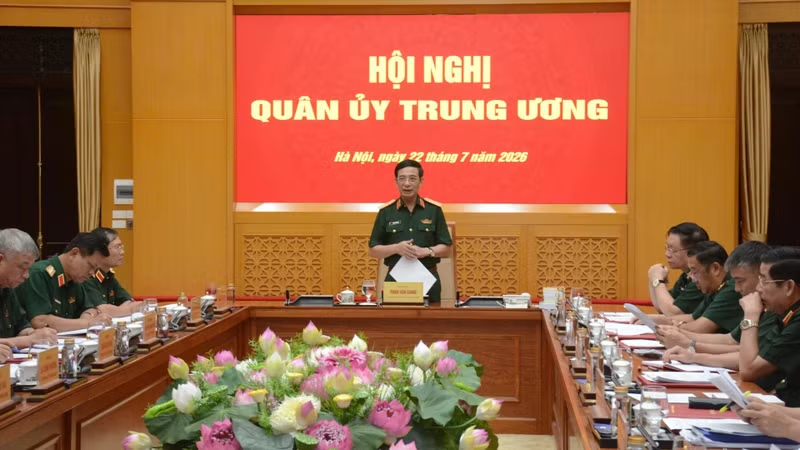
Vietnam's Military Commission Discusses Key Policies Under Defense Minister Phan Van Giang
Vietnam's Central Military Commission convened a meeting to review and provide opinions on crucial policy matters, led by Defense Minister and Deputy Prime Minister Phan Van Giang. Discussions likely focused on military modernization and national security enhancement.
This article requires PRO
This article is outside the free access window or is a special report. PRO unlocks it and the full archive.
Related articles
- Durian Trade Highlights Complexities of China-Vietnam Border
The export and import of durian are shedding light on the economic activities and associated political and social challenges in the border regions between China and Vietnam, with the fruit symbolizing the complexities of their bilateral relations.
- Vietnamese Durian Gains Traction in Chinese Market
Vietnamese durian is gaining popularity in the Chinese market. Efforts are underway to improve quality and expand exports, highlighting a new facet of economic ties between the two nations.
- Vietnamese PM to Visit Laos, Cambodia to Boost Relations and Regional Stability
Vietnamese Prime Minister Le Minh Hung is set to make official visits to Laos and Cambodia. The primary objective is to deepen strategic partnerships and accelerate the implementation of high-level agreements. The visits are expected to enhance cooperation in economy, trade, investment, and tourism, contributing to regional peace and stability.
- ASEAN to Strengthen Cooperation on Transboundary Haze Pollution
Malaysia, as host of the 2027 Sub-Regional Ministerial Steering Committee (MSC) Meeting, will leverage its chairmanship to translate the ASEAN Agreement on Transboundary Haze Pollution (AATHP) into concrete actions. This involves enhancing data sharing, improving law enforcement, and fostering cross-border cooperation to address the escalating haze pollution crisis.