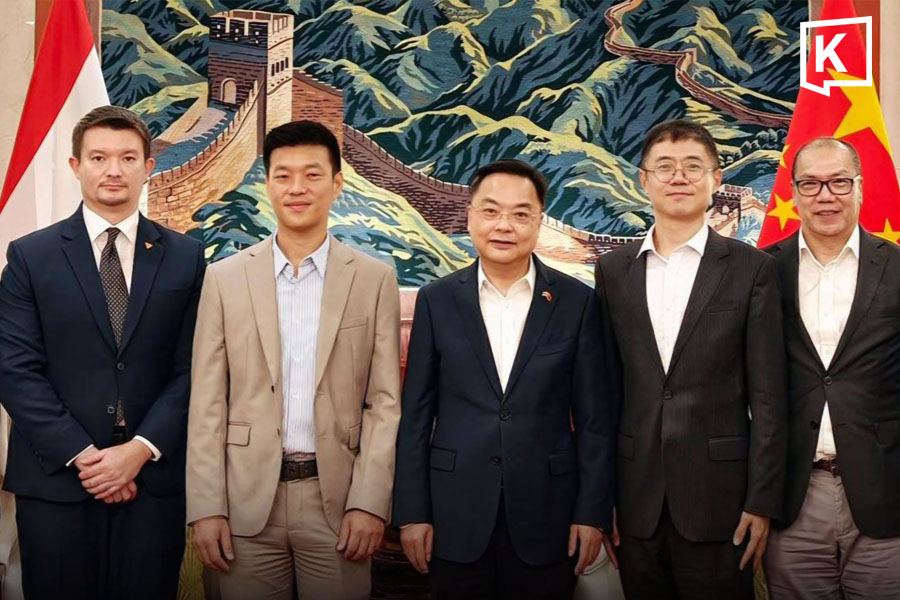
People’s Party Submits Cross-Border Pollution Evidence to Chinese Embassy
Diplomacy
2026年7月15日
5
Khaosod English
Relations
🇹🇭Thailand🇲🇲Myanmar🇨🇳China

People’s Party Submits Cross-Border Pollution Evidence to Chinese Embassy

AI サマリー

Thailand's People's Party submitted evidence of cross-border water pollution, believed to originate from mining operations in a neighboring country, to the Chinese Embassy. China expressed willingness to cooperate on objective, scientific investigations and a joint probe with Thailand and Myanmar.

BANGKOK — 15 July 2026, People’s Party leader and party-list MP Natthaphong Ruengpanyawut, together with Chiang Mai MP Pattharapong Leelaphat, submitted evidence on cross-border water pollution to the Chinese Embassy this week, urging Beijing to help address toxic contamination believed to originate from mining operations in a neighbouring country. Pattharapong said he stressed to Chinese Ambassador Zhang Jianwei that the issue affects people of all nationalities and requires urgent cooperation among all countries involved. He said the submission also emphasised that toxic substances detected in northern rivers for more than a year did not originate from Thailand’s natural heavy metals or activities within the country. The documents included water and sediment test results from Thailand’s Pollution Control Department, along with research by Thanapol Penrat of Naresuan University. Pattharapong said the evidence points to contamination affecting the Kok, Sai, Ruak, Mekong and Salween rivers. He also highlighted contamination in the Kraburi River, where arsenic and lead levels were found to exceed safety standards. According to the party, the pollution has spread through the food chain, with tests detecting excessive heavy metals in vegetables and lead contamination in fish caught from the Mekong River. The submission also included the coordinates of 2,676 mining sites, based on data from the Stimson Center, to assist Chinese authorities in determining whether any Chinese entities are connected to the operations. Pattharapong urged Beijing to enforce relevant Chinese laws governing rare earth management, outbound investment and export controls, and asked the Chinese government to investigate the matter and provide a written response that could be shared with the Thai public. “We ask the Chinese government to investigate the matter and provide a written response so it can be communicated to the Thai public, demonstrating China’s commitment to resolving this issue as a founding member of the Lancang-Mekong Cooperation framework with its dedicated environmental mechanism,” he said. He stressed that the People’s Party was not seeking to blame any particular company or country, but wanted governments involved in the mineral supply chain to jointly investigate mining operators and tackle the pollution at its source. The party also submitted research proposing low-cost treatment methods for contaminated mine sites. According to Pattharapong, treating polluted water at operating mines would cost between 5 and 20 baht per cubic metre, while attempting to restore rivers after contamination had spread could cost hundreds or even thousands of times more and, in some cases, may prove impossible. The Chinese Embassy Reponds In a statement issued on Wednesday, the Chinese Embassy in Bangkok said China understands concerns over the ecological environment and public health in the river basin. However, because the affected rivers cross the Thailand-Myanmar border, the issue should be investigated in an objective, scientific and responsible manner. The embassy said China is willing to strengthen cooperation with countries in the basin on water resources management and environmental protection, and supports Thailand and Myanmar improving communication and coordination to launch a joint investigation as soon as possible. However, it said that while the facts remain unclear and responsibility has yet to be established, “some individuals” have used the issue to make baseless accusations and smear China. The embassy said China firmly opposes such actions and hopes the People’s Party will maintain an objective and rational position and continue to play a constructive role. According to the embassy, Natthaphong congratulated the Communist Party of China on its 105th anniversary during the meeting and expressed his willingness to learn from the party’s experience in party-building while promoting greater mutual understanding and trust between Thailand and China. The post People’s Party submits cross-border pollution evidence to Chinese Embassy appeared first on Khaosod English.

多角的分析

経済的影響

越境汚染問題は、タイ北部の水資源の質に直接影響を与え、農業用水や漁業資源の枯渇、さらには食品安全性の懸念を引き起こす可能性がある。これは地域経済、特に農業や観光業に打撃を与える。汚染源が特定されず、対策が遅れるほど、経済的損失は拡大する。低コストの汚染処理方法の提案は、経済的実現可能性を示す試みだが、根本的な解決には国際的な協力と資金投入が不可欠となる。

投資家心理

越境汚染問題は、タイ北部、特に河川流域に投資する企業にとってリスク要因となる。水質悪化は操業に影響を与える可能性があり、また、環境規制の強化や国際的な非難につながるリスクも考慮する必要がある。中国からの投資やレアアース関連産業への投資を検討する際には、サプライチェーンの環境リスク評価がより重要になるだろう。中国政府の対応次第では、地域への投資センチメントに影響を与える可能性がある。

社会的影響

越境汚染は、タイ北部の住民の健康と生活基盤を脅かしている。汚染された水や食物の摂取による健康被害、農業や漁業への依存からの生計手段の喪失は、地域社会の不安定化を招く可能性がある。特に、コック川、メコン川などの主要河川流域の住民は、直接的な影響を受けている。汚染源の特定と責任追及が遅れることで、住民の不満や不安が増大し、社会的な緊張が高まる懸念がある。

市民の声

タイ北部の住民は、長年にわたり水質汚染に苦しんできた。特に、コック川、メコン川などの主要河川の汚染は、飲料水、灌漑用水、そして食料源としての魚や野菜の安全性を脅かしている。汚染物質が食物連鎖に入り込んでいるという報告は、住民の健康への直接的な懸念を引き起こしている。人民党の行動は、こうした住民の切実な声を行政に届けようとする試みであり、政府による迅速かつ効果的な対応を求める声は大きい。

背景・歴史的文脈

タイ北部における越境汚染問題は、近隣国、特にミャンマー北部の鉱山開発活動に起因すると長年指摘されてきた。これらの地域では、レアアースやその他の鉱物資源の開発が活発に行われているが、環境規制が不十分であるため、汚染物質が河川を通じてタイ側に流出している。2020年代に入り、汚染の深刻化と広がりが顕著になり、タイの汚染管理局や大学による調査が進められてきた。人民党による中国大使館への証拠提出は、問題解決に向けた外交的アプローチを強化する試みであり、中国の協力なしには根本的な解決が難しいという認識に基づいている。

原文ソース

Khaosod English

原文を読む