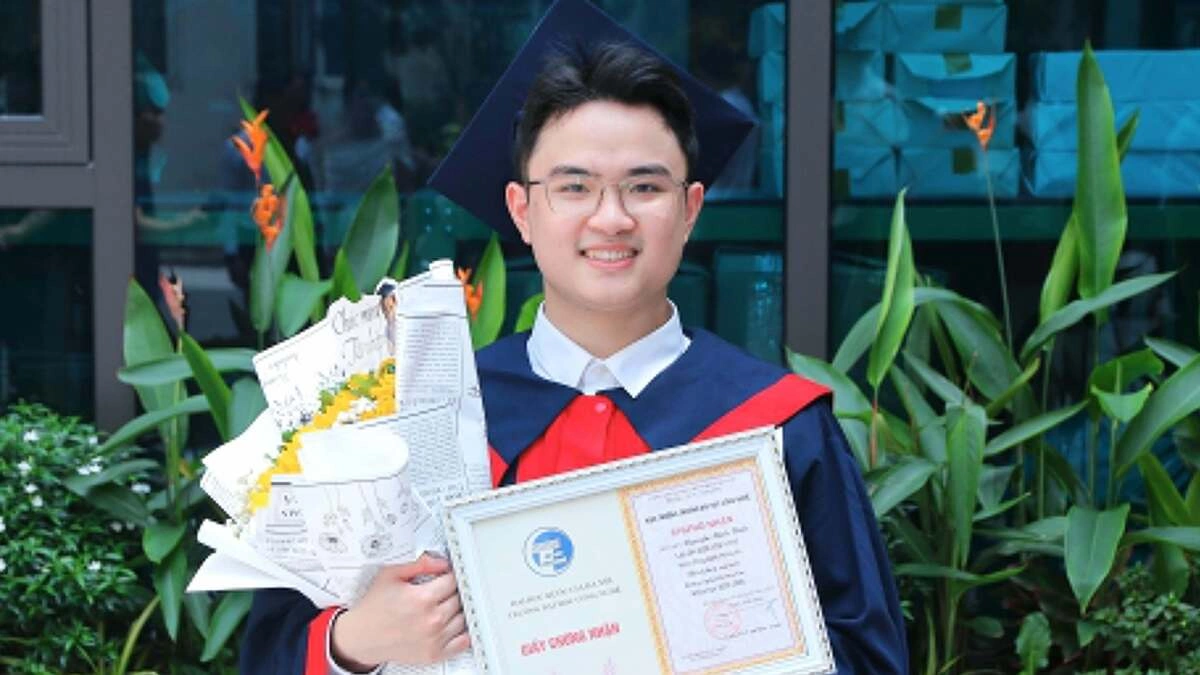
AI Pioneer: Vietnam Tech University Top Graduate Publishes 3 International Papers on Medical AI
Nguyen Minh Hien, a top graduate from Vietnam's University of Technology, has achieved three international publications on AI applications in medical data analysis, excelling in the interdisciplinary field of Bioinformatics. His success highlights a growing trend of young Vietnamese researchers contributing to cutting-edge global science.
Nguyen Minh Hien, a top graduate from the University of Technology, Vietnam National University Hanoi, has achieved three international publications on AI applications in medical data analysis, earning him the title of "thủ khoa" (top graduate). With an impressive GPA of 3.93/4.0, Hien has focused on the interdisciplinary field of "Tin-Sinh học" (Bioinformatics), aiming to apply his knowledge to cancer research and precision medicine. Hailing from Bac Ninh province, Hien possessed a strong foundation in mathematics and informatics from his high school years, where he won national awards. Upon entering university to study Information Technology, his path took a significant turn in his second year when he joined a research group. It was then that he discovered the exciting intersection of IT and Biology. "Bioinformatics allows me to see how programming, algorithms, and artificial intelligence can support the analysis of complex biological data, especially in cancer research and precision medicine," Hien explained. "This is a timely research direction with significant development potential." In the early stages of his research, Hien encountered challenges due to the complexity of existing scientific papers and the lack of detailed implementation specifics, making it difficult to replicate experiments. He was assisted by his research group colleagues in understanding source code, implementing, and adjusting experiments related to breast cancer data analysis. Hien also delved deeper into algorithms, machine learning, and biomedical data analysis methods, supplementing his understanding through international literature and discussions with his instructors and senior group members. Hien views learning as a "long-term game," emphasizing the importance of resource allocation and strategic planning to tackle difficult problems. He broke down his academic and research goals into smaller objectives to manage pressure. He strategically completed most of his coursework within the first three years, then gained practical experience at a technology company to broaden his perspective on complex data such as medical images and proteins. He dedicated 20-30% of his time to research. By his fourth year, he had become a co-author of three international publications on the application of AI in analyzing cancer data. Two of these were published on IEEE Xplore, and one on Springer Nature, both reputable global scientific databases. These studies explored various types of patient biological data, including gene activity levels and DNA variations, to aid in cancer subtyping and the identification of relevant biomarkers. "These results can inform future research, contributing to more personalized diagnosis and treatment for patients in the future," Hien stated, detailing his role in literature review, data processing, running experiments, verifying results, and refining the experimental process. The three publications also formed the "backbone" of his graduation thesis on applying AI to construct evolutionary trees, a computational research approach that analyzes relationships between biological samples. "In vaccine research, it provides information on virus changes, helping scientists evaluate and update vaccine components when necessary," he described. Hien believes that conducting research requires students to read independently, experiment, document discrepancies, and adjust their methods with each iteration. This, he says, is his favorite but also most pressure-inducing task. "AI experiments on biomedical data require significant computational resources, so I had to learn to flexibly use platforms with GPUs, optimize source code, and manage experimental runtime," Hien shared. He realized that simply replicating a research paper wouldn't yield results; understanding the problem, verifying data, checking source code, and conducting systematic experiments were crucial. Dr. Hoang Thi Diep, a lecturer in the Faculty of Information Technology and Hien's research and thesis supervisor, praised his special passion for life sciences and his seamless collaboration with his research group. "Hien has a strong algorithmic foundation, a high capacity for self-learning, and is very persistent in experimental work," she commented. Hien plans to pursue a Master's degree to further cultivate his academic knowledge in the coming years. "The most valuable thing for me is not just having international publications, but learning how to conduct research within a serious team: reading independently, experimenting, knowing when to ask the right questions, and recognizing the contributions of my collaborators," Hien concluded.
多角的分析
Nguyễn Minh Hiển 氏の成果は、ベトナムにおける科学技術分野、特にAIとバイオインフォマティクスの成長ポテンシャルを示唆している。これは、ベトナムが従来の製造業中心の経済から、より付加価値の高い知識集約型産業へと移行しようとする国家戦略と軌を一にする。AI分野への投資と人材育成は、将来的な経済成長の新たな牽引役となり得る。国際的な学術発表は、ベトナムの科学技術レベルの向上と国際的な評価獲得に貢献し、技術移転や国際共同研究の機会を創出する可能性がある。
Hiển 氏のような若手研究者の活躍は、ベトナムの科学技術分野への投資機会を示唆する。特にAI、バイオテクノロジー、ヘルスケア関連のスタートアップや研究機関への投資は、将来的な高リターンが期待できる。国際的な学術論文の発表は、ベトナムの研究開発能力の高さを国際社会にアピールするものであり、海外からの直接投資(FDI)や技術提携を促進する要因となり得る。これは、ベトナム経済の高度化とイノベーションエコシステムの発展に寄与するだろう。
Nguyễn Minh Hiển 氏の成功は、ベトナムの若者にとって、学業へのモチベーションを高める象徴となる。特に、地方出身の彼が全国レベルの大学でトップクラスの成績を収め、国際的な舞台で活躍している事実は、教育機会の格差是正や、地方の若者にもチャンスがあるという希望を与える。また、AIと医学の融合という先端分野への挑戦は、ベトナム社会全体における科学技術リテラシーの向上や、将来の医療システムへの期待を高める効果も期待できる。彼の経験は、教育機関や研究機関における実践的な学習環境の重要性も浮き彫りにしている。
Hiển 氏の活躍は、ベトナム市民、特に若い世代にとって、学業や研究への新たな刺激となるだろう。AIと医学という最先端分野での国際的な成果は、彼らが将来、より高度な技術や知識を習得し、国の発展に貢献できるという希望を与えている。また、地方出身の彼が全国トップクラスの大学で成功したことは、教育へのアクセスや機会均等に対する社会的な関心を高める可能性がある。彼の経験は、困難に立ち向かい、目標を達成するための粘り強さの重要性を示唆している。
背景・歴史的文脈
ベトナムは、ドイモイ政策以降、経済成長を最優先課題とし、教育・科学技術分野への投資を拡大してきた。特に近年は、AI、バイオテクノロジー、デジタル経済といった先端技術分野を国家戦略の柱として位置づけ、人材育成と研究開発を強化している。2020年代に入り、ベトナム政府は「2030年までの国家AI発展戦略」を策定し、AI技術の研究開発、応用、人材育成を推進。国際的な学術誌への論文発表は、ベトナムの科学技術レベルの向上を示す指標の一つとして注目されており、Hiển氏の成果は、こうした国家的な取り組みの具体的な現れと見ることができる。
原文ソース
VnExpress