General articles are free for 24 hours after publish.
South Korea's 'Dark Eagle' Debate: North Korean Threat and Regional Stability
The debate over deploying the US-made 'Dark Eagle' hypersonic weapon in South Korea highlights the dilemma between increasing North Korean threats and potential Chinese backlash. Balancing alliance strength with diplomatic considerations is crucial.
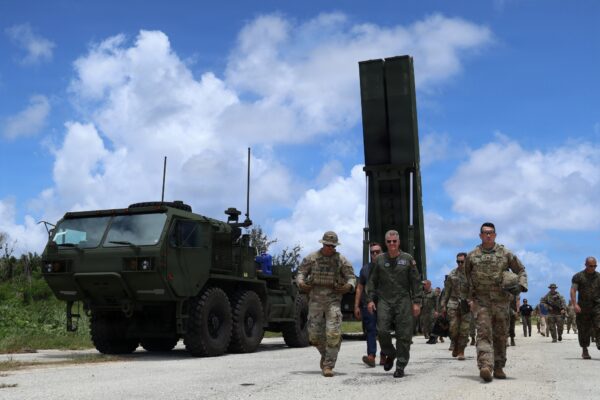
Soldiers with 7th Infantry Division (Multi-Domain Command – Pacific) train with the Dark Eagle Long-Range Hypersonic Weapon during exercise Valiant Shield, June 6, 2026. Rumors about the United States potentially deploying its Multi-Domain Task Force (MDTF) and the “Dark Eagle” hypersonic weapon to the Korean Peninsula are sparking predictable anxieties. Given the fierce economic and political backlash South Korea endured after hosting the Terminal High Altitude Area Defense (THAAD) system in 2016, it is easy to see why critics are sounding the alarm. They argue that bringing in offensive hypersonic missiles will simply turn South Korea into a pawn in the broader China-U.S. rivalry. But focusing strictly on China’s anxieties and possible reaction misses a far more urgent reality: South Korea faces an existential, rapidly accelerating threat from North Korea’s evolving military capabilities. War is no longer just fought on land, at sea, or in the air; it spills over into space, cyberspace, and the electromagnetic spectrum. The MDTF is built for this new reality. The task force is not just another conventional weapon to park on a base. It is a theater-level tool designed to blind an adversary’s radars, sever their communications, and seize control of the battlefield almost instantly. The star of the MDTF is the Dark Eagle. According to the U.S. Army, this hypersonic glide vehicle boasts a range of over 3,500 kilometers (2,175 miles). What makes it genuinely disruptive is not just its speed – exceeding Mach 15 – but its unpredictability. Unlike traditional ballistic missiles that follow a standard, trackable arch, the Dark Eagle skims the upper atmosphere at altitudes of 30 to 50 kilometers. By flying this low and fast, it slips beneath the sightlines of ground-based early warning radars and easily bypasses legacy air defense systems. For the Korean Peninsula, this technology rewrites the rules of deterrence. Over the past few years, North Korea has aggressively shifted toward solid-fuel ballistic missiles and mobile launchers. This means Pyongyang can roll a missile out of a tunnel and fire it in roughly 10 to 15 minutes. Older weapons, like Tomahawk cruise missiles, simply fly too slowly to eliminate these targets before they launch. The Dark Eagle solves this timing crisis. If stationed in South Korea, it could obliterate command bunkers in Pyongyang or missile sites across the country in minutes. Even if launched from bases in Guam or Japan, the weapon would reach its target in roughly 10 minutes. This speed fundamentally shifts the strategic calculus. Knowing that a U.S. hypersonic weapon can strike the origin point of an attack almost instantly guts the logic of a surprise launch. It renders North Korea’s deeply buried nuclear bunkers highly vulnerable, serving as a visceral deterrent against miscalculation by leadership in Pyongyang. Naturally, positioning an offensive weapon like a hypersonic missile in Northeast Asia is going to ruffle feathers. If THAAD was a shield, the Dark Eagle is undoubtedly a spear. But Seoul cannot afford to abandon the precise, asymmetric deterrence that modern weapons provide simply because of diplomatic friction with China. Furthermore, the deployment of the MDTF would offer a strategic benefit: silencing the recurring political chatter in Washington about drawing down U.S. Forces Korea (USFK). Committing a flagship, next-generation asset to the peninsula would be ironclad proof that the United States is willing to project its most advanced military capabilities to defend South Korea. The conversation needs to move past the rigid binary of either unconditionally hosting the MDTF forever or rejecting it out of sheer geopolitical panic. Washington and Seoul need a strategy that bolsters defense while managing diplomatic fallout. Instead of rushing into a permanent deployment, the two nations should establish a joint working group of experts and military officials to map out the logistics and political implications. A smart first step would be a limited, rotational deployment of the MDTF during upcoming combined military exercises. This would allow both militaries to test how the Dark Eagle integrates into existing defense networks without the permanence that triggers regional crises. A phased, transparent approach buys Seoul the time it needs to build public consensus while offering diplomatic space to reassure neighbors that the weapon is meant to stabilize the region, not upend it. Ultimately, the debate over the Dark Eagle is about much more than a single weapon system. It is a crucial test of how the U.S.-South Korea alliance is adapting to the unpredictable, multidomain threats of the 21st century. It is time approach the situation with strategic clarity, ensuring both the strength of the alliance and lasting peace on the Korean Peninsula.
Original source
The Diplomat Indonesia