General articles are free for 24 hours after publish.
Vietnam Party Central Committee Discusses Governance and Foreign Policy
The Communist Party of Vietnam Central Committee concluded discussions on crucial issues including strengthening societal discipline, formulating a national security strategy, administrative reforms, and ASEAN's role in international relations. Emphasis was placed on ASEAN's unity in the East Sea issue and building relationships with major powers.
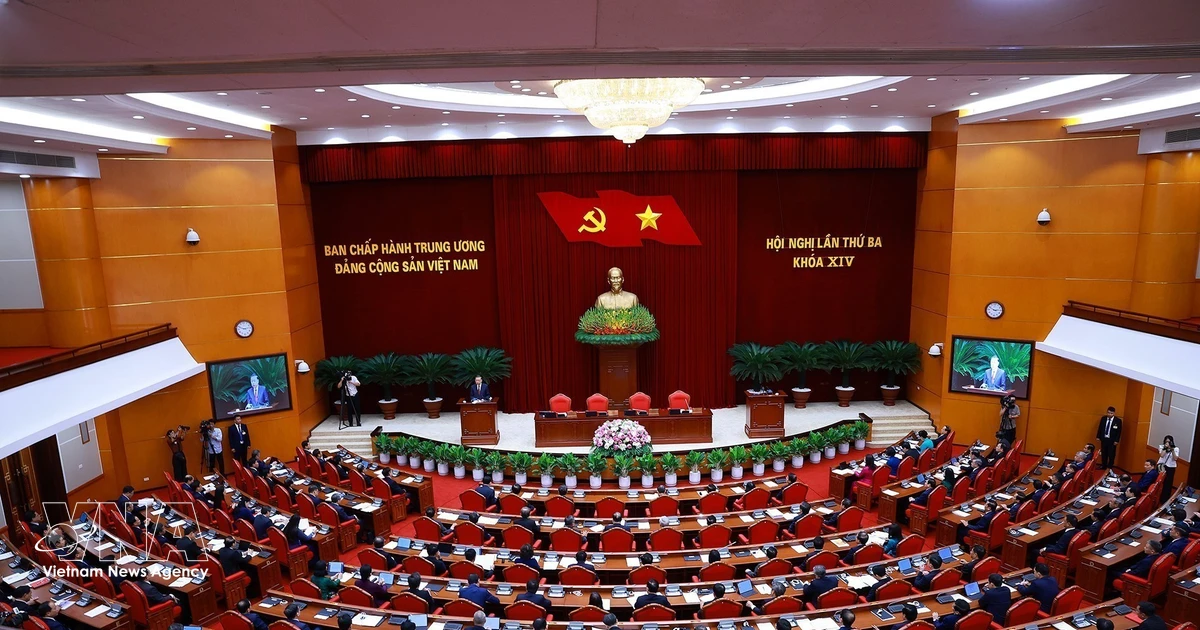
The third meeting of the 14th Party Central Committee concluded in Hanoi on the afternoon of July 24, 2026. The 14th Party Central Committee on July 22 considered proposals on building a disciplined, safe, civilised, harmonious and development-oriented society, and developing a national security strategy, as well as discussed the establishment of Quang Ninh and Bac Ninh as centrally-governed cities. The third meeting of the 14th Party Central Committee opened in Hanoi on the morning of July 20, 2026. The following is a brief review of the day’s events as reported by the Vietnam News Agency. Amid growing geopolitical shifts that pose increasing challenges to intra-ASEAN consensus, Vietnam’s capacity to build workable common platforms has become more important than ever, particularly as Vietnam serves as a bridge among members at different levels of development and countries with differing strategic relationships with major powers, said Collins Chong Yew Keat, a foreign affairs, security and strategy analyst at the University of Malaya. ASEAN Secretary-General Kao Kim Hourn has described Vietnam as an important and constructive member of ASEAN over the past three decades, highlighting its significant contributions to the political-security, economic and socio-cultural pillars. He expressed confidence that Vietnam will continue playing an active role in advancing the ASEAN Community Vision 2045. President of the Cambodian National Assembly Samdech Khuon Sudary will pay an official visit to Vietnam from July 27 - 29. Under the leadership of the Party and the unified management of the State, people-to-people diplomacy will continue to be a sustainable bridge of friendship, an important channel for converging resources, spreading soft power, and protecting national interests, contributing to building the overall strength of Vietnamese diplomacy in the new era of development. More than a year after Vietnam embarked on its sweeping administrative restructuring, the country's governance system has undergone significant changes. The administrative apparatus at all levels has been streamlined, intermediate layers reduced, and the functions, responsibilities and authority of state agencies gradually clarified. Greater decentralisation has also strengthened the role of grassroots authorities. Vietnam is commited to responsible natural resource governance and stands ready to work closely with international partners to ensure natural resources become a driver of peace, prosperity and sustainable development. Science and technology are playing an increasingly important role in identifying fallen soldiers' remains. In particular, next-generation gene sequencing technologies have opened new possibilities by significantly improving the ability to identify severely degraded DNA samples. The following is a list of selected news summaries reported last night by the Vietnam News Agency. Hang affirmed Vietnam regards the US as one of its leading important partners, noting that bilateral relations are built on a solid foundation and hold significant potential for further development. Vietnamese Minister of Foreign Affairs Le Hoai Trung held separate bilateral meetings with Philippine Secretary of Foreign Affairs Maria Theresa Lazaro, Vice-President of the European Commission and EU High Representative for Foreign Affairs and Security Policy Kaja Kallas, and Norwegian Minister of Foreign Affairs Espen Barth Eide, on the sidelines of the 59th ASEAN Foreign Ministers' Meeting (AMM-59) and related meetings in the Philippines on July 23. At ASED 14, the ASEAN Education Work Plan 2026–2030 was launched, setting out the region’s shared priorities for building inclusive, comprehensive and transformative education systems. The plan focuses on nurturing resilient and well-rounded individuals, developing a highly skilled and competitive workforce, and strengthening a common ASEAN identity rooted in shared values. In its capacity as co-chair in 2025, Vietnam worked closely with the RoK and the Mekong countries to maintain high-level exchanges, enhance the effectiveness of the Mekong–RoK Business Forum, organise the Mekong–RoK Forum for the first time to share project outcomes and implementation experience, and promote innovative solutions in water resource management through the third Mekong–RoK Water Forum. Vietnamese Minister of Foreign Affairs Le Hoai Trung stressed the importance of maintaining peace and stability and upholding international law and commonly accepted norms of conduct across all regions, including the East Sea. Vietnamese Minister of Foreign Affairs Le Hoai Trung affirmed that ASEAN would continue working with China to fully and effectively implement the Declaration on the Conduct of Parties in the East Sea (DOC) and to conclude at an early date a substantive and effective Code of Conduct in the East Sea (COC) that is consistent with international law, particularly the 1982 United Nations Convention on the Law of the Sea (UNCLOS). The Party Central Committee on July 23 discussed a proposal to transfer responsibility for giving advice on mass mobilisation work from the Party Central Committee's Commission for Information, Education and Mass Mobilisation to the Party Committee of the Vietnam Fatherland Front and central mass organisations, as well as a proposal to rename the Commission for Information, Education and Mass Mobilisation as the Commission for Information and Education. Responding to a reporter's question about recent clashes around Bai Co May (internationally known as Second Thomas Shoal) in the East Sea, Hang said Vietnam urged the parties concerned to act with restraint, respect the sovereign rights and jurisdiction of coastal states over their exclusive economic zones and continental shelves as established in accordance with the 1982 United Nations Convention on the Law of the Sea (UNCLOS), and fully and effectively implement the DOC. The CPV and CPC have maintained direct interactions, particularly in relation to their respective theories of reform and the formulation of many current policies, enabling them to learn from each other’s experience. At the conference, Hoang Trung Dung, Member of the Party Central Committee, Vice Chairman of the Party Central Committee’s Organisation Commission, announced five decisions on personnel assignments. Copyright, VietnamPlus, Vietnam News Agency (VNA) Editor-in-chief, Mr. Tran Tien Duan.
Original source
VietnamPlus English