Vietnam Streamlines Administration: Thai Nguyen Province Reduces Village Units by 55%
Politics
2026年7月18日
5
Nhan Dan
Relations
🇻🇳Vietnam🇹🇭Thailand🇯🇵Japan

General articles are free for 24 hours after publish.

Vietnam Streamlines Administration: Thai Nguyen Province Reduces Village Units by 55%

Share
AI Summary

Vietnam's northern Thai Nguyen province has reduced its village and residential units by over 55% by June 2026 through a reorganization and merger initiative. This effort aims to enhance local governance efficiency and improve public services, aligning with national administrative streamlining goals.

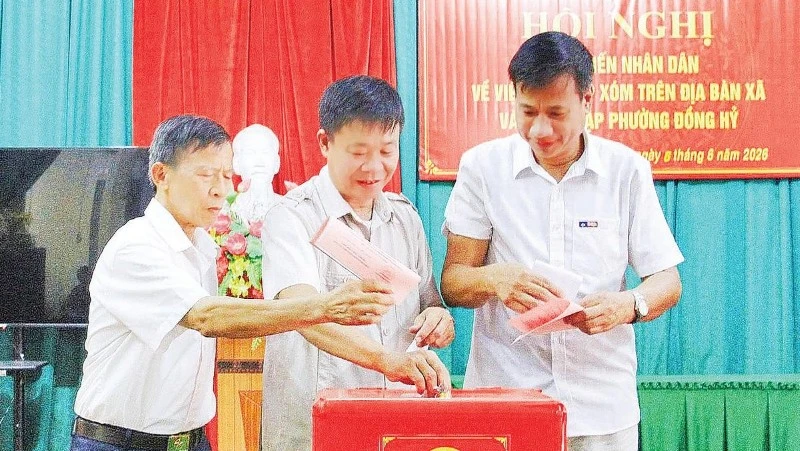
Thai Nguyen province in northern Vietnam has significantly streamlined its administrative structure by merging and reorganizing its village and residential units. By the end of June 2026, the province successfully reduced the number of these local administrative units by over 55%. This initiative is part of a broader national effort to enhance the efficiency of local governance and improve public services. According to the Department of Home Affairs of Thai Nguyen, this reorganization involved a large scale of mergers, directly impacting community organization, cultural identity, grassroots political systems, and the structure of non-specialized personnel. The province's objective is not merely to reduce the number of administrative bodies but to elevate the effectiveness of grassroots management, foster community self-governance, standardize the qualifications of local officials, and ultimately provide better services to the populace. The implementation process emphasized prudence, ensuring the maintenance of political stability, social order, the rights of citizens, and the legitimate interests of grassroots officials. For example, in Trai Cau commune, 24 existing villages were consolidated into 10 new residential groups. A referendum indicated a strong consensus, with 99.63% of household representatives approving the merger plan and the new names for the residential groups. This move also aligns with Trai Cau commune's preparation for its future elevation to Trai Cau ward status. Dao Trong Khanh, Vice Chairman of the People's Committee of Trai Cau commune, stated, "The Party Committee and the People's Committee have organized numerous meetings to discuss the merger and reorganization of villages. Our goal is not only to reduce the number but also to ensure geographical proximity, cultural and customary similarities, convenient transportation, and community cohesion, with a particular emphasis on personnel development." By the end of June 2026, nearly 95% of household representatives across Thai Nguyen province had endorsed the merger plans and new designations. This resulted in the establishment of 1,403 new village and residential units, a reduction of 1,742 from the previous 3,145 units, marking a 55.39% decrease. However, 56 village and residential units (3.99%) that did not meet the standards were retained due to special circumstances, such as their location in mountainous or ethnic minority areas, where preserving historical traditions, culture, religion, national defense, security, and local unity and stability is paramount. Following the reorganization, Party organizations, village and residential group leaders, heads of community activities committees, mass organizations, mediation teams, and local security forces have been reconstituted. Community digital technology teams and self-governance models commenced operations in July 2026, ensuring continuity and no disruption to residents' daily lives and work. In late June 2026, the Thai Nguyen Provincial People's Council issued Resolution No. 42/2026/NQ-HĐND, stipulating the allowance rates for Party branch secretaries, village and residential group leaders, and heads of community activities committees. The province also directed relevant agencies to expedite the review of employment histories, allowances received, and social and health insurance periods for individuals not continuing in their roles, to ensure timely and appropriate policy implementation and prevent any discontent. Local Party committees and authorities indicate that the larger scale of the reorganized village and residential units necessitates higher qualifications for leadership positions. Consequently, training programs to enhance the capabilities of Party branch secretaries, village and residential group leaders, and heads of community activities committees are deemed essential to meet the demands of the new era. Furthermore, a unified directive on the application of streamlined personnel policies for non-specialized staff departing due to the reorganization is urgently needed to facilitate timely and accurate benefit settlements for affected individuals.

0

Original source

Nhan Dan

原文を読む