General articles are free for 24 hours after publish.
Ex-Chief Justices Question 16-Vote Threshold in Impeachment Trial
Former Philippine Chief Justices have raised questions about the fixed 16-vote threshold for convicting an impeached official, arguing that the constitutional requirement of two-thirds of the Senate might be interpreted differently, depending on the number of senators present and able to vote.
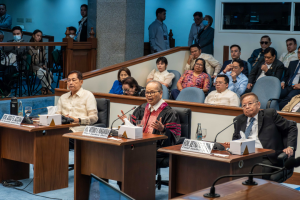
THREE retired chief justices told the Senate impeachment court that the two-thirds threshold for convicting an impeachable official should not necessarily be fixed at 16 votes, while a retired associate justice maintained that the Constitution requires two-thirds of all 24 Senate members. The Senate impeachment court on Wednesday heard from retired Chief Justices Artemio V. Panganiban, Reynato S. Puno and Hilario G. Davide, Jr., and retired Associate Justice Adolfo S. Azcuna, who were invited as friends of the court to weigh the 16-vote requirement for Vice-President Sara Duterte-Carpio’s conviction. Mr. Davide, who submitted a legal memorandum instead of appearing before the court, argued that the two-thirds requirement should be based on senators who are legally and physically capable of voting rather than automatically on all 24 members of the Senate. “Clearly then, the basis of computing the two-thirds must be the number of senators who are qualified to vote, not the 24 in the present Senate,” according to his memorandum read by impeachment court clerk Renato N. Bantug, Jr. Mr. Panganiban said Article XI, Section 3(6) of the 1987 Constitution could be interpreted through a literal reading of the text or by considering the purpose of the provision. “The Senate has 24 members; two-thirds of 24 is mathematically 16. Therefore, 16 votes are necessary to convict,” he said, but added that mathematics is an exact science in the abstract but does not always account for reality. “For example, one small drop of water, when put together with another small drop of water, may become in reality one bigger drop of water,” he said. “Reality sometimes changes the denominator in mathematics.” Mr. Panganiban stressed the importance of active participation by senator-judges in the trial, saying they must independently evaluate the evidence before exercising their constitutional responsibility. “I respectfully submit that active participation and independent evaluation of the evidence are essential to discharge the Senate and the senators’ constitutional responsibility,” he said, calling for a commonsensical interpretation of the Constitution. He also questioned whether senators who are unable to participate in the trial because they are abroad, detained, hospitalized or otherwise absent should be allowed to cast a final vote despite not having evaluated witnesses, documents and testimonies. Mr. Puno likewise argued that the impeachment court has the authority to interpret the two-thirds requirement and that the 16-vote threshold should not necessarily be treated as fixed. “It is inappropriate to give Article XI, Section 3(6), a standalone literal reading,” he told the impeachment court. “If we give this kind of reading to Article XI, Section 3(6), the threshold of 16 senators to convict will be fixed and immutable.” He noted that if the Constitution intended to set the threshold at 16 votes, it could have specified the number rather than using the fraction “two-thirds.” Mr. Azcuna took the opposite position, saying the two-thirds requirement based on all members of the Senate is a constitutional safeguard against partisan impeachment convictions. “Basing the denominator on only those who actually participate and are present can effectively reduce the two-thirds to a simple majority,” Mr. Azcuna said. “This humble representation sustains the view that no person shall be convicted in an impeachment case without the concurrence of two-thirds of all the members of the Senate.” If only 20 senators were able to participate, two-thirds would amount to 13 or 14 votes, he said, effectively lowering the requirement to a simple majority of the full chamber. Mr. Azcuna said this would undermine the purpose of the supermajority requirement. “The framers of the ‘supermajority impeachment clause’ were reacting to a specific fear that impeachment could become a tool for a transient legislative majority to remove a political rival or an official from a disfavored party, effectively overturning an election result through legislative fiat rather than through the ballot box,” he said. The Senate impeachment court is considering Senator-Judge Erwin T. Tulfo’s challenge to Presiding Officer Francis “Chiz” G. Escudero’s earlier ruling that 16 votes, or two-thirds of the full 24-member Senate, are required for conviction. Until the court rules otherwise, the 16-vote threshold remains in effect. The House prosecution and Ms. Duterte’s defense are scheduled to present their arguments on the threshold issue on Sept. 23, after which the senator-judges are expected to resolve the question. — Kaela Patricia B. Gabriel
Original source
BusinessWorld Nation