General articles are free for 24 hours after publish.
Angkor's Bakong Temple Undergoes Archaeological Excavation of Western Approach Bridge Ahead of Restoration
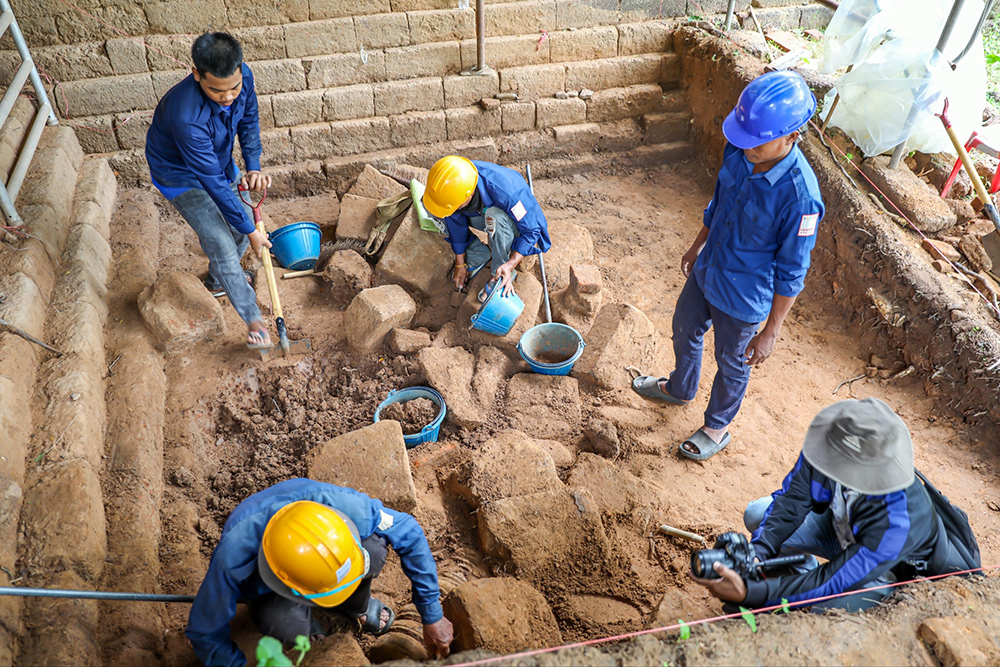
Archaeological excavations have commenced on the western approach bridge of Bakong Temple in Cambodia's Angkor complex. The initiative aims to gather technical data for restoration and aesthetic improvement by thoroughly examining the structure of the bridge, which has deteriorated over more than 1,000 years.
SIEM REAP-- Experts from the Apsara National Authority are conducting archaeological excavations along the western approach bridge of Bakong Temple. This initiative aims to gather technical data and study the overall condition of the structure before proceeding with restoration and aesthetic enhancement projects. Mr. Saray Kimhuol, Head of the Roluos Area Temple Conservation Department at the Department of Conservation of Temples and Archaeology, stated that the western approach bridge of Bakong Temple measures 70 meters in length, 12 meters in width, and 4 meters in height. Before commencing actual restoration work, the team must first conduct archaeological excavations to fully understand the original structure and to collect fragments of sandstone blocks and Naga (dragon) sculptures that have collapsed and become buried in the approach. Over the past 1,000 years, the bridge's structure has suffered severe damage. The retaining walls on both sides, made of sandstone, have almost entirely collapsed. Furthermore, most of the Naga sculptures lining the sides of the bridge have been lost from their original positions. The primary causes of this damage are attributed to the invasive roots of trees and soil erosion due to rainfall during each monsoon season. Dr. Chea Socheat, an archaeologist and the person in charge of the excavation at this site, emphasized that the western approach bridge of Bakong Temple has never undergone archaeological research or restoration in the past. Therefore, the current excavation is crucial for collecting comprehensive data in accordance with the recommendations and technical standards of the International Coordinating Committee for the Protection and Development of Historical Sites of Angkor and Sambor Prei Kuk. The team has prepared an action plan and excavation techniques, initially designating four excavation points: the northeast, southeast, southwest, and northwest corners. Subsequently, excavations will continue at the central and western sections of the approach. The objectives of this excavation are threefold: first, to study the foundation structure of the approach, the thickness of the sandstone retaining walls, and the soil compaction techniques used in the roadbed. Second, to examine the structural relationship between the approach and the descent stairs, as well as the various stages of construction. Third, to investigate the surface of the approach, determining whether it was paved with sandstone, sandstone blocks, or simply compacted earth, as no clear traces remain today. Finally, the team aims to locate and retrieve sandstone fragments and sculptures of Naga bodies, along with two Garuda sculptures that once stood on either side of the Naga's tail at the eastern end of the approach, of which only the pedestals currently remain, for reassembly and return to their original locations. Source: AKP Khmer
Original source
AKP Khmer