General articles are free for 24 hours after publish.
China, North Korea Exchange High-Level Visits Amid Geopolitical Realignment
A series of high-level exchanges between China and North Korea signals a deepening of bilateral ties and potentially stronger geopolitical alignment. Notably, China appears to be shifting its stance towards North Korea, which is also strengthening its relationship with Russia.
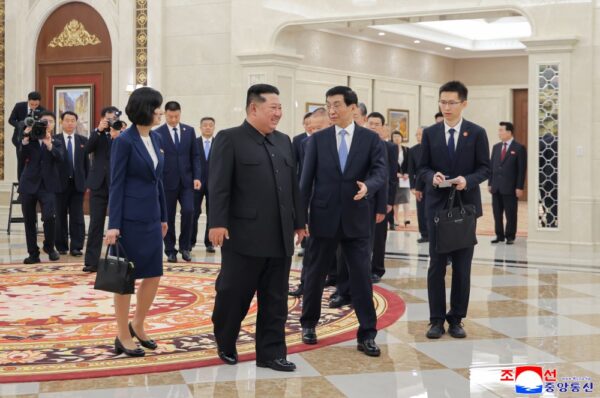
A string of high-level exchanges between China and North Korea is underway, signaling a deepening of bilateral ties and a potential strengthening of geopolitical alignment. This comes as Beijing appears to be adapting its stance amidst Pyongyang's deepening relationship with Moscow. On July 15, Jo Yong Won, secretary of the Central Committee of the Workers’ Party of Korea, met with Wang Huning, a member of the Politburo Standing Committee of the Chinese Communist Party, in Pyongyang. According to the Korean Central News Agency (KCNA), Jo stated that "the ever-changing present international political situation has required the two countries to further strengthen the militant unity, support and solidarity and steadily intensify and develop the friendly and cooperation relations for the victorious advance of the common cause of socialism in conformity with the basic spirit of the DPRK-China Treaty of Friendship, Cooperation and Mutual Assistance." As Pyongyang seeks to enhance its ties with Beijing, Jo reiterated Pyongyang’s will to develop bilateral relations "in a many-sided way." Wang also met with North Korean leader Kim Jong Un, according to photos published by KCNA, though no detailed report on these discussions had been issued as of this writing. Just days before Wang's visit to Pyongyang, a top North Korean official, Pak Thae Song, premier of the Cabinet, made a trip to Beijing from July 10-12. While there, Pak met with China’s top leader Xi Jinping. These reciprocal visits came just a month after Xi visited Pyongyang to hold a summit meeting with Kim. It was Xi’s first visit to North Korea in seven years. Officially, the purpose of all these exchanges is to commemorate the 65th anniversary of the China-DPRK Treaty of Friendship, Cooperation and Mutual Assistance. While in Pyongyang, Wang said that "the conclusion of the treaty between China and the DPRK laid a legal foundation to consolidate the militant friendship formed at the cost of blood," according to KCNA. However, the 60th anniversary of the treaty passed without such fanfare, making it clear the current geopolitical environment is the main driver. Xi made his North Korea trip shortly after he hosted both U.S. President Donald Trump and Russian President Vladimir Putin in Beijing. The sequence put the Korean Peninsula squarely inside China’s broader balancing act among the major powers. During their summit in Pyongyang, Xi and Kim agreed to strengthen their "strategic relationship" with socialist principles. Importantly, Xi refrained from commenting on North Korea’s possession and development of nuclear weapons. Chinese readouts made no mention of denuclearization, even as a long-term goal, which many took as de facto recognition of North Korea as a nuclear-armed state. In his talks with Pak, the North Korean premier, Xi once again made no mention of nuclear issues. Instead, the Chinese leader urged both countries to "strengthen strategic coordination, resolutely defend our respective sovereignty, security and development interests, and create a favorable external environment for both countries," according to a readout from the Chinese Foreign Ministry. In the wake of Russia’s invasion of Ukraine, ties between Moscow and Pyongyang have blossomed. North Korea provided ammunition and deployed its troops to Russia to support Moscow’s operation in Ukraine. In exchange, it has widely been speculated that Pyongyang might have received economic assistance and sensitive missile technology from Moscow. China had maintained a position as something of a mediator on Korean Peninsula issues since the days of the Six Party Talk. In recent months, however, Beijing seems to have shifted its stance to take the same side with North Korea, creating more space for Pyongyang to evade U.S. and U.N. economic sanctions while bolstering its ties with Beijing. As Beijing has stopped bringing up Pyongyang’s nuclear issues, the trade and cooperation between the two sides will likely be strengthened even as Washington, Seoul, and Tokyo beef up their trilateral cooperation in the region.
Original source
The Diplomat Indonesia