General articles are free for 24 hours after publish.
Taiwan Integrates Conflict Scenarios into Disaster Drills
Taiwan's annual disaster preparedness drill, simulating a major earthquake, now incorporates invasion scenarios to test its capacity for multi-system failures during conflict. The exercise aims to strengthen international cooperation and build a comprehensive national resilience framework.
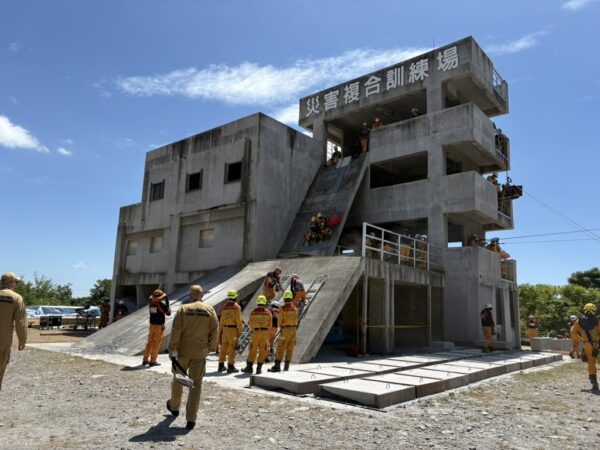
In the seaside town of Taitung, four hours from Taipei by train, Taiwan’s premier national disaster preparedness exercise simulated a response to a 7.3 magnitude earthquake – layered with variables Taiwan could face in a conflict contingency. This year’s drill marked a critical operational shift, moving past standard disaster response to stress-test Taiwan against cascading, multisystem failures alongside expanded participation from regional and international partners. The base scenario estimated damage to 43 bridges and nearly 1,800 buildings, along with 63 casualties. Search-and-rescue teams and fire departments from seven cities and counties in Taiwan conducted a full-scale mobilization southward, while everyone on Taiwan’s cellular network received mobile alerts testing the national alert system. What was once a routine annual drill has evolved into a vital benchmark for Taiwan’s ability to manage crises requiring a whole-of-society response and international assistance. Since 2018, the “921” exercise has commemorated the devastating September 21, 1999, Chi Chi earthquake, but its scale, complexity, and visibility increase each year. The evolution of the 921 exercise reflects Taiwan’s shift toward unscripted, full-scale scenarios modeled on U.S. curriculum. What used to be a photo-ready display of capabilities is now a deliberate effort to integrate civil government officials, military field medical teams, the private sector, and NGOs into a unified command system responsible for coordinating life-saving rescues, medical treatment, sheltering, and long-term recovery. Particularly notable is the Taiwanese government’s willingness to test unfamiliar concepts and navigate uncertainties in front of an international audience. The 921 exercise integrates international teams and observers, many of whom face similar natural – and geopolitical – threats. The active international participation marks a key distinction between this drill and Taiwan’s Urban Resilience exercise held in June. During this year’s 921 exercise, 180 international participants brought gear and equipment to the island, working alongside local teams for three days, including the exercise’s first overnight, 24/7 continuous operation. A Japanese Disaster Medical Assistance Team (DMAT) coordinated with six Taiwanese DMATs, formed by local hospitals and supervised by the Ministry of Health and Welfare. In an adjacent tent, American and Taiwanese medical teams simulated joint field care. Additionally, 100 international observers traveled to each exercise site to observe the capabilities on display. Beyond Taiwan’s warm hospitality during events like this, international partners get to visualize what a civilian-supported response might look like during conflict – and how they might see themselves in it. Taiwan’s Ministry of Interior aimed to establish and test a humanitarian assistance and disaster response (HADR) corridor during the 921 exercise, embedding regional allies directly into its civil resilience planning. Taiwan’s emergency responders practiced working together to salvage trapped vehicles from floodwaters in a riverbed and conducted field medical treatment alongside teams from Japan, the Philippines, and Turkiye. The exercise is also of great interest to Nordic partners like Finland, which sent firefighters to bring back lessons as they rebuild their own civil defense plans alongside a volatile neighbor. Taiwan faces strong typhoons and regular earthquakes, requiring a professional and ready emergency response mechanism. Organizers have now begun to smartly layer these exercises with wartime injects – the scripted crisis events used to test responders. One drill simulated rescuing a downed foreign fighter pilot from the mountains, transporting him to a multinational field hospital, and then airlifting him to a Taiwan Coast Guard vessel. I watched on a livestream, powered by mobile communication units, as a stretcher was lowered onto the ship off the coast. Each September, the 921 exercise grows in scale and complexity as responsibility rotates among cities and counties. Familiarizing jurisdictions with this integration is essential preparation. Taiwan sits between two tectonic plates, the Philippine Sea Plate and the Eurasian Plate, and the train from Taipei to Taitung runs through the East Rift Valley. Taitung could easily be isolated in an extreme disaster caused by an earthquake, so it’s important to test local capability. Beyond the natural disaster threat, China conducts continuous drills along the coastlines of Yilan County, where 921 took place in 2025, and Taitung County in the southeast. Equally serious for Taiwan’s preparation is practicing the mobilization of its resources and testing the HADR corridor with these potential, aggressive operations in mind. Taiwan’s government also wants to be ready to assist its neighbors, as reinforced in President Lai Ching-te’s remarks closing the exercise.
Original source
The Diplomat Indonesia