General articles are free for 24 hours after publish.
Beyond System Loss: World Bank Urges PH to Fix Costly Power Contracts for Cheaper Electricity
The World Bank identifies costly power contracts, slow renewable energy deployment, and weak grids, not just system losses, as primary drivers of high electricity prices in the Philippines. Revising contracts and promoting renewables could significantly lower rates, it suggests.
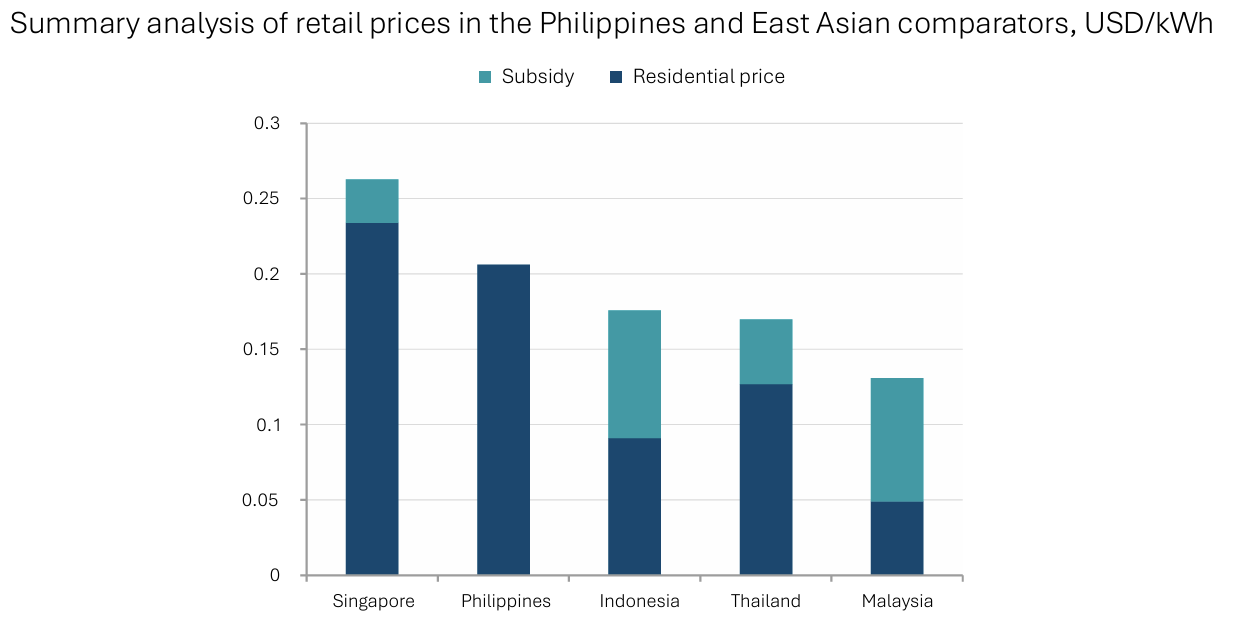
MANILA, Philippines – While policymakers are focused on reducing system losses, the World Bank says lowering electricity bills over the long term will require tackling the much larger generation cost through more competitive power contracts, faster renewable deployment, and stronger grids. Generation accounts for about two-thirds of a typical electricity bill, making it the largest component by far. Yet many distribution utilities remain tied to older contracts that were negotiated when fuel prices and electricity demand looked very different, limiting how quickly cheaper renewable energy can lower rates. Filipino households pay around $0.21 per kilowatt-hour, compared with $0.13 in Thailand, $0.09 in Indonesia, and $0.05 in Malaysia. Only Singapore, at about $0.23 per kWh, had a higher residential rate among the countries compared in the World Bank’s latest Philippines Economic Update. Part of the difference is that some neighboring governments heavily subsidize electricity. But even after the World Bank added those subsidies back into regional prices, Philippine residential rates were still around 57% higher than Malaysia’s and 17% higher than Indonesia’s. “It’s not a subsidy story,” World Bank senior country economist Jaffar Al-Rikabi said during the report’s launch on Monday, August 3. “It’s how do we lower electricity prices and boost growth story.” The World Bank traced expensive electricity to several problems that reinforce one another, such as heavy dependence on imported fuel, power contracts carrying older and higher costs, limited competition in electricity generation and in the procurement of power, renewable energy projects that remain unfinished, and a grid that makes it difficult to move cheaper electricity efficiently across the archipelago. If the government can address these bottlenecks, the Philippines stands to gain immensely. Under the World Bank’s faster implementation scenario, the average rate could fall to around P9.80 per kWh, compared with P13.60 if delays persist. The reforms could also generate about 161,000 additional jobs, leave roughly 730,000 fewer Filipinos in poverty, and raise GDP by more than 1% by 2030. “We estimate that residential tariffs, for example, in Luzon over 2026 to 2030 period can fall by as much as 28% with very fast effective implementation of the issues highlighted here,” Al-Rikabi said. Meralco’s old contracts Most electricity is not bought through the Wholesale Electricity Spot Market (WESM) where generators compete to sell power based on short-term conditions. Distribution utilities instead secure the bulk of their supply through medium- and long-term power supply agreements (PSAs). For a large utility whose procurement mix closely resembles Meralco’s, PSAs accounted for around 70% of electricity purchases from January to March 2026, according to an analysis by the World Bank. Older independent power producers supplied another 22%, while less than 8% came from WESM. The World Bank did not identify the representative utility by name. Meralco does not retain the generation charge as distribution income. It collects the amount from customers and passes it on to generators. But as the country’s largest distribution utility, it plays a central role in choosing the PSAs and suppliers behind the largest part of millions of customers’ bills. Must Watch How much could you save if system loss charges are removed from your Meralco bill? “Going forward, as we think about new generation of PSAs, for example, how do we ensure these are sort of priced in a way that is competitive?” Al-Rikabi said. PSAs can provide reliable supply and protection from sudden spot market spikes. But they can also preserve costs and conditions agreed upon years ago, including capacity payments and clauses that pass fuel and foreign exchange risks to customers. “Many of them [were negotiated] decades ago,” Al-Rikabi said. “The energy markets have shifted really quite dramatically.” Renewable energy, for instance, was not yet the feasible, low cost option it is today when some older agreements were signed. The World Bank found that realized PSA prices were above its estimated cost benchmarks across gas, coal, and solar. Solar and coal contract prices were around 1.5 times their respective levelized cost of electricity, while gas was around twice the benchmark. The remaining challenge, Al-Rikabi said, is implementation. Procurement rules have already been tightened. PSAs for captive consumers must undergo competitive selection, while the Energy Regulatory Commission reviews tariffs, costs, and how risks are divided between generators, utilities, and customers. The government will now have its hands full ensuring that these stronger rules on paper actually produce competitive contracts. How do we fix our broken electricity system? Cheap energy stuck in the pipeline Renewable energy could reduce reliance on imported fuels and bring down generation costs. The Philippines has opened the sector to greater foreign investment and awarded large volumes of capacity through its Green Energy Auction Program. But awarding a project does not mean it’s already producing electricity. Less than 20% of the renewable capacity awarded in the first two auctions had been completed, according to the World Bank. Al-Rikabi said around 68% of projects awarded during the first auction had been suspended. He pointed to difficulties involving land use, permits, governance, coordination with local governments, and grid connections. “This is an execution story,” Al-Rikabi said. One need only look at Solar Philippines, founded by Batangas Representative Leandro Leviste, who now faces graft and plunder complaints. The Department of Energy terminated several renewable energy service contracts linked to the company after it failed to meet project commitments. The canceled contracts represented around 11,428 megawatts, or roughly 64% of all renewable capacity terminated by the government in 2024 and 2025. Even a completed solar or wind farm cannot lower bills if the electricity cannot reach consumers. The World Bank found persistent congestion within Luzon and the Visayas, with the Luzon-Visayas interconnection constrained much of the time. In the Visayas and Mindanao, prices often rise in the late afternoon and evening as demand increases and the system turns to more expensive generators. – Rappler.com Must Read [Rappler’s Best] The sun sets for the Leviste son
Original source
Rappler Business