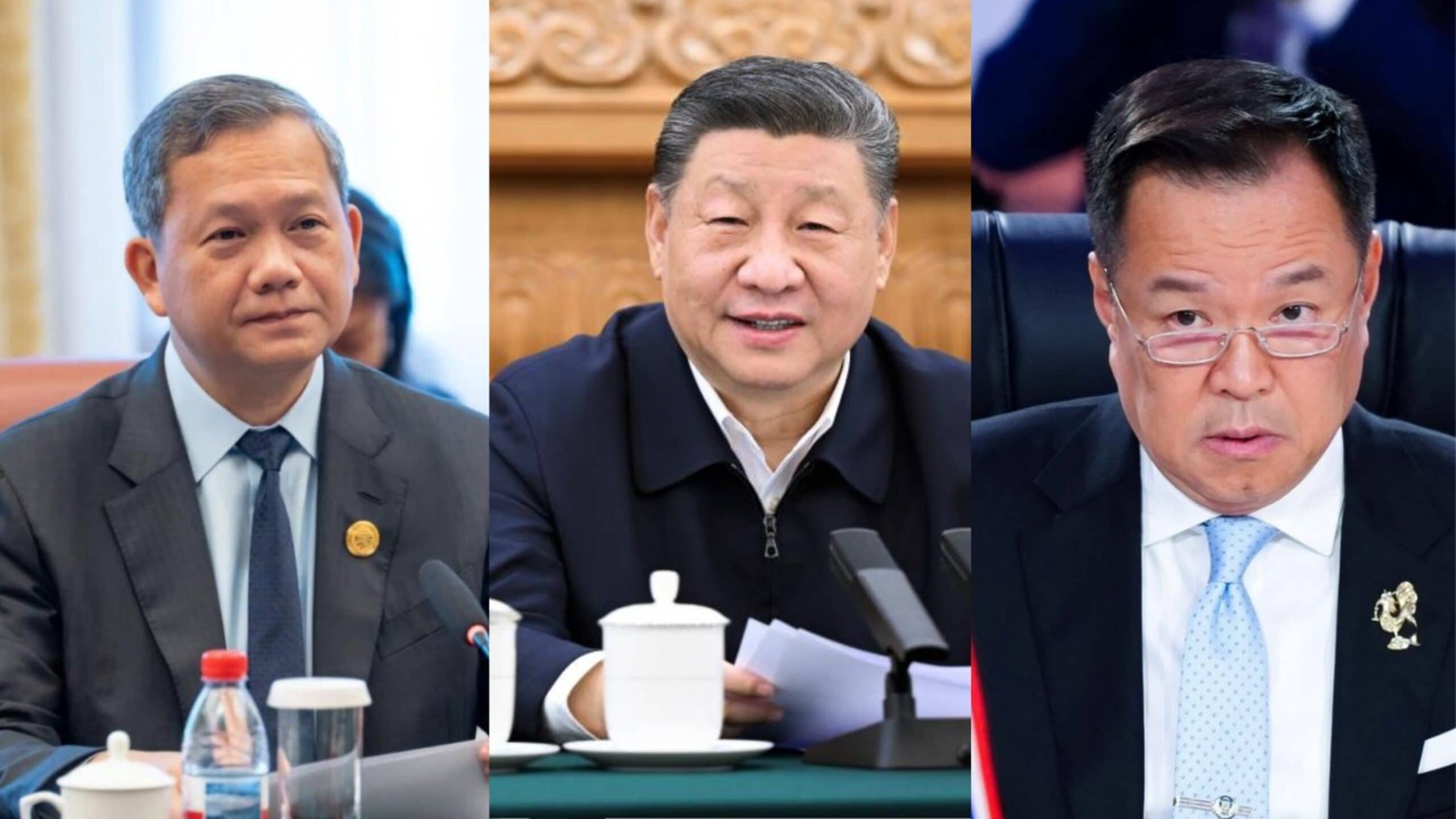
Cambodian and Thai Premiers to Meet Xi in Shanghai Amid Border Dispute Concerns
Cambodian Prime Minister Hun Manet and Thai Prime Minister Anutin Chanvirakul are set to attend the World AI Conference in Shanghai, where they will meet with Chinese President Xi Jinping. While China's role in mediating the Cambodia-Thailand border dispute is anticipated, political factors within Thailand are seen as a potential obstacle to progress.
Cambodian Prime Minister Hun Manet and Thai Prime Minister Anutin Chanvirakul are scheduled to attend the opening session of the World AI Conference 2026 (WAIC) in Shanghai on July 17, at the invitation of Chinese President Xi Jinping. However, attention is focused on whether China will play a role in pushing for border talks between the two nations, which have not met at the negotiating table since December. Prime Minister Manet will be accompanied on his July 15-17 trip by Foreign Minister Prak Sokhonn, Defence Minister Tea Seiha, and Sun Chanthol, First Vice-Chairman of the Council for the Development of Cambodia (CDC). Meanwhile, Thai Prime Minister Anutin is reportedly joined by his Foreign Minister, Sihasak Phuangketkeow. Both prime ministers are scheduled to meet with President Xi Jinping, as well as Premier Li Qiang. A statement from the Cambodian Ministry of Foreign Affairs said, "This working visit highlights the shared commitment between Cambodia and China to deepen their long-standing friendship and promote mutually beneficial cooperation." It added, "The visit also serves as a new driving force to advance the implementation of the Comprehensive Strategic Partnership of Cooperation, enhance the Diamond Cooperation Framework and build an all-weather Cambodia-China Community with a Shared Future in the new era." The Thai Ministry of Foreign Affairs also issued a release stating, "The visit is to further strengthen the Thailand-China Comprehensive Strategic Cooperative Partnership for the mutual benefit of the two peoples." Both Prime Ministers Manet and Anutin attended the 3rd ASEAN Future Forum (AFF 2026) held in Hanoi, Vietnam, in early June. While the two leaders shook hands for the cameras, no discussions took place that addressed the ongoing border dispute. Analysts suggest that China will leverage its position as a major trading partner of both nations to push for a resolution. However, Kin Phea, Director of the International Relations Institute at the Royal Academy of Cambodia, points to those "who actually hold power" in Thailand as the main obstacle to finding a resolution. "The Thai military has not implemented the measures that their civilian government agreed with their Cambodian counterparts. They allow the military to arbitrarily carry out their actions, including encroaching on Cambodian sovereign territory," Phea stated. "China should push for both countries to meet for talks and solve the issue peacefully, through diplomatic paths or other consultation efforts, based on international law. China should play a more active role as an arbitrator so that both countries can solve their conflict, end tensions, and return to normalcy." He noted that these intentions were declared at the China-brokered Fuxian Consensus reached in December 2025. "Thailand must be forced to respect the consensus. They must withdraw their troops from occupied areas, return to the negotiating table, and work with the Joint Boundary Commission (JBC) without further delay," Phea added. Several parts of Cambodia remain under Thai occupation, with approximately 20,000 Cambodian civilians unable to return to their homes.
多角的分析
上海AI会議への両国首脳の参加は、中国が主導するデジタル経済圏への影響力拡大戦略の一環と見られる。カンボジアとタイは、中国の巨大な市場と技術へのアクセスを求めており、AI分野での協力は経済成長の新たなフロンティアとなる可能性がある。しかし、国境問題の未解決は、両国間の物流や投資リスクに不確実性をもたらし、経済協力の深化を妨げる要因となりうる。
中国との関係強化は、カンボジアおよびタイにとって投資誘致の機会となりうるが、国境紛争の長期化は、特に国境地域周辺への投資リスクを高める。投資家は、地政学的な安定性と法的な確実性を重視するため、中国が仲介役として実質的な進展をもたらすかどうかが、今後の投資判断の鍵となる。AI分野での協力は新たな投資機会を生む可能性があるが、インフラや人材育成への投資も不可欠となる。
タイによるカンボジア領土の占領は、国境地域に住む約2万人のカンボジア市民の生活に直接的な影響を与えている。彼らは故郷に帰れず、農業や生計の手段を奪われている。国境問題の未解決は、両国民間の感情的な対立を生む可能性もあり、平和的な解決が強く望まれている。AI会議への参加は、両国の技術発展に寄与する可能性があるが、社会的な安定なくして真の恩恵は得られない。
国境紛争により、カンボジア市民約2万人が故郷に戻れず、生活基盤を失っている。彼らの苦境は、両国政府、特にタイ政府による早期の解決策の実施を求めている。上海での首脳会談は、こうした市民の生活改善に向けた具体的な一歩となることが期待されるが、現時点では政治的な駆け引きに留まる可能性も否定できない。
背景・歴史的文脈
カンボジアとタイの国境紛争は、長年にわたり両国関係の火種となってきた。特に、プレア・ビヒア寺院周辺など、一部地域における領土問題は、両国間の歴史的経緯や民族感情と結びつき、複雑化している。2005年の両国間の境界画定に関する協力覚書(MOU)は、一部地域で進展が見られたものの、タイ国内の政治的混乱や軍部の影響力により、完全な履行には至っていない。2025年12月の中国仲介による「福仙合意」も、具体的な実行段階には至っていないのが現状である。
原文ソース
Phnom Penh Post