Bank Indonesia Governor's Resignation Shocks Markets, Raises Independence Questions
Economy
2026年7月28日
5
The Diplomat Indonesia

General articles are free for 24 hours after publish.

Bank Indonesia Governor's Resignation Shocks Markets, Raises Independence Questions

Share
AI Summary

Bank Indonesia Governor Perry Warjiyo has unexpectedly resigned two years before his term ends, sending shockwaves through markets and reigniting concerns about political interference in economic policymaking. The selection of his successor will be key to restoring investor confidence.

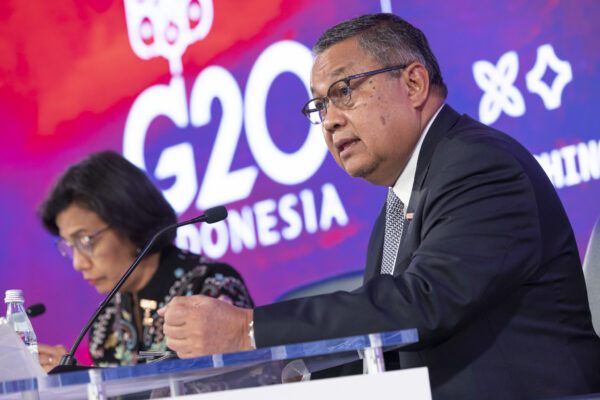
Read The Diplomat, Know The Asia-Pacific Perry Warjiyo, who has served as governor of the central bank since 2018, said that he was stepping down for “personal reasons.” Bank Indonesia Governor Perry Warjiyo (right) and Indonesian Finance Minister Sri Mulyani Indrawati speak during a G20 press briefing during the 2022 Annual Meetings at the International Monetary Fund in Washington, D.C., Oct. 13, 2022. The governor of Bank Indonesia (BI) stepped down from his post yesterday, sending a tremor through markets and prompting fresh concerns about political interference in economic policymaking. During a press conference, State Secretariat Minister Prasetyo Hadi announced Perry Warjiyo’s resignation, which comes two years before the expiry of his current term as BI governor. “As of yesterday, we officially received a letter of resignation from the Governor of BI to the President,” Prasetyo said during the press conference, accompanied by members of the BI Board of Governors, the state news agency Antara reported. “The president accepted Perry Warjiyo’s resignation and conveyed his utmost gratitude for his dedication in leading Bank Indonesia for seven years,” he added. Perry began his career at BI in 1984, and has served as governor since 2018. He cited only “personal reasons” for stepping down and did not meet President Prabowo Subianto directly before submitting his resignation, Prasetyo said. He added that Senior Deputy Governor Destry Damayanti, a former chief economist at Bank Mandiri, would serve as acting governor until a replacement governor is elected. This candidate would be chosen from a list of three candidates proposed by Prabowo, which would be forward to parliament for a “fit and proper test.” Legislators would then select one of the candidates. Perry’s departure comes at a difficult time for the Indonesian economy. The country’s currency fell to record lows this year, passing the psychological threshold of 18,000 rupiah to the U.S. dollar in June. It is now trading at a lower level than at any time since the Asian Financial Crisis of 1997-1998. The unexpected resignation set off a minor tremor in Indonesian markets. The Jakarta Stock Exchange Composite Index fell 0.5 per cent, and the rupiah slumped from around 17,935 to the U.S. dollar to 18,009 by the close of trading yesterday. The bigger issue is how Perry’s resignation might compound investors’ growing skepticism about the Prabowo administration’s economic stewardship. BI has been under pressure to support Prabowo’s economic policy, which aims to achieve an annual GDP growth of 8 percent per year for the rest of his term. This has included high-spending populist policies, including a multibillion-dollar free meal program, which have widened the fiscal deficit and pushed it toward its legally mandated ceiling of 3 percent of GDP. The former general has also increased the state’s involvement in the Indonesian economy in a bid to maximize the country’s return from natural resources and international trade. These policies, along with the firing of respected Finance Minister Sri Mulyani Indrawati last September, have unsettled investors and undermined Indonesia’s hard-won reputation for fiscal conservatism. In March, both Moody’s and Fitch announced ratings outlook downgrades for Indonesia, with the latter citing the “increasing ⁠policy uncertainty and erosion of Indonesia’s policy mix consistency and credibility” and the “growing centralization of policymaking authority.” This came shortly after the global index provider MSCI threatened to downgrade Indonesia to “frontier market” status due to a number of transparency concerns in its stock market, including the high concentration of ownership in certain companies and the limited “free float” of shares. MSCI will announce its verdict in November. Perry’s surprise exit only compounds these concerns, and investors will be watching closely to see who is chosen to replace him. As Channel News Asia reported, “the majority of his five deputies are long-time central bankers with at least 30 years of experience working for Bank Indonesia.” One of the exceptions is Thomas Djiwandono, 54, a former journalist, financial analyst, consultant, and politician for the Gerindra Party, who also happens to be a nephew of President Prabowo. Prabowo appointed Djiwandono as deputy finance minister in October 2024. He then nominated him as BI deputy governor in February of this year, an appointment that prompted concerns about nepotism and political influence over BI. While Prabowo has not given any indication that he wishes to appoint his nephew to lead the central bank, the question is likely to linger over the transition period. Indonesian media outlets have reported recently that Prabowo may also look beyond BI for the central bank’s next governor, with current Finance Minister Purbaya Yudhi Sadewa a potential candidate, CNA reported. While the Indonesian government said that the leadership transition at BI would not disrupt monetary ​policy or economic stability, and Interim Governor Destry said yesterday that the central bank would “always ensure the continuity of its duties,” the Prabowo administration will have to go to extra lengths to overcome the perception of political interference. “What must now be anticipated after Perry’s resignation is the weakening of Bank Indonesia’s independence,” Bhima Yudhistira ⁠Adhinegara, executive director of the Center of Economic and Law Studies, told Reuters. “Restoring investor confidence will certainly not be easy, especially since the direction of monetary policy is ​under executive control.” Subscribe today and join thousands of diplomats, analysts, policy professionals and business readers who rely on The Diplomat for expert Asia-Pacific coverage. Get unlimited access to in-depth analysis you won't find anywhere else, from South China Sea tensions to ASEAN diplomacy to India-Pakistan relations. More than 5,000 articles a year. Already have an account? Log in. Sebastian Strangio is Southeast Asia editor at The Diplomat. Get briefed on the story of the week, and developing stories to watch across the Asia-Pacific.

0

Original source

The Diplomat Indonesia

原文を読む