General articles are free for 24 hours after publish.
Vietnam Eyes Deeper Cooperation with Russia's Far East in Economy and Investment
Vietnam's Finance Minister highlighted the need to strengthen economic, trade, and investment cooperation with Russia at the Eastern Economic Forum, noting current trade volumes are modest compared to bilateral potential. He called for concrete project promotion and resolution of logistics and financial challenges.
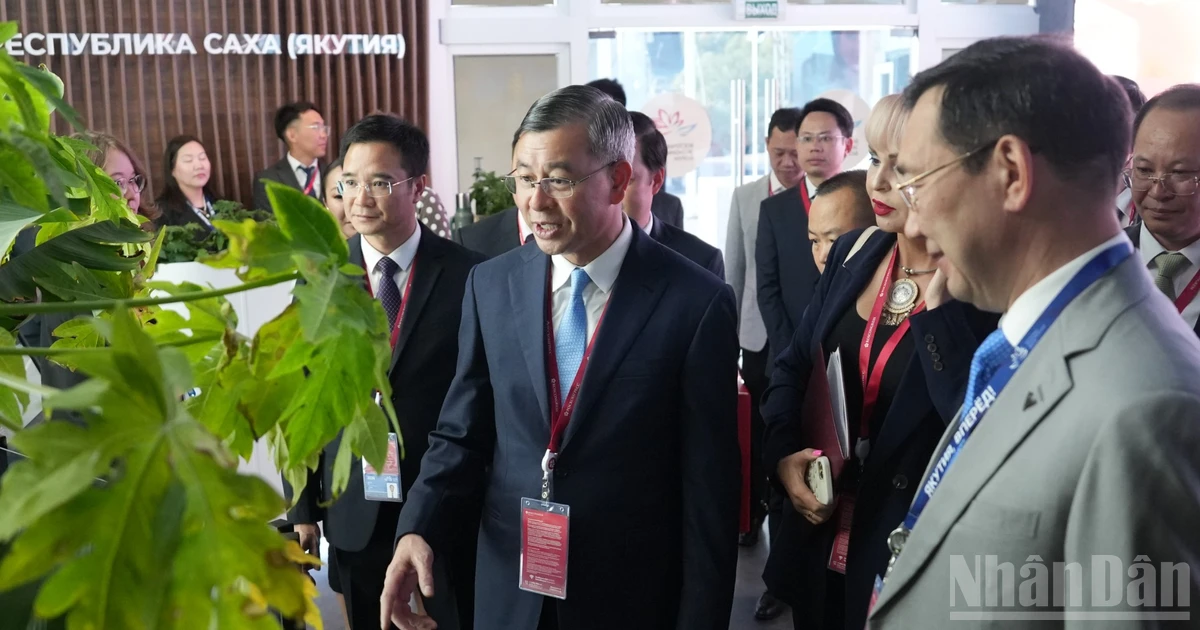
Vietnamese Finance Minister Ngo Van Tuan, leading the Vietnamese delegation at the Eastern Economic Forum 2026 in Vladivostok, Russia, from September 1-4, has emphasized the need to elevate bilateral cooperation, particularly in economic, trade, and investment sectors. In an interview with Nhan Dan correspondent in Russia, Minister Tuan highlighted the traditional good relationship between Vietnam and Russia, recalling the significant support from the former Soviet Union and present-day Russia for Vietnam's struggle for independence and national unification, as well as its economic development. However, he acknowledged that economic ties, especially in trade and investment, remain modest. Despite an average annual increase of approximately 10.8% in bilateral trade from 2016 to 2025, following the upgrade of relations to a comprehensive strategic partnership and the signing of the Free Trade Agreement between Vietnam and the Eurasian Economic Union (EAEU), the total trade turnover between Vietnam and Russia reached only $4.7 billion in 2025. This figure is considerably low compared to Vietnam's overall trade of about $930 billion. "Starting from the beginning of the new term, we show a very high determination to elevate economic relations to be commensurate with the political and diplomatic relations between the two countries," Minister Tuan stated. Regarding opportunities arising from Russia's Far East development policy and its increased engagement with the Asia-Pacific region, Minister Tuan expressed confidence that the forum would open significant opportunities for Vietnamese and other Asian businesses. He noted the Far East's vast area of approximately 6 million square kilometers, rich in mineral and natural resources, with substantial potential in agriculture, fisheries, and forestry. Currently, Vietnam's major investment in the region is a project by TH Group with a modest capital of about $22 million. The minister pointed out the region's imbalance: 6 million square kilometers with only about 6 million people, leading to a shortage of resources for development activities. Conversely, Vietnam is entering a phase of rapid economic development with a goal of double-digit growth. The potentials and strengths of Russia and its Far East align well with Vietnam's development needs. Areas like agriculture, timber exploitation, and mineral extraction offer scope for enhanced cooperation. Vietnam's large, diligent, and skilled population of over 100 million people can also be a complementary resource. The long-standing traditional relationship provides a solid foundation. The traditional cargo routes from Vladivostok to Hai Phong and Ho Chi Minh City, taking about 7-10 days, represent a logistical advantage and open numerous cooperation opportunities. Discussions also covered the development of artificial intelligence (AI), digital transformation, and the application of IT in various aspects of life and economic activities, which Minister Tuan believes offer substantial opportunities for bilateral collaboration. "The issue is to enhance exchanges, gain a clearer understanding of each other's markets and legal systems, and consolidate strategic trust. Specifically, we need to find a large, leading investment project that can drive further cooperation activities," he said. The minister expressed his belief that trade and investment relations between Vietnam and Russia in general, and between Vietnam and the Russian Far East in particular, will witness new developments. When asked about specific priorities to materialize these potentials and opportunities, Minister Tuan proposed five key solution groups: First, enhance the effectiveness of the Vietnam-Russia Intergovernmental Cooperation Committee. Instead of waiting for bottlenecks to arise, a concrete cooperation plan should be developed with regular evaluations. Specific objectives and expected outcomes for each project, such as targeted annual and quarterly export-import growth rates, need to be defined, along with analysis of achievements and shortcomings to devise solutions. Second, effectively leverage the Free Trade Agreement between Vietnam and the EAEU. Third, strengthen information exchange and mutual understanding of markets and legal systems. Fourth, resolve bottlenecks in connectivity between the banking and payment systems of the two countries. Fifth, enhance the connectivity of transport and logistics systems. Representatives from the Vietnam Maritime Corporation are participating, seeking solutions for developing transport based on logistics technology, warehousing, and cold storage systems. Minister Tuan concluded by expressing his gratitude and optimism for the future of bilateral economic ties. Source: Nhan Dan
Original source
Nhan Dan