General articles are free for 24 hours after publish.
Min Aung Hlaing, Aung San Suu Kyi, and the language of authoritarian reality
Guest contributor Alan Clements “Extremely lenient.” Those are the words Min Aung Hlaing uses to describe his treatment of Aung San Suu Kyi, the elected civilian leader his military arrested when it seized power on Febru
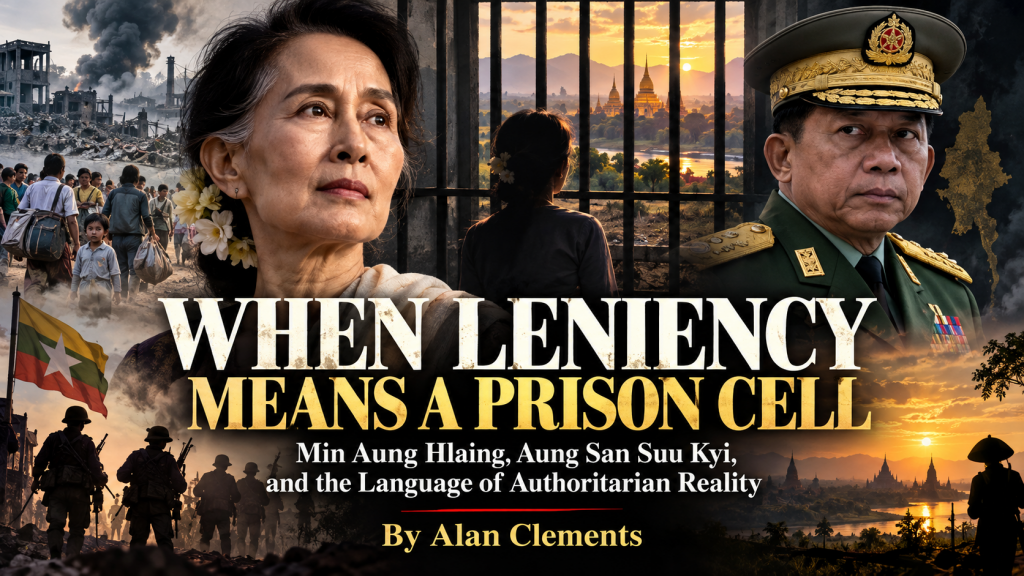
Guest contributor Alan Clements “Extremely lenient.” Those are the words Min Aung Hlaing uses to describe his treatment of Aung San Suu Kyi, the elected civilian leader his military arrested when it seized power on February 1, 2021. There are moments when a phrase contains an entire political system within it, when language becomes so radically detached from observable reality that answering it requires something more than disagreement. It requires the recovery of language itself. In his new interview with TIME, Myanmar’s military commander turned president continues to defend that seizure of power through allegations of electoral fraud, suggests that any future amnesty for Suu Kyi “depends on her,” and argues that democracy assumes different forms in different civilizations. What he promises is a democracy appropriate to Myanmar’s “culture, customs, and traditions.” There is an almost unbearable inversion contained in those words. A man whose military imprisoned the leader chosen overwhelmingly by Myanmar’s electorate now describes her continued captivity as evidence of his restraint. The jailer invokes mercy. The institution that nullified an election invokes democracy. Power first creates the prison and then asks to be admired for the conditions under which it might someday open the door. I have spent more than four decades living with Burma, studying its culture, knowing its people, witnessing its dictatorships, interviewing dissidents and political prisoners, and trying to understand what prolonged authoritarianism does not only to institutions but to consciousness itself. I first entered the country in 1979 as a Buddhist monk. I have watched fear become administrative procedure, censorship become ordinary speech, imprisonment become political vocabulary, and propaganda gradually acquire the peculiar texture of reality for those required to inhabit it. Yet I resist reducing Min Aung Hlaing to a monster existing outside history. That would be emotionally satisfying and intellectually inadequate. Dictatorships do not descend from another planet. They emerge from history, institutions, inherited fears, collective wounds, ideologies and human beings. To understand those conditions is not to excuse what people subsequently do with power. It is to understand how power becomes capable of excusing itself. Burma has endured profound historical violence. British expansion began with the first Anglo-Burmese War in 1824; annexation proceeded until the monarchy was destroyed and Upper Burma incorporated into the British Empire in 1886. Colonial rule reordered institutions, economies and identities. Japanese occupation followed during the Second World War. Independence finally arrived in 1948. Colonial domination leaves more than political borders behind. It can leave a wounded imagination of sovereignty: the conviction that national survival depends upon vigilance, unity, obedience and protection against forces forever threatening to dismember the country. None of this mechanically produces dictatorship. But it helps us understand the historical soil in which Burma’s military developed its extraordinary conception of itself. Since General Ne Win’s 1962 coup, generations of soldiers have been educated within an institution that repeatedly represented itself not merely as one participant in the nation but as the indispensable guardian of the nation. Under such conditions, domination can gradually rename itself duty. Violence becomes security. Dissent becomes terrorism. Obedience becomes patriotism. Eventually the institution defending its power may cease to distinguish between protecting itself and protecting the country. Understanding that history matters. Turning history into absolution would be another form of dishonesty. This is why Min Aung Hlaing’s word “lenient” deserves such scrutiny. Aung San Suu Kyi was not seized after losing an election. Her National League for Democracy overwhelmingly won the November 2020 election. Independent observers identified structural deficiencies in Myanmar’s electoral system, but the Carter Center reported that voters were able to express their will freely and found no major irregularities on election day capable of sustaining the military’s extraordinary justification for overturning the political order. And to understand the historical circumstance in which Aung San Suu Kyi attempted to govern Myanmar, one must remember what she was confronting: a military retaining immense constitutional and coercive power, a nation fractured by generations of armed conflict, and an authoritarian inheritance that had imprisoned her for years and repeatedly crushed democratic dissent. Against that inheritance, her defining political wager was dialogue. It was reconciliation rather than retribution, negotiation rather than the annihilation of one’s adversaries. Her government placed national reconciliation at the center of its ambitions and convened the 21st Century Panglong peace process in an attempt to bring ethnic nationalities, armed organizations, political actors and the military itself into a shared conversation about a democratic federal future. There was something radical in that choice. In a political culture so long dominated by the grammar of command, weaponry, hierarchy and force, Aung San Suu Kyi attempted, against almost impossible constraints, to introduce another conception of power: patience instead of retaliation, listening instead of domination, reconciliation instead of revenge. I think of this as a feminine principle in political life, but I do not mean that women inherently possess these qualities or that men do not. Nor do I mean femininity as biology, sentimentality, passivity or weakness. I mean a human capacity available to women and men alike: the capacity to remain receptive without surrendering strength, to hold apparently irreconcilable realities without immediately converting difference into enmity, to privilege relationship over domination, and to recognize that the deepest exercise of power may sometimes lie not in defeating an adversary but in creating conditions in which neither side must destroy the other in order to survive. That experiment was fragile and unfinished, unfolding inside a political structure in which the military had never truly relinquished its power. But it cannot honestly be collapsed into the fiction that she represented a threat to democracy requiring military intervention. She represented another proposit
Original source
DVB