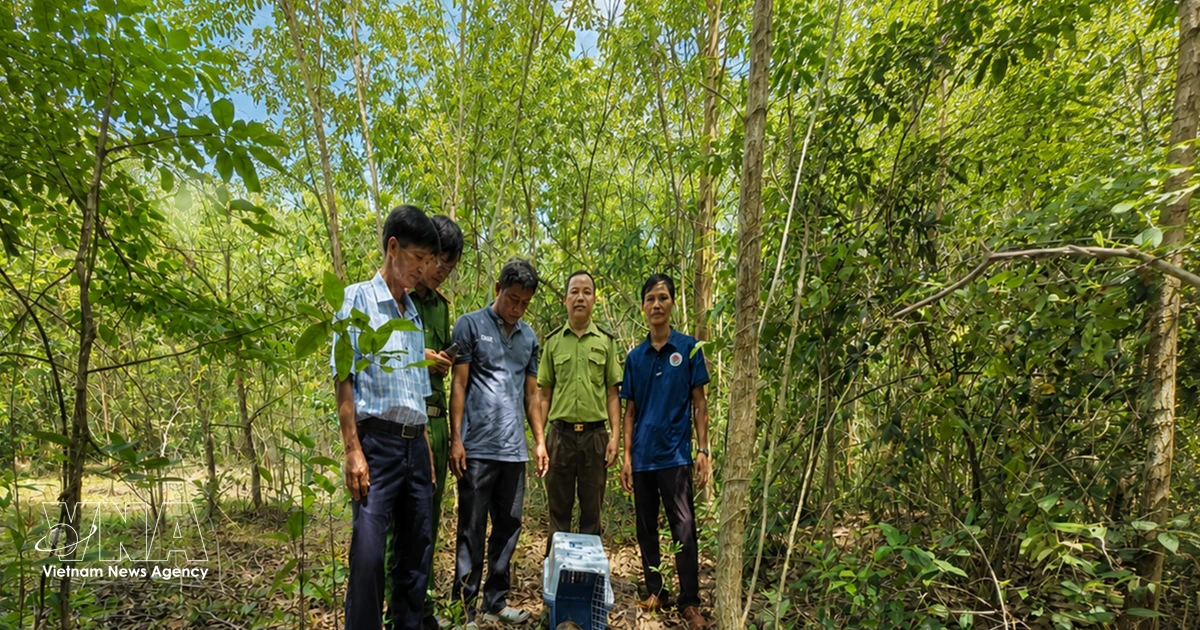
Rare Pangolin Released into Wild as Vietnam Bolsters Wildlife Protection
A critically endangered pangolin has been released back into the wild in Tay Ninh Province, Vietnam, highlighting the country's intensified efforts to protect vulnerable wildlife through legal frameworks and joint conservation campaigns.
Initial examination showed that the 10kg pangolin appears to be in good health, shows no visible signs of injury and retains normal mobility. Pangolins, scaly mammals capable of curling into a ball for self-defence, are classified as critically endangered and are strictly protected under both Vietnamese and international law. The pangolin weighed around 3 kg and belongs to Group IB - endangered, previous and rare species prioritised for protection under Vietnamese law. Of the six cranes, two are males and four females, with individual weights ranging from 5.3kg to 6.7kg. The birds were raised at Nakhon Ratchasima Zoo in Thailand and transported to Vietnam by air. Since 2001, Habitat for Humanity Vietnam has helped build or renovate more than 36,000 homes nationwide while supporting thousands of households in accessing housing finance and improving disaster resilience. With a total investment of nearly 1.6 trillion VND (over 60.7 million USD), the Long My domestic solid waste treatment plant will cover about 10ha, and have a waste treatment capacity of 800 tonnes per day and a power generation capacity of 15 MW. The latest transfer marks the second phase of the sarus crane conservation and development project at the Tram Chim National Park in Dong Thap for the 2022–2032 period. Deputy Minister of Agriculture and Environment Le Cong Thanh, in his speech, said climate change is making weather more severe and unpredictable, with a powerful El Nino set to hit Vietnam in the second half of 2026 and early 2027. Against such backdrop, enhancing forecasting and early warning capacity, while effectively translating scientific information into management decisions and timely response actions, has become urgent, he said. The animals included a monitor lizard, a pangolin, an elongated tortoise (Indotestudo elongata) and an impressed tortoise (Manouria impressa). The robust growth of the marine economy has created significant opportunities for Vietnam while at the same time posing major challenges to marine environment protection. From coastal aquaculture areas and renowned tourist bays to marine protected areas rich in biodiversity, traces of plastic waste, land-based pollution and unsustainable exploitation remain visible every day. According to the Department of Dyke Management and Natural Disaster Prevention and Control under the Ministry of Agriculture and Environment, natural disasters during the 2020–2025 period caused increasingly serious damage nationwide. On average, natural disasters claimed more than 300 lives each year and caused economic losses exceeding 45 trillion VND (1.7 billion USD), up about 167% compared to the 2015–2019 period. As Vietnam’s first national park and one of the region’s leading nature conservation centres, Cuc Phuong will serve as an important field site for research, training and knowledge exchange among the partners. The pressing concerns comprise persistent environmental hotspots in industrial parks and industrial clusters; increasingly complex air and water pollution in major cities directly affecting public health; and shortcomings in waste management and wastewater treatment across river basins and rural areas that have yet to meet practical requirements. In Vietnam, airlines, fuel suppliers and energy companies have begun collaborating to deploy SAF on commercial flights, demonstrating that key links in the fuel value chain—from production and supply to operation—are gradually taking shape. On June 5, 2026, the 38th session of the International Coordinating Council of UNESCO's Man and the Biosphere Programme (MAB-ICC 38) officially designated Vietnam's Phong Nha–Ke Bang National Park as a member of the World Network of Biosphere Reserves (WNBR). The recognition marks another milestone in the country's conservation efforts, bringing its total number of UNESCO-designated World Biosphere Reserves to 12. The zone will cover the area within Hanoi’s Ring Road 1, encompassing nine wards: Hoan Kiem, Cua Nam, Ba Dinh, Giang Vo, Ngoc Ha, Tay Ho, O Cho Dua, Hai Ba Trung, and Van Mieu – Quoc Tu Giam. The lesser adjutant is a rare and endangered species classified in Group IB, which includes forest animals given the highest level of protection under Vietnamese law. Implemented under Plan 628, a joint initiative between the Ministry of Public Security and the Ministry of Agriculture and Environment, the campaign marks a shift towards a more coordinated and long-term approach to protecting wildlife and natural resources. Maintaining the UNESCO Global Geopark status is expected to further elevate the international profile of Lam Dong’s geological heritage while supporting sustainable tourism and green economic growth linked to the preservation of natural and cultural assets. All five animals had become separated from their natural environments before being found by local residents. The first bomb was found beneath the Son River, about 150 metres from a tourist boat pier in Phong Nha commune, after a local homestay owner alerted authorities. The vision of a strong maritime nation will be reflected in green ports, offshore wind farms, thriving coastal communities, restored mangrove forests, sustainable coastal cities, resilient island outposts and generations of Vietnamese equipped with ocean knowledge and a deep sense of responsibility for the nation’s maritime future. The chicks were born at Pairi Daiza’s Oasis greenhouse following a carefully monitored breeding and care programme. According to the International Union for Conservation of Nature (IUCN), the Vietnamese pheasant is classified as Critically Endangered and may already be extinct in the wild. Copyright, VietnamPlus, Vietnam News Agency (VNA) Editor-in-chief, Mr. Tran Tien Duan.
多角的分析
ベトナム経済は急速な成長を遂げているが、その裏で環境負荷の増大が課題となっている。特に、工業化の進展に伴う大気・水質汚染、そして不十分な廃棄物処理は、長期的な経済成長の持続可能性を脅かす可能性がある。今回のセンザンコウ放流のような野生生物保護活動は、環境保全への投資という側面を持つが、それ以上に、持続可能な観光資源としての自然保護や、環境規制強化による産業界への影響といった経済的側面も考慮する必要がある。ベトナム政府は、海洋経済の発展と環境保護の両立を目指しており、グリーンポートや再生可能エネルギーへの投資を推進しているが、その効果はまだ限定的である。
ベトナムは、魅力的な投資先として注目されているが、環境規制の強化や、それに伴うコスト増のリスクは、投資家にとって無視できない要素となる。今回のセンザンコウ放流のような野生生物保護の動きは、ベトナムが環境問題への対応を強化していることを示唆しており、将来的な環境規制の厳格化につながる可能性がある。特に、環境負荷の高い産業への投資や、サプライチェーンにおける環境リスク管理は、より重要視されるだろう。一方で、環境保全や再生可能エネルギー分野への投資機会も拡大すると考えられる。
タイニン省でのセンザンコウ放流は、ベトナム社会における野生生物保護への意識の高まりを示す象徴的な出来事である。しかし、ベトナム社会は依然として、工業化の進展による環境汚染、特に都市部での大気・水質汚染に直面しており、これが住民の健康や生活の質に直接影響を与えている。また、自然災害の激甚化は、地方のコミュニティに大きな被害をもたらしており、防災・減災対策の強化が喫緊の課題となっている。このような状況下で、希少生物の保護活動は、社会全体で自然との共存を目指す機運を高める可能性があるが、同時に、経済発展と環境保護のバランスをいかに取るかが、社会的な議論の的となるだろう。
タイニン省でセンザンコウが自然に放流されたことは、私たち市民にとって、自分たちの国にこんなにも貴重な生き物がいるということを再認識する機会となる。しかし、同時に、私たちの日常生活は、工場からの煙や、川の水質汚染といった問題に囲まれている。特に、ハノイやホーチミンなどの大都市では、空気が悪くて洗濯物を外に干せない日があったり、川の臭いが気になったりすることがある。また、最近は雨が降るとすぐに洪水になる地域も増えている。こうした中で、センザンコウのような希少な動物たちが安心して暮らせる環境を守っていくことは、私たち市民一人ひとりの責任でもあると感じる。
背景・歴史的文脈
ベトナムは、経済成長を最優先する政策を長年続けてきた結果、環境問題が深刻化している。1986年のドイモイ(刷新)政策以降、急速な工業化と都市化が進み、森林破壊、水質汚染、大気汚染などが顕著になった。特に、2010年代以降、国際社会からの環境保護への圧力が高まる中、ベトナム政府は法整備や国際協力による保護活動を強化している。2020-2025年の自然災害による被害額が前期間比で167%増加したことは、気候変動への対応の遅れも示唆しており、政府は気候変動対策と野生生物保護を国家戦略の重要な柱と位置づけ始めている。
原文ソース
VietnamPlus English