General articles are free for 24 hours after publish.
Terror Attacks Target Migrant Workers Again in Kashmir, Fueling Demographic Fears
Kashmir has seen a resurgence of terrorist attacks targeting migrant laborers, causing widespread unease. The attacks, analyzed in the context of past incidents and political developments, highlight the reasons behind targeting non-locals and their impact on the region.
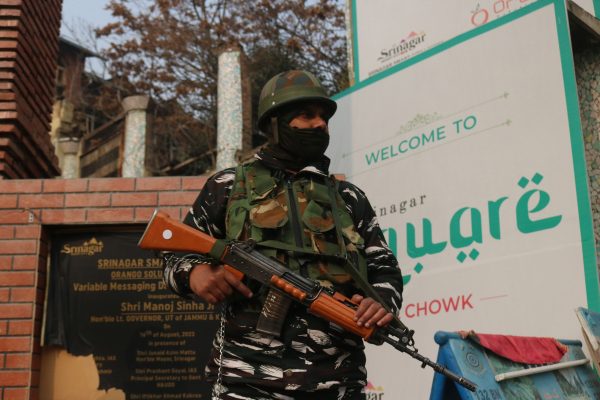
Two laborers from central India were shot dead at a brick kiln in Kulgam in the Kashmir valley on July 31. The attack shatters a year of relative calm and signals a renewed threat of terrorism in the region. The incident has triggered panic among tens of thousands of laborers from India’s poorer northern states who come to the Kashmir valley every year between March and November to work on construction sites, road projects, brick kilns, and apple orchards. The July 31 killings prompted some of them to return home. The Kulgam attack came close on the heels of the killing of a Jammu and Kashmir (J&K) police constable at a busy market in Anantnag district. The attacks have raised concern over the return of terrorism to the Kashmir valley. Indeed, the incident at Kulgam is the first targeted killing of non-local civilians by terrorists since April 22, 2025, when 26 men, all civilians, were shot dead at Pahalgam; 25 of them were from outside J&K and one was a Kashmiri pony ride operator, who tried to stop the shooting. The massacre at Pahalgam led to India launching Operation Sindoor targeting terrorist camps and infrastructure in Pakistan and Pakistan-administered Kashmir, which culminated in a four-day war between India and Pakistan in May. There had been no attacks on civilians since then; the bloodletting over the past fortnight broke that lull. The killings at Kulgam came days before the seventh anniversary of New Delhi’s abrogation of J&K’s autonomy. It was on August 5, 2019, that the Narendra Modi government announced the revocation of Article 370 and Article 35A – a unilateral action that was hugely unpopular in J&K. India will also be marking its 79th Independence Day on August 15. The run-up to anniversaries of milestone events usually sees an uptick in terror attacks in the Kashmir valley. Since August 2019, over 25 non-local workers have been killed in terror attacks in Kashmir. In October that year, six laborers from West Bengal were lined up and shot dead in Kulgam. There were 10 migrant laborer fatalities in 2022. A terror strike on a construction team working on the Z-Morh tunnel in Ganderbal district resulted in the death of six migrant workers and a Kashmiri doctor in October 2024. The post-2019 surge in attacks on non-local workers can in part be attributed to Delhi’s nullification of Article 35-A, a constitutional provision that preserved the distinct identity of J&K. Kashmiris were apprehensive that the scrapping of Article 35-A would “open the floodgates to non-locals to work and live in the valley, altering the local demography and allowing outsiders to get jobs here,” a Kashmir University professor told The Diplomat. Terror groups “capitalized on these anxieties” to kill scores of non-local laborers working in J&K, she said. Officials in India’s security establishment attribute the attacks on non-local workers to the success of the Modi government’s crackdown on terrorists and separatists. The number of active local militants has fallen in recent years and the network has shrunk somewhat. Under those circumstances, militants “opt for attacks on civilians, who are soft targets. Such attacks are not only easier to carry out, but they are low-cost and have high impact,” a senior official of the Central Reserve Police Force told The Diplomat. Especially when these attacks result in “fatalities of non-locals, it gets immense media coverage, helps the terror outfit remain relevant and keeps their handlers across the border [in Pakistan] happy,” he said. “By targeting non-local laborers, terrorist groups seek to spread fear, discourage investment and developmental activities, disrupt the inflow of outside workers, and challenge the perception of normalcy that has gradually returned to J&K in recent years,” Ajit Kumar Singh, senior fellow at the Institute for Conflict Management, wrote on the South Asia Terrorism Portal. Citing security officials, journalist Zulfikar Majid wrote in the Deccan Herald that “the recent terrorist attacks in the Kashmir valley do not indicate a major resurgence of militancy.” Rather, the “insurgency [is] adapting to weakness rather than demonstrating renewed operational capability,” he argued. Following the attack at Pahalgam last year, tourism in J&K was hit hard. Non-local workers in the valley were badly rattled. In spring this year, the laborers returned, as did the tourists, expecting a safer environment. The attack at Kulgam has made the migrants fearful again. In response, Indian security forces launched a massive manhunt and tightened the security cordon in the valley. Surveillance and night patrolling have been stepped up. But keeping workers safe may be easier said than done. There are thousands of migrant laborers in the valley. Some have brought along their families. “What we plan to do is move them and their families to a single location in the same village for the night, so that it is easier to secure them,” a police officer told Indian Express. But creating non-migrant clusters could make them more vulnerable. Establishing Kashmiri Pandit (Hindu Kashmiris) clusters or townships has often been put forward as a way to draw back this displaced community, which was forced to leave the valley in 1990. The idea was a non-starter, one reason being that such clusters would make the Pandits sitting ducks for Islamist radicals. Non-local clusters could also be targeted by militants opposed to J&K’s economic recovery. The government will have to act fast to create an environment where migrant workers feel safe to avert their flight from the valley. Subscribe today and join thousands of diplomats, analysts, policy professionals and business readers who rely on The Diplomat for expert Asia-Pacific coverage. Get unlimited access to in-depth analysis you won't find anywhere else, from South China Sea tensions to ASEAN diplomacy to India-Pakistan relations. More than 5,000 articles a year. Already have an account? Log in. Sudha Ramachandran is South Asia editor at The Diplomat. Get briefed on the story of the week, and developing stories to watch across the Asia-Pacific.
Original source
The Diplomat Indonesia