General articles are free for 24 hours after publish.
Cambodia Rejects Thai Claim of Stalled Land Border Talks, Citing Separate Frameworks
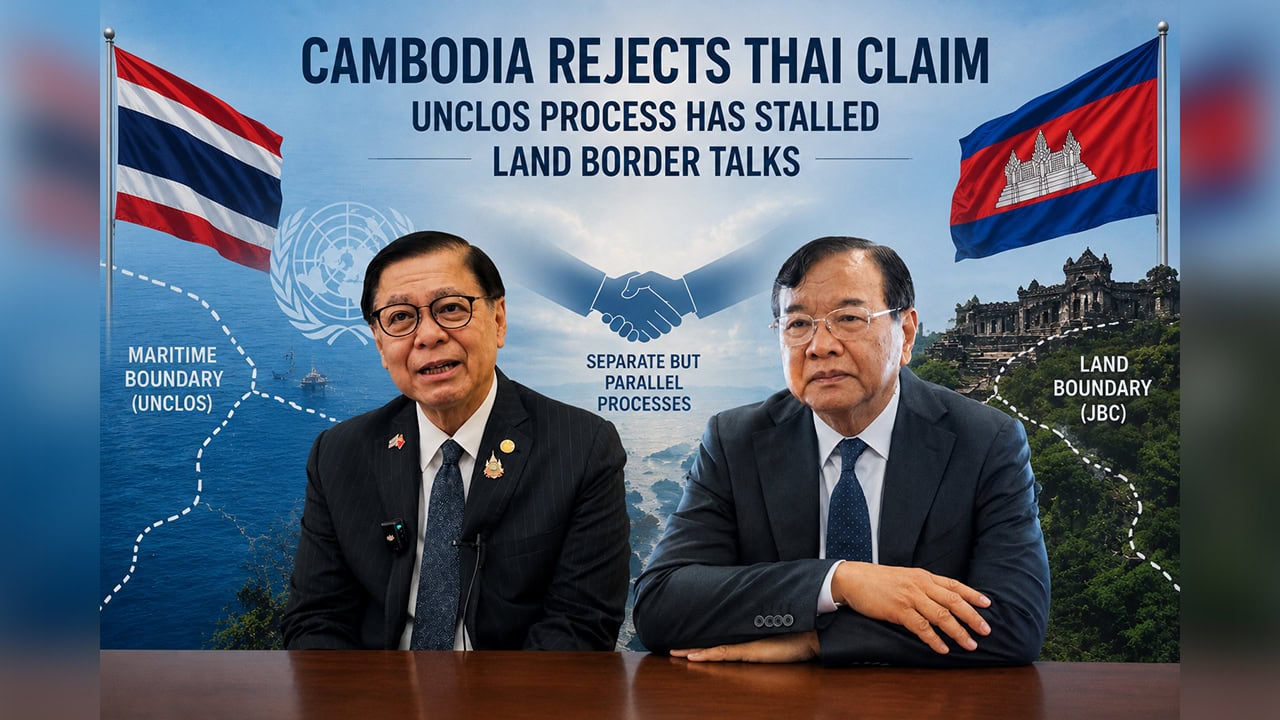
Cambodia's Ministry of Foreign Affairs has strongly rejected claims by Thailand's Deputy Prime Minister that pursuing compulsory conciliation under UNCLOS has stalled land border talks. Phnom Penh insists maritime and land boundary issues are governed by separate legal frameworks and should proceed independently.
The Ministry of Foreign Affairs has rejected claims by Thailand's Deputy Prime Minister and Foreign Minister Sihasak Phuangketkeow that Cambodia's pursuit of compulsory conciliation under the UN Convention on the Law of the Sea (UNCLOS) has derailed land border negotiations. Phnom Penh insists that maritime and land boundary disputes are governed by separate legal frameworks and should proceed independently. In a July 20 statement, the ministry described remarks made by Sihasak in Beijing as "simply not true," after he suggested Cambodia’s recourse to UNCLOS had “closed the door” to talks on the land border. "The maritime boundary and the land boundary are governed by different legal frameworks and different bilateral mechanisms. Cambodia’s recourse to UNCLOS concerns the maritime border alone," it said. The statement marked Phnom Penh’s first formal response to comments made by Sihasak earlier this week, in which he argued that Cambodia’s decision to initiate compulsory conciliation under UNCLOS had undermined bilateral trust and complicated negotiations on the land boundary. Cambodia maintained that UNCLOS is an internationally recognised and peaceful mechanism for resolving maritime disputes and should not be used as justification for suspending unrelated work on land boundary demarcation. "UNCLOS itself is an agreed and peaceful means for resolving maritime disputes, and its use should reassure rather than cause concern of a neighbour genuinely committed to the rule of international law," it said. The ministry added that the maritime conciliation process “cannot credibly be treated as grounds for suspending unrelated work on demarcating the land boundary through the Joint Boundary Commission (JBC)”, which was established under the Memorandum of Understanding signed on June 14, 2000, and reaffirmed in the December 27, 2025 ceasefire agreement. Phnom Penh turned Bangkok’s criticism back on Thailand, arguing it was Thailand — not Cambodia — that had previously withdrawn from the agreed bilateral framework for negotiating maritime issues. "It was Thailand that unilaterally withdrawn from this agreed framework for bilateral negotiations on maritime issue, despite Cambodia’s direct request that it not do so," the statement said. The ministry noted what it described as an inconsistency in Thailand’s position, saying Bangkok had repeatedly indicated in the past that it was prepared to rely on UNCLOS mechanisms to resolve maritime disputes while now criticising Cambodia for invoking the same convention. Calling for renewed bilateral engagement, Cambodia urged Thailand to stop what it described as deliberate delays and return to implementing existing agreements governing border demarcation. "Cambodia therefore calls on Thailand to stop creating pretexts for its deliberate delays and to return in good faith to the demarcation process both countries have already agreed to under the terms of the 2000 MOU and ceasefire agreement," the statement said. It stressed there was “no reason whatsoever, whether legal or practical”, to delay the work of the JBC while the maritime conciliation under UNCLOS proceeds in parallel. The ministry also sought to bolster its position by citing international support. It noted that on July 11, the Parliamentary Assembly of the Francophonie adopted a resolution reaffirming support for Cambodia’s sovereignty and territorial integrity, calling for de-escalation and backing the resumption of the JBC’s demarcation work. Cambodia urged Thailand to respect the International Court of Justice’s 1962 and 2013 judgments concerning the Temple of Preah Vihear and to continue land boundary delimitation in accordance with the 1904 and 1907 treaties, as reaffirmed in the 2000 Memorandum of Understanding. In its strongest language, the ministry warned that indefinitely delaying the demarcation process with the aim of maintaining what it described as unlawfully occupied Cambodian territory would violate international law. "Delaying the demarcation process indefinitely in order to render permanent and annex unlawfully occupied Cambodian territories is a flagrant violation of the UN and ASEAN Charters and cannot be allowed to stand," the statement concluded. The diplomatic exchange follows renewed tensions after Sihasak told reporters in Beijing that Cambodia’s decision to pursue compulsory conciliation under UNCLOS had effectively undermined prospects for continued land border negotiations. Cambodian officials and legal analysts have consistently argued that the maritime conciliation process is separate from the bilateral mechanisms governing land border demarcation and does not prevent the Joint Boundary Commission from carrying out its work.
Original source
Phnom Penh Post