General articles are free for 24 hours after publish.
Cagwait fisherfolk's citizen science kit for mangrove conservation on display at NatGeo museum
A citizen science kit developed by fisherfolk in Cagwait, Surigao del Sur, Philippines, is now on display at the National Geographic Museum in Washington, D.C. The kit was created through a collaboration between local fisherfolk associations and a science-based NGO to identify and monitor mangrove and seagrass habitats.
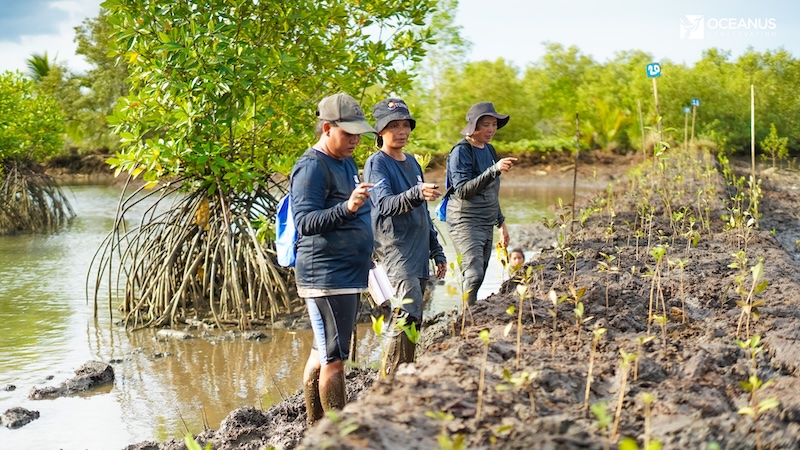
DAVAO CITY (MindaNews / 09 August 2026) — Inside the National Geographic Museum of Exploration’s 100,000-square-foot facility in Washington, DC that houses Jane Goodall’s handwritten, early-research field notes and a moon rock collected during the 1969 Apollo 12 mission, one can also find a citizen science kit of community mangrove guardians in Cagwait, Surigao del Sur, their legacy to grassroots marine conservation. The kit forms part of the museum’s collection of hundreds of exploration tools from around the world, alongside immersive experiences, multi-media environments, artistic installations, and historical archives that spotlight NatGeo’s legacy in conservation. NatGeo defines citizen science as “the practice of public participation and collaboration in scientific research to increase scientific knowledge. Through citizen science, people share and contribute to data monitoring and collection programs.” Consisting of a GPS unit, a seagrass field guide, and a mangrove assessment data sheet, Cagwait’s citizen science kit was developed through community-led conservation projects mobilizing local fisherfolk associations to identify and monitor mangrove and seagrass habitats, in partnership with Oceanus Conservation, a science-based NGO that conserves and restores blue carbon habitats in the Philippines. Oceanus co-founder Camille Rivera, a 2022 National Geographic Explorer who headed the projects that brought the tools to the museum, attended the museum’s private unveiling before it officially opened to the public on June 26, bringing their vision of “harmonizing science, education, technology, and collaboration to advance inclusive conservation action,” according to a statement posted on their website on June 25. In a Zoom interview with MindaNews last month, Rivera talked about the inspiration behind their commitment to championing the type of community-surfaced knowledge encapsulated in the citizen science kit they co-developed in Cagwait, and why it’s important “to work alongside community members as partners in conservation.” Roots According to Rivera, when she was first starting out and working for a different NGO as Community and Education Officer in 2018, she met a mangrove leader named Evelyn in Negros Oriental who helped her realize that communities have inherent knowledge. “We were going around, kayaking around the mangroves, listening to the birds… and I remember specifically she would just tell me, like, “Look at that, that’s this one, (and she would say) a very local name. And she would point to another one, (and she would say the) local name. I go back to my base… and I was identifying the mangroves, and it’s exactly what she was telling me,” she said. “And then she would have stories to tell, like “Oh you know this propagule, this mangrove, we would use this as a pencil kasi wala kaming pangsulat (Oh you know this propagule, this mangrove, we would use this as a pencil because we don’t have anything to use for writing),” she added. In an article published in the February 2024 issue of Vogue Philippines, Rivera narrated to the writers about losing her previous job during the pandemic. She founded Oceanus after, and harnessed her learnings from her previous engagements as core principles for designing how they work with communities. With a main office in Makati, a satellite office in Cagayan de Oro, and a Field Station in Cagwait, Oceanus implements projects throughout the Philippines using an approach that is intentionally rooted in each community’s context, bridging inherent knowledge with lived experience and local stories, and supplementing it with scientific discipline to empower the community to lead conservation efforts. In their press statement, she also described this relationship as one of “stewardship and connection, where communities do not simply benefit from their environment but actively care for it as part of their identity and survival.” “I wanted (Oceanus) to be an organization that will always be translating science; it cannot just be (confined to) academic papers, it has to go out there,” she said. One of the most successful manifestations of that approach is the citizen science kit she carried from Cagwait to Washington, DC. Small beginningsBefore the tools reached the NatGeo Museum, they first passed through the hands of the members of Cagwait’s fisherfolk associations. Armed with the kit and a phone with a camera and a data collection app, fisherfolk from Poblacion, Aras-asan, and Bitaugan West documented physical information about seagrasses, as well as mangrove saplings and matured trees they also helped plant, using rehabilitation and survival monitoring methods taught to them by Oceanus. Ginalyn Quijada, vice president of the Bitaugan West Fisherfolk Association (BWFA), is one of the 70 citizen scientists in the municipality who received training from the organization. Together with her daughter, Princess Ann Asequia, the secretary of the association, she continues to be among those who conduct active monitoring. “Importante gyud ang (pag-monitor) kay mailhan man nimo kung pila kabuok patay, pila kabuok ang buhi (Monitoring is really important because it helps us see how many of the mangroves were alive, and how many died),” Quijada told MindaNews in a Zoom interview on July 25. But she also stressed the importance of involving the community in monitoring, especially as there had been cases of people cutting mangroves. Emmanuel Cababarros, Field Officer at Oceanus, also told MindaNews in a Zoom interview on July 23 that part of the reason citizen science was started was to ensure the community has data, especially for navigating development changes. He said changes were happening so fast. The community knew some people were cutting mangroves but even if the community complains, no action will be taken if they have no evidence to present, Cababarros said. With the monitoring, the community would have documentation that mangroves exist in the area and if, in their next monitoring, they found that the trees disappeared, then they would have the data they need to ground reports in evidence, he explained. Step by step While it’s normal for Quijada and the rest of the fisherfolk to do monitoring activities now, it initially took an in-depth, step-by-step training with the Oceanus team to ensure the community is equipped to carry out citizen science activities. Cababarros said the approach required them to be there at every step, especially because the association members, who are mostly in their 40s or older, were apprehensive about using the devices and technologies at first. He said their team strategy for the presentation was to upload a screenshot of the phone onto every slide, with red arrows that indicated which parts of the phone to click or use. “Step-by-step gyud hangtud maanad sila (We did it step-by-step until they got used to it),” he said. Afterwards, they dedicated a whole da
Original source
MindaNews Philippines (GN)