General articles are free for 24 hours after publish.
Defense Secretary Urges Reserve Force to Protect Maritime Domain
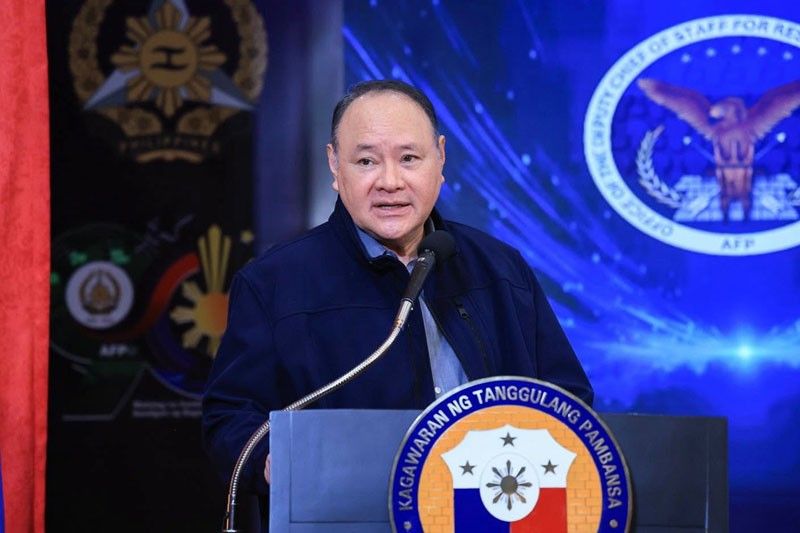
Philippine Defense Secretary Gilberto Teodoro Jr. has directed the Reserve Force to enhance protection of the country's maritime domain, particularly along the eastern seaboard. This comes amid three major threats: natural calamities, internal and external security threats, and actual conflict.
MANILA, Philippines — Defense Secretary Gilberto Teodoro Jr. has called on the Armed Forces of the Philippines (AFP) Reserve Force to help protect the country’s maritime domain. Teodoro made the call during the culmination of the 47th AFP National Reservist Week at Camp Aguinaldo on Saturday as he highlighted the Reserve Force’s role in addressing gaps in the AFP’s active duty force structure through “force and mission replication and support,” including “functional replication, and substitution, if necessary, of operating units.” He asked the Reserve Force to pursue activities along the Pacific Ocean boundary and areas leading to the Pacific Ocean, particularly in coastal and island provinces, where the country faces vulnerabilities in its eastern seaboard. “Our vulnerability is in the eastern seaboard. I would like the Reserve Commands to pursue activities on our Pacific Ocean boundary and or areas leading to the Pacific Ocean. That is a huge gap,” Teodoro said. As a maritime and archipelagic country, he said the Philippines must control its territorial land domain, baseline areas from which its maritime entitlements are drawn, its exclusive economic zone (EEZ), and other areas under its jurisdiction, including its extended continental shelves. He emphasized the country’s responsibility to help secure supply chains and protect Filipino seafarers, whom he identified as the number one nationality victimized by piracy and other untoward activities due to world and ethnic conflicts elsewhere. He identified three major threats confronting the country according to their imminence: natural calamities and disasters, internal and external security threats, and actual conflict. For internal and external security threats, he emphasized deterrence as the country’s prime objective, requiring increased posture through infrastructure, capabilities, force size, and activities conducted singly, bilaterally, or multilaterally to demonstrate the ability to resist threats. Teodoro emphasized the need for continued modernization, infrastructure build-up, enhancing community survivability, and internal hardening against malign foreign influence and disinformation, noting the reality of cognitive warfare and changing narratives.
Original source
Philstar Nation