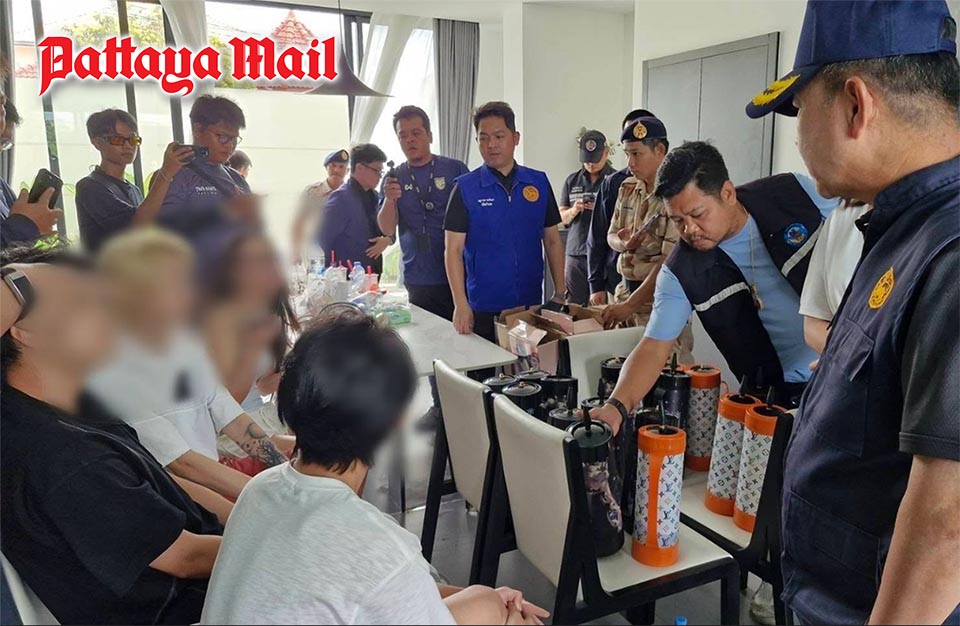
Pattaya Luxury Pool Villas Raided in Nominee Probe, Laughing Gas Found
Authorities in Chonburi, Thailand, raided five luxury pool villa businesses suspected of illegal foreign nominee ownership. The crackdown uncovered unlicensed hotel operations and nitrous oxide, with suspicions raised about Thai nominees' investments being inconsistent with their financial backgrounds. Strict legal enforcement has been promised.
A multi-agency task force led by Chonburi Governor Narit Niramaiwong raided five luxury pool villa businesses in Pattaya on Thursday as part of a sweeping crackdown on suspected illegal foreign nominee ownership. The operation targeted businesses suspected of using Thai nominees to conceal foreign ownership of property and tourism businesses, in line with the Thai government’s campaign against illegal foreign investment. The first property inspected was Aura Villa Reserve on Soi Arunothai 8 in Central Pattaya, a luxury development comprising 15 four-and-a-half-storey villas with private swimming pools and other high-end facilities. Chinese guests were found preparing to check out as officials arrived. Investigators found the business was registered as Aura Villa Reserve Co., Ltd., with Thai and Hong Kong shareholders. Financial records allegedly showed the villas had been operating as daily rental accommodation despite being licensed only as residential properties and lacking a hotel license. Employees told investigators the business had been operating for about five months, charging around 6,500 baht per night. Most bookings were reportedly made through travel agents who resold the accommodation to Chinese tourists for between 8,000 and 10,000 baht per night. During the inspection, Governor Narit noticed what appeared to be a cylinder on the second-floor balcony of one villa. Officers investigated and discovered 20 canisters of nitrous oxide inside the property. Four Chinese nationals—three men and one woman—were found asleep inside the villa and were questioned by authorities. They admitted purchasing the gas through Chinese sellers via WeChat, paying around 300 yuan (approximately 1,000 baht) per canister. Police seized the cylinders as evidence and took the group in for further questioning and drug testing. Governor Narit said the coordinated operation involved multiple government agencies to tackle foreign businesses allegedly operating through Thai nominees in violation of Thai law. Initial inspections found several properties were operating as hotels despite being licensed only as residential buildings and without hotel licenses. Authorities said criminal proceedings would begin immediately while police, immigration, tax officials and the Ministry of Commerce continue investigating shareholder structures, funding sources and who ultimately controls the businesses. The governor revealed that some Thai shareholders claimed investments worth 70 to 80 million baht, despite having financial backgrounds that appeared inconsistent with such holdings, raising further suspicions that they were acting as nominees for foreign investors. He also disclosed that provincial authorities are investigating 349 companies suspected of illegally holding land through foreign-controlled corporate structures. Companies found in violation could be ordered to dispose of the land, with properties subject to public auction if they fail to comply within 180 days. Governor Narit warned that both Thai nationals acting as nominees and foreign investors attempting to circumvent Thai ownership laws would face strict legal action, including imprisonment and substantial fines. He also urged pool villa and hotel operators to ensure they obtain all required licences and to remain vigilant against guests using their properties for illegal activities, including the storage or use of narcotics, psychoactive substances or other dangerous materials.
多角的分析
今回の摘発は、タイ政府が推進する外国人による不動産・観光事業への不法投資取り締まりの一環であり、経済的な側面では、外国人投資家がタイの所有権規制を回避するために名義貸し(ノーミネー)を利用する構造が浮き彫りになった。これは、タイ国内の不動産市場や観光産業における公正な競争環境を阻害する要因となる。また、不法に運営される事業所は、正規の事業者と比較して税収の機会損失を生む可能性があり、経済全体への影響も懸念される。さらに、発見された亜酸化窒素(笑気ガス)の存在は、違法薬物や危険物の流通ルートと関連している可能性も示唆しており、これは公衆衛生上のリスクにもつながりうる。
外国人投資家にとって、タイの所有権規制は事業展開における重要なハードルとなっている。今回の摘発は、名義貸しという違法行為に頼るリスクを改めて示唆している。当局は、タイ人名義人だけでなく、それを指示・利用する外国人投資家に対しても厳格な法的措置を講じる姿勢を示しており、海外からの投資家は、より透明性の高い、法を遵守した事業運営方法を模索する必要に迫られるだろう。特に、不動産や観光分野への投資を検討している投資家は、現地の法律や規制を十分に理解し、専門家のアドバイスを得ることが不可欠となる。過去にも同様の摘発事例があり、規制回避による投資は常にリスクを伴うことを認識すべきである。
今回の事件は、パタヤという国際的な観光地における外国人による違法行為と、それに加担するタイ国民の存在という社会的な側面を浮き彫りにした。高級プールヴィラがホテルとして無許可で運営されていたことは、観光客の安全やサービス品質の低下を招く可能性がある。また、タイ人名義人の投資額がその経済的背景と一致しないという指摘は、タイ国民が外国人投資家の「踏み台」として利用されている実態を示唆しており、社会的な格差や経済的搾取の問題にもつながりかねない。さらに、発見された「笑気ガス」は、若者を中心に娯楽目的で使用されることがあり、社会的な問題として近年注目されており、地域社会における治安や青少年保護の観点からも懸念される。
タイ国民にとって、今回の摘発は、外国人による不法な経済活動がもたらす影響を身近に感じさせる出来事である。特に、タイ人名義人として関与したとされる人々は、法的な処罰を受けるリスクに直面している。また、正規のホテルや不動産事業を営むタイ国民にとっては、違法な事業者が不当な競争優位性を享受することへの不公平感が生じる可能性がある。さらに、高級ヴィラが違法な目的で使用されることは、地域住民の生活環境や治安に対する不安を高める要因となりうる。当局は、国民に対して、名義貸しや違法行為への関与をしないよう強く警告しており、市民は法律遵守の重要性を再認識する必要がある。
背景・歴史的文脈
タイでは、外国人が直接的に土地や特定の事業(例:メディア、農業)を所有・経営することを制限する法律が存在する。これに対し、外国人投資家がタイの法律を回避するために、タイ国民を名義人として会社を設立したり、不動産を登記したりする「名義貸し(ノーミネー)」が長年問題視されてきた。特に不動産や観光分野では、外国人による投資が活発な地域(バンコク、プーケット、パタヤなど)でこの問題が顕著である。タイ政府は、過去にも何度か外国人による不法投資の取り締まりを強化しており、2020年には土地所有に関する規制が強化された。今回の事件は、これらの規制強化の動きの中で、高級プールヴィラという特定のセクターに焦点を当てたものと言える。亜酸化窒素の発見は、観光地における新たな違法行為の兆候を示唆している。
原文ソース
Pattaya Mail