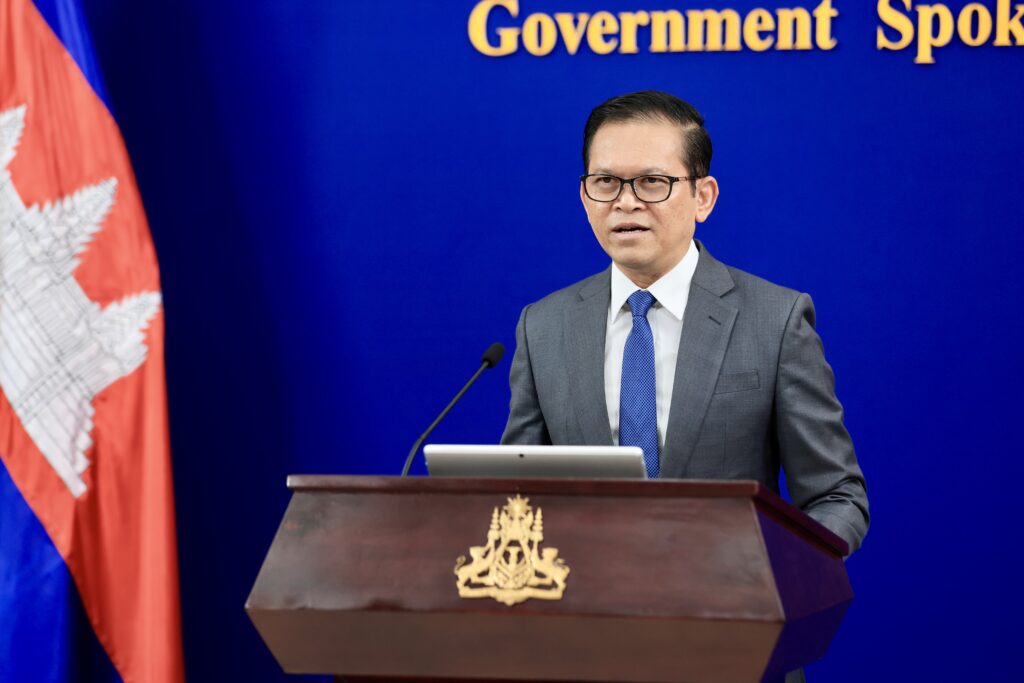
Cambodia Reiterates Stance on Peaceful Border Resolution with Thailand
The Cambodian government spokesperson reiterated the nation's commitment to peacefully resolving border issues with Thailand through diplomatic negotiations, based on international law. Citing experiences with prolonged conflict, the stance emphasizes avoiding the use of force and utilizing bilateral mechanisms for resolution.
Pen Bona, the spokesperson for the Royal Government of Cambodia, reiterated on July 9th that Cambodia consistently upholds its stance on peacefully resolving border issues with Thailand through diplomatic negotiations based on international law. Concurrently, Cambodia firmly commits to protecting the international Cambodia-Thailand border line inherited from the Indochina-Siam Border Committee. Mr. Pen Bona stated that as a nation that has experienced nearly three decades of devastating war and painstakingly achieved peace through the "Win-Win" policy, the Cambodian government has always maintained a firm position to resolve border issues with Thailand, as well as all neighboring countries, peacefully, by avoiding the use of force, through diplomatic negotiations, and by utilizing existing bilateral mechanisms, based on treaties, conventions, and international law. Specifically, since the second ceasefire came into effect on December 27, 2025, the Cambodian side of the Joint Border Committee (JBC) has sent nine diplomatic notes to the Thai side, requesting the organization of a special meeting of the JBC Cambodia-Thailand and proposing the dispatch of Joint Survey Teams (JSTs) to continue implementing work on the ground, following up on the work previously carried out by both parties. This request aligns with the content of the minutes of the JBC Cambodia-Thailand special meeting dated October 22, 2025, and the spirit of point 3 of the Joint Communiqué of the 3rd Special Meeting of the General Border Committee (GBC) dated December 27, 2025, which gives the highest priority to the JBC of both parties to continue surveying and demarcating the border on the ground as soon as possible, allowing citizens to return to their homes quickly, without hindrance, with safety, and with dignity. The repeated requests to the Thai side to organize a special JBC Cambodia-Thailand meeting and to dispatch JSTs clearly reflect Cambodia's goodwill for peace and its objective to resolve issues peacefully through bilateral mechanisms and based on the principles of international law. The government spokesperson reminded the public of point 3 of the Joint Communiqué dated December 27, 2025, which states: "Both parties agree that any agreement under this Joint Communiqué shall not affect the demarcation of the border and the international boundary between the two countries. Both parties agree to assign the Joint Border Committee to continue the work of surveying and demarcating the border as quickly as possible, in accordance with existing agreements between the two countries, in order to achieve long-term peace along the border. Both parties agree to use the existing mechanisms of the Joint Border Committee to ensure the safety and security of the joint survey teams on the ground, including safety from landmines. Both parties agree that the Joint Border Committee shall give the highest priority to the work of surveying and demarcating the border in areas affected by civilian populations." Based on this agreement, Cambodia continues to urge the Thai side to demonstrate goodwill by organizing a special JBC Cambodia-Thailand meeting and proposing the dispatch of JSTs to continue implementing work on the ground as requested by Cambodia, without further delay. Concurrently, Cambodia requests the Thai side to immediately cease all activities on Cambodian territory that it illegally occupies, with the aim of creating a fait accompli on the ground. Only the joint technical working group of the JBC mechanism has the true authority to resolve border issues justly, accurately, and transparently, in accordance with the principles of international law. The government spokesperson reiterated that Cambodia firmly upholds the principle of protecting the Cambodia-Thailand international border line left by the Indochina-Siam Border Committee, respecting the principles of international law, the principle of Uti Possidetis Juris (principle of maintaining existing possessions), the French-Siam treaties, maps, and boundary demarcation records of the Indochina-Siam Border Committee, as well as related agreements and documents previously agreed upon by both parties. Cambodia does not recognize any alteration of the border line through the use of force. Source: Kampuchea Thmey Local
多角的分析
カンボジア経済は、国境を接するタイとの安定した関係に大きく依存している。国境問題の長期化や緊張の高まりは、物流の停滞、貿易の阻害、さらには国境地域における経済活動への悪影響をもたらす可能性がある。特に、農産物や繊維製品などの輸出入に影響が出れば、カンボジアの主要産業に打撃を与えかねない。政府が平和的解決を強調するのは、経済的安定を維持し、投資環境を保つ上で不可欠である。
投資家にとって、国境問題は地政学的リスクとして常に懸念される要因である。タイとの国境紛争がエスカレートする可能性は、カンボジアへの直接投資(FDI)や既存事業の運営に不確実性をもたらす。特に、国境地域に事業拠点を持つ企業や、国境を越えたサプライチェーンに依存する企業は、リスク評価を厳格に行う必要がある。カンボジア政府の対話重視の姿勢は、投資家心理を安定させる一因となりうるが、タイ側の対応次第では依然としてリスク要因となりうる。
国境問題は、国境付近に居住する住民の生活に直接的な影響を与える。土地の利用、移動の自由、さらには安全保障といった問題が生じうる。カンボジア政府が、測量・境界確定作業を速やかに進め、住民が安全かつ尊厳をもって故郷に戻れるようにすることを優先事項としている点は、社会的な安定を重視する姿勢を示している。しかし、過去の紛争経験から、住民の間には依然として国境問題に対する不安が存在する可能性があり、政府による丁寧な説明と住民生活への配慮が求められる。
カンボジア国民、特に国境地域に住む人々にとって、国境紛争の再燃は生活基盤への直接的な脅威となりうる。土地の所有権、農地の利用、移動の制限などは、彼らの生計に深刻な影響を与える。政府が平和的解決と対話を強調する一方で、過去の紛争の記憶が残る住民の間には、国境問題の進展に対する不安や、タイ側の行動に対する警戒感が依然として存在する可能性がある。早期の測量・境界確定作業の進展は、住民の生活安定に直結する重要な要素である。
背景・歴史的文脈
カンボジアとタイの国境線は、フランス植民地時代に引かれた線と、その後の両国の合意や条約によって定められている。しかし、一部地域では境界線の解釈や、地図の不一致、未確定の地域が存在し、これが長年にわたり両国間の緊張の原因となってきた。特に、2008年のプレア・ビヒア寺院周辺での武力衝突は、国境問題の深刻さを改めて浮き彫りにした。その後、両国は国境合同委員会(JBC)を設置し、平和的な解決を目指しているが、具体的な進展は遅々として進んでいない状況がある。今回の政府報道官の発言は、こうした背景を踏まえ、カンボジアが対話と国際法に基づく解決を強く望んでいることを改めて国際社会に示し、タイ側の積極的な対応を促す意図があると見られる。
原文ソース
Kampuchea Thmey Local