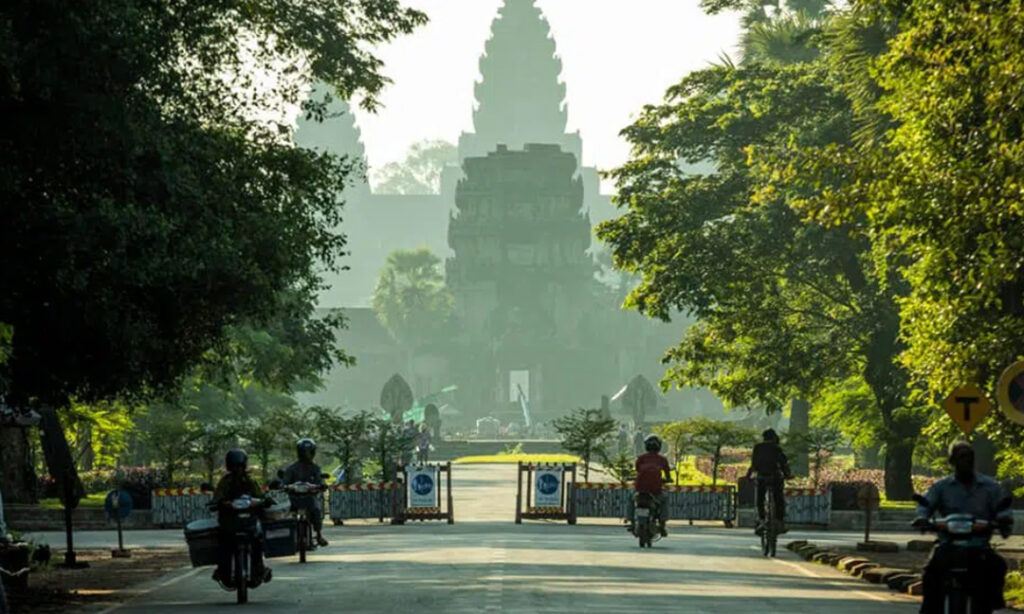
Over 10,000 Ancient Sites Discovered in Angkor Area, Including Temples, Bridges, and Ancient Villages
Approximately 10,188 ancient sites have been discovered within the Angkor Archaeological Park in Siem Reap, Cambodia. These findings include temples, bridges, ancient settlements, and water management systems. The National Authority for Apsara stated these sites are crucial evidence of the ancient Khmer Empire's societal, economic, and infrastructural development.
Approximately 10,188 ancient sites have been discovered within the Angkor Archaeological Park, which spans 401 square kilometers in Siem Reap Province, Cambodia. These findings include temples, bridges, ancient roads, ancient settlements, and water management systems. Yith Chandarath, Deputy Director-General of the National Authority for Apsara (ANA), explained the significance of these ancient sites. Ancient sites refer to locations or stations that are legacies, achievements, or works from past ancestors, remaining to the present day. They encompass religious worship sites, public infrastructure development sites, human habitation sites, artifact production sites, burial sites, and agricultural production sites. Traces of past human habitation, activities, and achievements serve as tangible evidence or crucial information that records the history of social evolution, human life, socio-economics, customs, traditions, religion, and social infrastructure. Ancient public infrastructure includes remnants such as temples, hospitals, rest houses, ancient villages, roads, bridges, and water systems (dams, canals). It also includes ancient water retention structures like reservoirs, irrigation channels, ponds, lakes, tanks, moats, and wells. According to ANA officials, the ancient sites in the Angkor region are categorized as follows: 1. Temples: Generally constructed from sandstone, laterite, wood, and brick, often surrounded by walls, moats, and adjacent to water bodies like moats, reservoirs, or barays. Examples include Koh Ker Temple, Preah Khan Temple, and Banteay Kdei Temple. Some temples face west (Angkor Wat, Wat Athvea), some face north (Preah Vihear), and others lack surrounding moats (Chau Say Tevoda, Dammanun). Some are accompanied by ponds, barays, or moats to the north (Banteay Srei, Beng, Kok Patoe, Reachea Juntol, Phimeanakas). 2. Ancient Roads: Significant evidence of the Khmer Empire's prosperity. Two types are identified: the five major roads connecting Angkor to surrounding cities, such as to Wat Phou (present-day Laos), forming a complex network. These roads are constructed by compacting earth in layers, raised above natural ground to prevent flooding during the rainy season, with canals on one or both sides as needed. They are easily identifiable by their directional connections between locations and are almost all recorded on ancient site maps. 3. Ancient Dams: Built to retain or divert water for flood prevention, redirection, or regional protection, and could also serve as roads. Constructed from compacted earth layers, similar to ancient roads. 4. Ancient Waterway Systems: Canals and dams are crucial waterway systems connecting districts for transporting goods, construction materials, supplying agricultural water, draining floodwaters, retaining water, and preventing inundation. Examples include the ancient canal from Amarindrapura (Ta Som area) to Harialay (Roluos) and to Isanapura (Kampong Thom), and the Sromach River. 5. Ancient Water Retention Structures: Barays are large water retention structures built by compacting earth into rectangular embankments, capable of storing millions of cubic meters of water. Other structures include ponds, moats, lakes, reservoirs, and wells. These water structures are significant evidence of the organization of communities living around them and also indicate the peri-urban areas of Angkor during the Khmer Empire. 6. Ancient Settlements (Koak Chas): Sites of ancient human habitation where people created settlements by digging and piling earth high above water for housing. These settlements were connected to ancient water structures. 7. Ancient Industrial Sites: Smelting furnace sites are mostly located northwest, north, and northeast of the Angkor region, near iron ore sources, for producing iron used in agricultural tools, hunting equipment, construction materials (temples), and weapons. Clay extraction sites for producing daily-use items like pots, bowls, and plates are also found around Angkor, especially on and around Kulen Mountain and Top Chey, where kilns produced pottery, tiles, pots, bowls, and plates. 8. Ancient Resource Extraction Sites: Quarries for sandstone and laterite used in building temples, bridges, roads, and other structures. Mining sites for metal elements used in producing agricultural tools, hunting equipment, construction materials, temples, and weapons. Source: Kampuchea Thmey Local
多角的分析
今回の発見は、アンコール遺跡群の広大さと古代クメール文明の高度なインフラ計画を改めて示しており、観光資源としての価値を一層高めるものと考えられる。特に、古代の水管理システムや広範な道路網は、当時の経済活動や物流の活発さを示唆しており、これらのインフラの維持・管理・研究に新たな投資や国際協力が必要となる可能性が高い。これにより、観光収入の増加だけでなく、関連産業の発展や雇用創ちにも繋がる可能性がある。
アンコール遺跡群における新たな史跡の発見は、カンボジアの観光産業への投資魅力をさらに高める要因となる。特に、これらの遺跡の保存・修復・研究が進めば、新たな観光ルートの開発や、より深い歴史体験を求める観光客の誘致につながる可能性がある。ただし、インフラ整備や観光客増加に伴う環境への影響、地域社会との調和といった課題も考慮する必要があり、持続可能な観光開発を目指す投資家にとっては、これらのリスク管理が重要となる。
アンコール遺跡群における1万を超える史跡の発見は、カンボジア国民の歴史的アイデンティティと文化遺産への誇りを一層強固にするだろう。古代の集落や生活様式が明らかになることで、過去の社会構造や人々の暮らしへの理解が深まる。一方で、これらの遺跡の保護・管理体制の強化は喫緊の課題であり、地域住民の生活への影響や、文化遺産保護と観光開発とのバランスをいかに取るかが、社会的な議論の的となる可能性がある。
今回の発見は、アンコール地域に住む人々にとって、自分たちの故郷が持つ歴史的な深さと広がりを再認識する機会となる。古代の集落や生活の痕跡が見つかることで、自分たちの先祖がどのように暮らし、どのような社会を築いていたのかを知る手がかりとなるだろう。しかし、遺跡の保護・管理が進むにつれて、土地利用の制限や観光客の増加による生活環境の変化など、住民の生活に直接的な影響が出る可能性も考えられる。
背景・歴史的文脈
アンコール遺跡群は、9世紀から15世紀にかけて栄えたクメール帝国の首都であった。その広大な領域には、アンコール・ワットやアンコール・トムをはじめとする数多くの寺院や建造物が点在している。19世紀以降、フランスの植民地時代に本格的な調査・修復が開始され、1992年にはユネスコ世界遺産に登録された。遺跡群は、古代クメール文明の高度な建築技術、都市計画、灌漑システム、そして宗教観を示す貴重な証拠として、国際的に高い評価を受けている。近年、LIDAR(ライダー)技術などの先端技術を用いた広域調査により、これまで知られていなかった多数の遺跡や、都市構造の全貌が明らかになりつつある。今回の発見も、こうした最新技術を用いた調査の一環であると考えられ、古代クメール帝国の社会構造や生活様式に関する理解を深める上で、重要な意義を持つ。
原文ソース
Kampuchea Thmey Local