General articles are free for 24 hours after publish.
China Fires Flares at Philippine Coast Guard Aircraft Near Spratlys
A Philippine Coast Guard (PCG) aircraft conducting a maritime domain awareness flight over the Spratly Islands in the South China Sea was targeted with flares by Chinese forces. The PCG condemned the incident as a threat to flight safety and highlighted violations of international law.
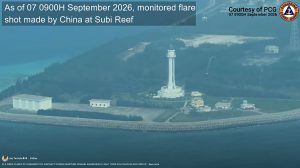
A PHILIPPINE Coast Guard (PCG) aircraft conducting a maritime domain awareness flight over the Spratly Islands in the South China Sea was targeted with multiple flares fired by Chinese forces on Sept. 7, the PCG said on Thursday, calling the incident a threat to flight safety. The unarmed aircraft was challenged over the radio by Chinese forces occupying Subi Reef before flares were fired in its direction, the PCG said in a statement posted by spokesman Jay Tristan Tarriela in his Facebook account. “Flares were fired at an unarmed Coast Guard aircraft,” PCG Commandant Admiral Ronnie Gil Gavan said in the statement. “The PCG does not need to characterize this behavior.” Chinese forces occupying Mischief Reef also fired flares at the aircraft, the PCG said. In both incidents, the aircrew told Chinese forces that their presence on the reclaimed features violated international law and that the flight was a routine and legitimate operation. The aircrew also observed a considerable number of Chinese maritime militia vessels sheltered inside the lagoons of both features. No personnel were seen on the vessels or reclaimed facilities, and no vehicle movement was monitored on the artificial islands, the PCG said. The 2016 arbitral award identified Mischief Reef as a low-tide elevation within the Philippines’ exclusive economic zone and continental shelf, Mr. Gavan said. China’s reclamation of the feature violated Philippine sovereign rights, he added. The PCG said firing flares at an aircraft in flight endangered flight safety and disregarded China’s duty of due regard under the Convention on International Civil Aviation. The agency said it would continue maritime domain awareness flights over the South China Sea and document what it described as China’s aggression and violations of international law. The Chinese Embassy in Manila did not immediately reply to a Viber message seeking comment. Defense Secretary Gilberto C. Teodoro, Jr. separately said the Philippines should not expect China to change its behavior, citing Beijing’s increasing assertiveness in the West Philippine Sea. “We should not expect any change in their behavior; what we should change is the way we react,” Mr. Teodoro said during the 2nd Manila Strategy Forum organized by the Center for Strategic and International Studies on Thursday. He cited the harassment of Philippine coast guard and naval vessels and aircraft, as well as China’s plan to establish a marine observatory at Scarborough Shoal. The Philippines must remain resilient and firm in defending its maritime domain, Mr. Teodoro said, adding that it should boost indigenous defense capabilities and deepen cooperation with like-minded countries. He also said the Philippines’ position in the Association of Southeast Asian Nations and the 2016 arbitral award provide opportunities for countries to push back against what he called unlawful aggression and efforts to distort the rules-based international order. VISITING FORCES AGREEMENT In a separate statement, Mr. Teodoro backed Senate concurrence in the Philippines-France Status of Visiting Forces Agreement (SOVFA), saying deeper military partnerships would strengthen Manila’s deterrence posture in the South China Sea. Mr. Teodoro said the Philippines is also seeking a similar military pact with Germany as Manila expands defense cooperation with other countries. “We cannot deny the fact that as many coalition partners that we have, it adds to our deterrent posture in this country,” he said during a Senate Foreign Relations Committee hearing on the visiting forces agreement. He said France has advanced defense, cyber and intelligence capabilities that could benefit the Philippines. The French nuclear-powered aircraft carrier Charles de Gaulle made its first port visit to the Philippines in 2025, which Mr. Teodoro cited as a sign of France’s commitment to upholding international law in maritime domains. He also cited French participation as an observer in multilateral exercises in the Philippines and its support for the 2016 arbitral award on the South China Sea. “All of these efforts, together with the SOVFA with France, will make connectivity and synergy much easier and much more dynamic for the Philippines on a progressive, forward-looking defense posture,” Mr. Teodoro said. The Senate committee approved the military pact, which the Philippines and France signed on March 26, at the committee level. If ratified, France would become the sixth country with a visiting forces agreement with the Philippines and the first European country to have one. The agreement establishes a legal framework for Filipino and French military personnel visiting each other’s countries. “This SOVFA will further solidify our ties,” Senator Juan Miguel F. Zubiri, who heads the committee, said at the hearing. “It is beneficial because it is a two-way street, an equitable and reciprocal agreement.” — Pexcel John Bacon and Kaela Patricia B. Gabriel
Original source
BusinessWorld Nation