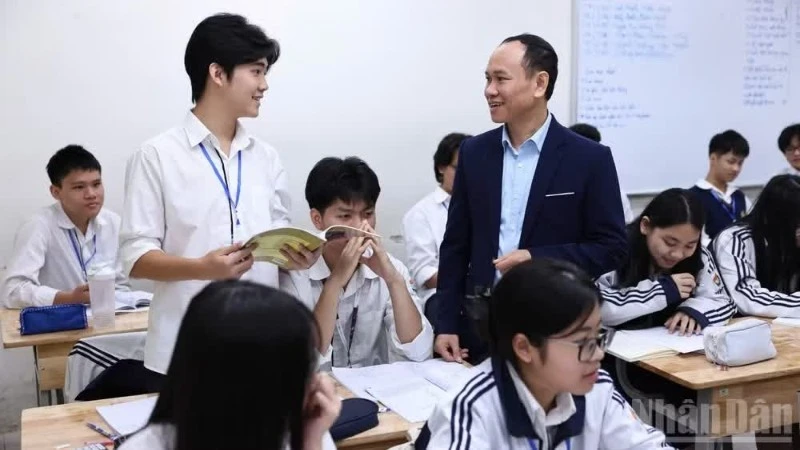
Vietnam Legalizes Hiring Retired Teachers to Enhance Education Quality
Health
2026年7月26日
5
Nhan Dan

General articles are free for 24 hours after publish.

Vietnam Legalizes Hiring Retired Teachers to Enhance Education Quality

Share
AI Summary

Vietnam's Ministry of Education and Training has introduced a new legal framework for rehiring experienced retired teachers, a significant step towards enhancing education quality and nurturing the next generation of educators. Experts anticipate this policy will contribute to Vietnam's long-term educational development.

The Ministry of Education and Training of Vietnam is advancing legal frameworks to harness the knowledge and experience of retired teachers in the educational field. The issuance of Circular No. 59/2026/TT-BGDĐT (Circular 59), which regulates full-time contract teachers and visiting lecturers after retirement, marks a significant step in concretizing related laws such as the Teacher Law, Education Law, Vocational Education Law, and University Education Law. This initiative has received positive evaluations and support from numerous experts and educators. Circular 59 not only establishes a legal basis for rehiring retired teachers but also clearly stipulates that their utilization must be based on the actual needs of educational institutions. It emphasizes that this approach should not affect the development strategies for the next generation of teachers, nor should it replace the existing core teaching staff, while adhering to labor laws. This signifies a move beyond addressing immediate labor shortages towards the sustainable development of the teaching workforce. In education, knowledge is transmitted not only through curricula and lectures but also from professional experience, pedagogical methods, scientific research capabilities, and academic prestige accumulated over many years. This is particularly true for professors, associate professors, doctors, and leading experts, whose value extends beyond teaching to guiding research, developing training programs, building research teams, and nurturing young lecturers. Many retired teachers remain healthy, possess strong professional knowledge, and wish to continue contributing. Providing opportunities for them to engage in teaching, scientific research, and professional development support addresses a practical need for many institutions, especially in fields facing a shortage of highly qualified lecturers. Experts view this policy as correct and necessary, providing a transparent legal framework for educational institutions to effectively utilize high-quality human resources. They note that the new regulations not only concretize the provisions of the Teacher Law but also create a clear legal corridor for institutions to proactively and effectively leverage their high-caliber human capital. However, to ensure the policy's effectiveness, educational institutions must comprehensively assess individual teachers' professional competence, health, ability to update knowledge, and work efficiency based on actual needs. Retired teachers should be considered a supplementary force, providing support and academic guidance, rather than replacing the development process of younger teachers. The article stresses that the notion of automatic retention upon reaching retirement age should be avoided. Regular performance evaluations based on teaching and research outcomes and actual contributions are also crucial to ensure the efficient use of this demographic. The utilization of retired teachers should be seen as a solution to rationally exploit intellectual resources accumulated over many years of work and to facilitate the transfer of professional experience to the next generation. This approach should be integrated with the training and development of younger educators, as these two tasks are not separate but complementary. When experience is inherited, knowledge is disseminated, and young teachers have more opportunities to mature, the quality of training and scientific research will continue to improve, contributing to meeting the demand for high-quality human resources in the new era.

0

Original source

Nhan Dan

原文を読む