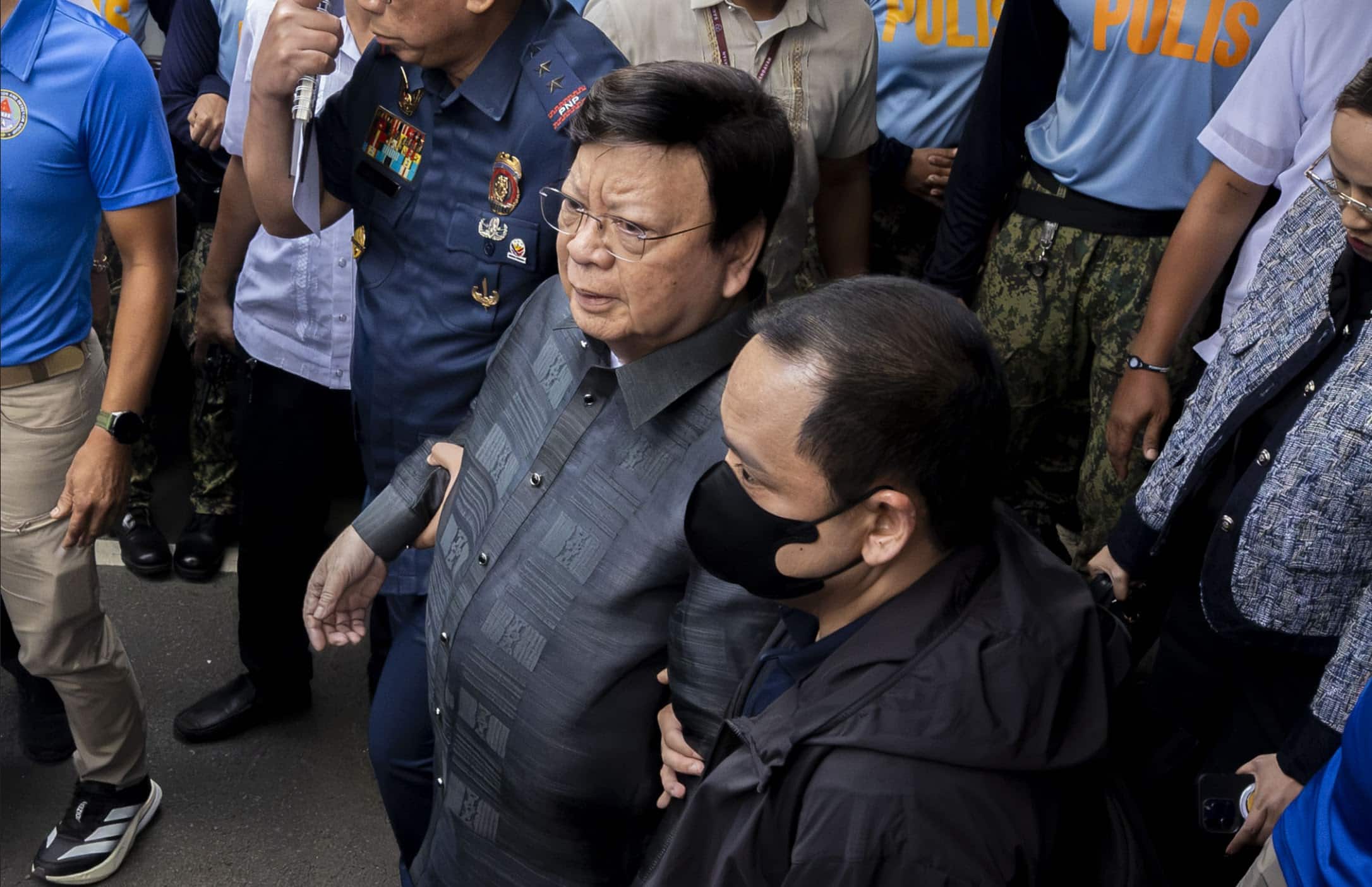
PNP says Marcoleta fit to travel, but jail transfer still uncertain
Senator Rodante Marcoleta, arrested and hospitalized, has been deemed fit to travel due to improved health, but hospital staff recommend continued admission for pneumonia treatment. His transfer to jail remains uncertain, with the court mandating daily health reports.
Sen. Rodante Marcoleta. INQUIRER PHOTO / GRIG C. MONTEGRANDE Sen. Rodante Marcoleta, who has been under hospital confinement since his arrest for a nonbailable plunder case on Monday, is now fit to travel as his health condition had improved, a Philippine National Police doctor told the Sandiganbayan on Friday. Marcoleta, unlike his coaccused former Anakalusugan Rep. Michael Defensor and businessmen Joseph Espiritu and Aristotle Viray, has yet to be committed to the Quezon City Jail after he was placed under observation at the PNP General Hospital (PNPGH) in Camp Crame due to his fluctuating blood pressure. The senator was expected to return to the Sandiganbayan last Wednesday to continue his booking process. But Lt. Col. Benaly Bayani, chief of the Internal Medicine Department at PNPGH, said Marcoleta had yet to be cleared to leave the hospital. During a hearing at the Sandiganbayan Third Division on Friday, Bayani told Associate Justice Karl Miranda, the division chair, that Marcoleta’s condition had “improved” and he was fit to travel provided he wears a face mask. “He only has occasional chest pain and no difficulty of breathing,” Bayani said. However, PNPGH recommended that Marcoleta remain in the hospital to finish the required treatment for his mild pneumonia, which was confirmed during checkups, she said. Miranda ordered Bayani to submit a daily notarized report of Marcoleta’s health condition “until he could physically come to court for [his] commitment.” Authorities already returned Marcoleta’s arrest warrant on Monday, but the court did not release a commitment order for him at that time due to his health condition. The cases filed by the Office of the Ombudsman against Marcoleta and his campaign donors—Defensor, Espiritu and Viray—stemmed from the P75-million campaign donation that the senator received from them while he was a party-list lawmaker in 2025. According to state prosecutors, the donation was not declared in the senator’s financial and campaign disclosures. Also on Friday, Associate Justice Ronald Moreno, a senior member of the Third Division, questioned the police’s decision to allow visitors to meet with Marcoleta despite the PNP doctors’ assessment that he required isolation for his mild pneumonia. Among Marcoleta’s visitors this week, aside from his lawyers and family members, were Vice President Sara Duterte and Sen. Robinhood Padilla. “Why are you allowing him to be visited if he needs isolation? That, I cannot reconcile,” Moreno asked Bayani, who took the witness stand during the hearing on the senator’s health status. Bayani explained that it was the PNP Criminal Investigation and Detection Group (CIDG) which has a say on the matter. Asked by Moreno if PNPGH will allow visitors for Marcoleta from now on, Bayani said: “No sir, I will coordinate with the CIDG.” In an interview after the hearing, Col. John Guiagui, CIDG unit director for Metro Manila, clarified that the visit of Duterte and Padilla were allowed because “that is the request of Senator Marcoleta and his family.” But from now on, Guiagui said, “We will follow the court order. We’ll see to it that visitations are restricted given [Marcoleta’s] medical condition.” Guiagui said only lawyers, immediate family members, and “requested visitors” involved in the senator’s cases can visit. Meanwhile, Miranda said the court allowed the consolidation of the plunder case in the Third Division and a separate case for violation of Presidential Decree No. 46 against Marcoleta which had been raffled off to the antigraft court’s Sixth Division. PD 46 prohibits government officials from receiving, and private individuals from giving, gifts on any occasion. On Wednesday, the Sixth Division forwarded the case records of PD 46 to the Third Division, subject to the latter’s acceptance. In a resolution, the Sixth Division said the PD 46 case “is merely a component” of plunder pending before the Third Division, noting that it is proper to consolidate PD 46 with the plunder case “for joint trial.” Aside from his plunder and PD 46 case now consolidated in the Third Division, Marcoleta is also facing two counts of violation of PD 46 in the antigraft court’s First and Fourth Divisions. Source: Inquirer NewsInfo
多角的分析
マルコレタ上院議員の事件は、直接的な経済的影響は限定的であるものの、政治的不安定性が投資家の信頼に影響を与える可能性を示唆している。過去の汚職事件では、政治家の逮捕や訴追が市場のボラティリティを高め、外国直接投資(FDI)を抑制する傾向が見られた。今回のケースは、政治家が公職にありながら不正な資金を受け取ったという疑惑であり、フィリピンのガバナンスと透明性に対する懸念を再燃させ、長期的な経済成長に影を落とす可能性がある。
投資家にとって、このニュースはフィリピンの政治リスクを再評価するきっかけとなりうる。汚職や権力乱用に関する疑惑は、法制度の信頼性やビジネス環境の予測可能性に疑問を投げかける。特に、政治家が関与する不正行為は、投資家がリスクプレミアムの上昇を要求する要因となり、資本コストの増加につながる可能性がある。今後の裁判の進展と、政府の対応が注視されるだろう。
マルコレタ議員への面会が、軽度の肺炎と診断されたにもかかわらず許可されたことは、公衆衛生と公平性に対する疑問を投げかけている。一般市民が同様の状況で特別な配慮を受けられるわけではないことから、特権階級への便宜供与との批判が生じる可能性がある。また、政治家が逮捕後も病院で手厚い治療を受け、面会も許されている状況は、法の前の平等を求める市民の声との乖離を生む可能性がある。
市民の視点では、マルコレタ上院議員の健康状態が移動可能と診断されたにもかかわらず、勾留先への移送が遅れている状況は、法の執行に対する不信感を生む可能性がある。特に、政治家が病気を理由に勾留を免れているかのような印象を与えかねず、一般市民が犯罪で逮捕された際の扱いとの格差を感じる可能性がある。これは、公務員に対する国民の信頼を損なう要因となりうる。
背景・歴史的文脈
フィリピンにおける汚職疑惑は、長年にわたる構造的な問題である。過去の政権下でも、高官の汚職事件は度々発覚し、国民の不満の的となってきた。特に、政治資金の不透明な取り扱いや、公務員が職務上の地位を利用して不正な利益を得る行為は、法の前の平等を損なうものとして批判されてきた。マルコレタ議員の事件は、2025年の選挙資金提供という文脈で、政治家と支援者間の資金の流れにおける透明性の欠如と、それがもたらす法的・倫理的課題を改めて浮き彫りにしている。
原文ソース
Inquirer NewsInfo