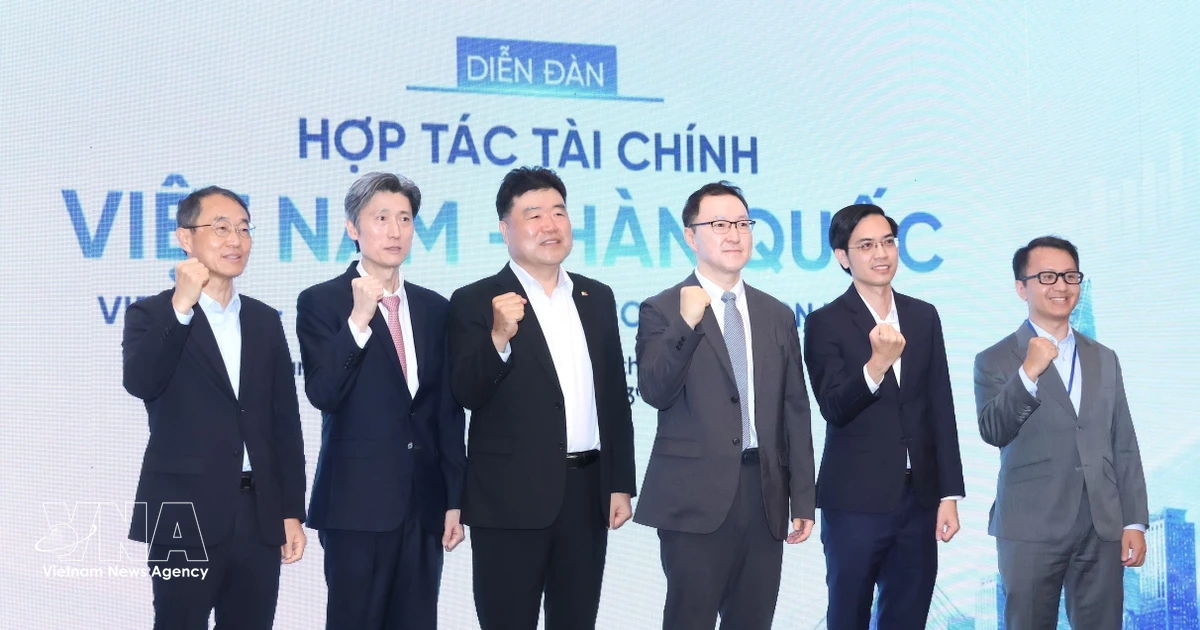
Vietnam, RoK Step Up Financial Cooperation, Expand Capital Flows into VIFC-HCMC
Vietnam and South Korea are deepening cooperation in financial collaboration and expanding capital flows. The strengths of Korean SMEs in K-brands, technology, and services align with Vietnam's young population, dynamic market, and growth potential. Vietnam is also revising its foreign investment strategy to focus on quality growth.
Vietnam and South Korea are strengthening financial cooperation and expanding capital flows into the Vietnam Investment Forum Center (VIFC)-Ho Chi Minh City. Song Chi Young, President of the Korea Federation of Micro Enterprises (KFME), stated that Vietnam's young population, dynamic market, and significant growth potential perfectly align with the strengths that Korean micro-businesses bring in K-brands, technology, and service expertise. Demand for Korean food in Vietnam continues to grow rapidly, fueled by the popularity of the "Korean Wave" or Hallyu, making the country a strategic market in South Korea's plan to expand agricultural and food exports to ASEAN, according to the Ministry of Agriculture, Food and Rural Affairs of South Korea. Resolution 10-NQ/TW marks a significant reset of Vietnam’s foreign investment strategy, introducing broad reforms to create a more unified and effective framework for attracting foreign capital. The resolution calls for a shift in development mindset, positioning FDI as a key driver of growth model transformation, with a focus on quality, value addition, and continuous improvement of the economy's intrinsic capacity and self-reliance. Many experts and businesses believe the policy provides a timely strategic boost, helping Vietnam to capitalize on the ongoing global supply chain realignment. Ho Chi Minh City is currently home to 20,259 FDI projects with a total registered capital of nearly $142 billion from 152 countries and territories. In the first half of 2026, the city attracted over $6.8 billion, fulfilling 62% of its annual target. Enterprises will receive State support covering 50% of interest payments on commercial loans used for technology application, transfer, and innovation projects, capped at 6% per year for up to five years. The campaign is expected to stimulate domestic consumption, boost retail sales, support economic growth, promote Vietnamese brands, and encourage consumers to prioritize locally made products while attracting international visitors via shopping events. The figures recorded in the first half of 2026 just reflected positive short-term results. Long-term success would depend not only on the growth pace but also on the quality and resilience of the economy and the sustainability of growth engines. With the current trading band of +/- 5%, the ceiling rate applicable for commercial banks during the day is 26,481 VND/USD, and the floor rate 23,959 VND/USD. According to a recent report by BIDV Securities (BSC), these projects span residential and urban developments, airports, expressways, high-speed rail, industrial facilities, and other strategic infrastructure. The advisory board will support research, provide policy advice, and recommend strategic directions for the center’s development, the VIFC-HCMC Executive Board said. Under the plan, Hanoi aims to maintain annual gross regional domestic product (GRDP) growth of 11% during 2026–2035 and 2036–2045, before easing to 5% during 2046–2065 and 4.5% during 2066–2085. The Ho Chi Minh City Development Joint Stock Commercial Bank (HDBank – HoSE: HDB) has successfully raised $721 million in an international syndicated loan from international financial institutions in the form of a Social Loan. Around the world, investors are increasingly choosing locations based not only on costs and logistics, but also on renewable energy, carbon performance, circular economy solutions, and ESG standards, experts said. Vietnamese Ambassador to Brazil Bui Van Nghi informed that two-way trade reached $4.22 billion in the first six months of 2026, up 16.8% year-on-year. Brazil's exports to Vietnam exceeded $2 billion, rising 16.6%, while its imports from Vietnam totalled about $2.11 billion, an increase of 17%. The restored Kunming–Nha Trang route is expected to cater to growing travel demand and facilitate tourism, trade, and cultural exchanges between Vietnam and China. Among the 218 economies assessed this year, Vietnam was one of only six to be upgraded to a higher income category by the WB Group. The move marks a notable milestone after 17 years in the lower-middle-income group, where Vietnam had remained since 2009. For Vietnam, the challenge is not simply adopting new technologies but ensuring that supply chains are sustainable and capable of generating long-term value. The company sold 172,299 motorcycles in June, up 4.7% from the same month last year, highlighting steady consumer demand even as the market gradually shifts towards greener transport options. For the first six months of 2026, motorcycle sales reached 515,743 units, up 0.6% year-on-year. Developed under a strategic cooperation agreement between the Vietnamese and Japanese governments, the nearly 1,000-hectare industrial park is expected to become the city's first eco-industrial park under the country's new regulatory framework. A key target is that by 2030, all concentrated agricultural, forestry, and fisheries production areas will have access to essential services, including product traceability, quarantine, testing, quality certification, processing, and market development. The move reflects growing international demand for stricter food safety, quality, and traceability standards, which have become increasingly important for agricultural exports. Copyright, VietnamPlus, Vietnam News Agency (VNA) Editor-in-chief, Mr. Tran Tien Duan.
多角的分析
ベトナム政府が推進する決議10-NQ/TWは、FDI(外国直接投資)を経済成長の主要な原動力と位置づけ、質、付加価値、自律性向上に焦点を移す戦略転換を示唆している。これは、従来の労働集約型産業から、より高度な技術やイノベーションを伴う産業へのシフトを意図していると考えられる。韓国の中小企業が持つ技術やサービスノウハウとの連携は、この戦略に合致し、ベトナム経済の「内包的生産能力」を高める可能性を秘めている。また、商業ローン利息支援は、国内企業の技術導入やイノベーションを促進し、経済の持続的成長を後押しするだろう。
ベトナムの FDI 戦略見直しは、投資家にとってより質の高い、付加価値の高いプロジェクトへの投資機会を示唆している。韓国との金融協力強化は、資本流入の安定化と多様化に寄与し、特に技術やサービス分野への投資を促進する可能性がある。ホーチミン市の堅調な FDI 誘致実績と、HDBank による大型シンジケートローン調達成功は、ベトナムの金融市場の健全性と国際的な信頼性を示している。ESG基準や再生可能エネルギーへの関心の高まりは、将来的な投資判断において重要な要素となるだろう。
ベトナムの若年人口とダイナミックな市場は、韓国のKブランドやサービスに対する需要を牽引している。これは、消費文化の国際化を加速させると同時に、国内産業の品質向上への刺激ともなりうる。決議10-NQ/TWは、経済成長だけでなく、より高度な産業構造への移行を目指しており、これは将来的な雇用機会の質や労働者のスキルアップにも影響を与えるだろう。また、食の安全やトレーサビリティへの国際的な需要の高まりは、国内の生産者や消費者に、より高い基準での生産・消費を促す圧力となる。
ベトナム国民、特に若年層は、韓国のKブランドや韓流文化への関心の高まりを通じて、国際的な消費トレンドに触れる機会が増えている。これは、国内消費の活性化に繋がり、経済成長を後押しする側面がある。一方で、決議10-NQ/TWが目指す経済の質的向上は、将来的に、より高度なスキルを持つ人材への需要を高め、教育や職業訓練の重要性を増す可能性がある。また、食品安全基準の向上は、消費者の健康を守る上で歓迎されるべき動きである。
背景・歴史的文脈
ベトナムは1986年のドイモイ(刷新)政策以降、市場経済を導入し、外国からの投資を積極的に誘致してきた。当初は労働集約型産業が中心だったが、近年は経済の高度化を目指し、FDI戦略の見直しを進めている。決議10-NQ/TWは、この流れを一層加速させ、技術革新や高付加価値産業への投資を重点化する方針を示している。韓国とは、地理的な近さと経済的な結びつきの強さから、長年にわたり緊密な関係を築いており、特に製造業分野での投資が活発である。今回の金融協力強化は、両国の経済関係をさらに深化させるものと見られる。
原文ソース
VietnamPlus English