General articles are free for 24 hours after publish.
Typhoon No. 5 Moves Northward, Exits East Sea Without Direct Impact on Vietnam Coast
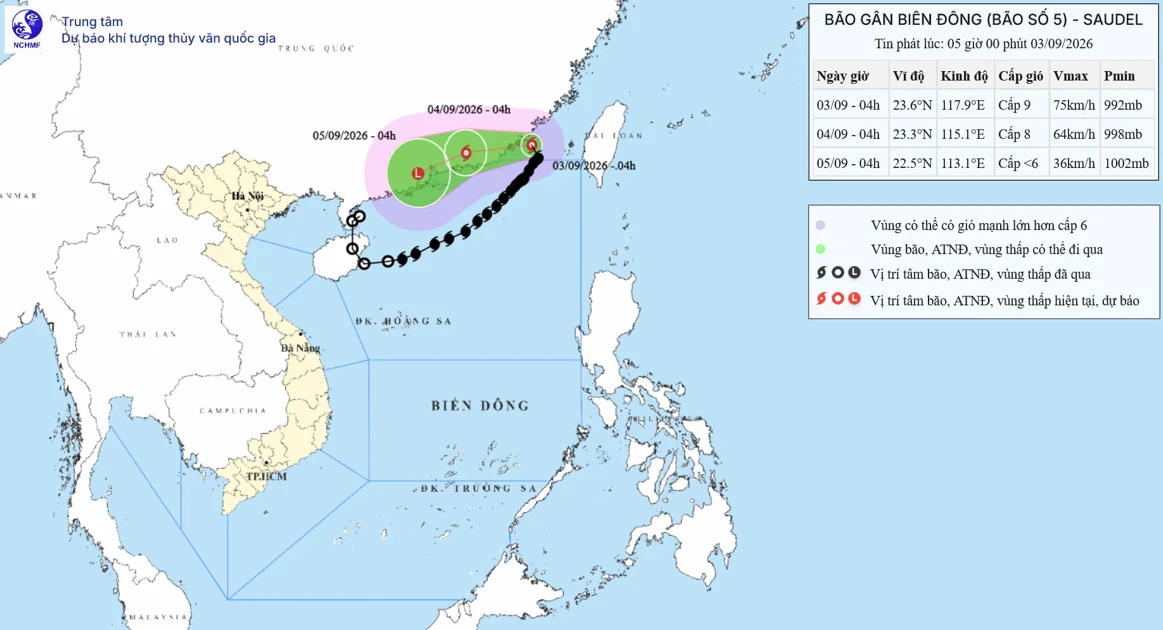
Typhoon No. 5, which had been approaching Vietnam's coast, shifted its course northwestward early on September 3, moving towards the Bashi Channel. This averted a direct impact on the Vietnamese mainland, though vigilance against high waves and strong winds is still required in a wide area.
Early on September 3, Typhoon No. 5, which had been approaching Vietnam's coast, shifted its course northwestward, moving towards the Bashi Channel. This is expected to avert a direct impact on the Vietnamese mainland. As of 4 AM local time on September 3, the typhoon's center was located at approximately 23.6 degrees North latitude and 117.9 degrees East longitude, over the sea northeast of the northern East Sea. The maximum wind speed near the center was force 8-9 (62-88 km/h), with gusts up to force 11 (110 km/h). The typhoon was moving west-northwest at a speed of about 10 km/h. Forecast for the next 24–60 hours: Due to the typhoon's impact, the sea area northeast of the northern East Sea is expected to experience strong winds of force 6-7 (39-61 km/h), with gusts up to force 8-9 (62-88 km/h), and wave heights of 2-4 meters. In the area where the typhoon's center passes, there will be storms of force 8 (62-74 km/h), with gusts up to force 10 (89-102 km/h), and wave heights of 3-5 meters, making the sea rough. Vessels operating in these dangerous areas are likely to be affected by squalls, tornadoes, strong winds, and high waves. Vietnam is situated along the path of tropical depressions and typhoons, and coastal areas often suffer damage during this season each year. Typhoon No. 5 was closely monitored by Vietnam's meteorological authorities regarding its trajectory. For coastal residents and fishermen, the approach of typhoons is always a matter requiring vigilance, necessitating early evacuation and safety preparations. Source: Nhan Dan
Original source
Nhan Dan