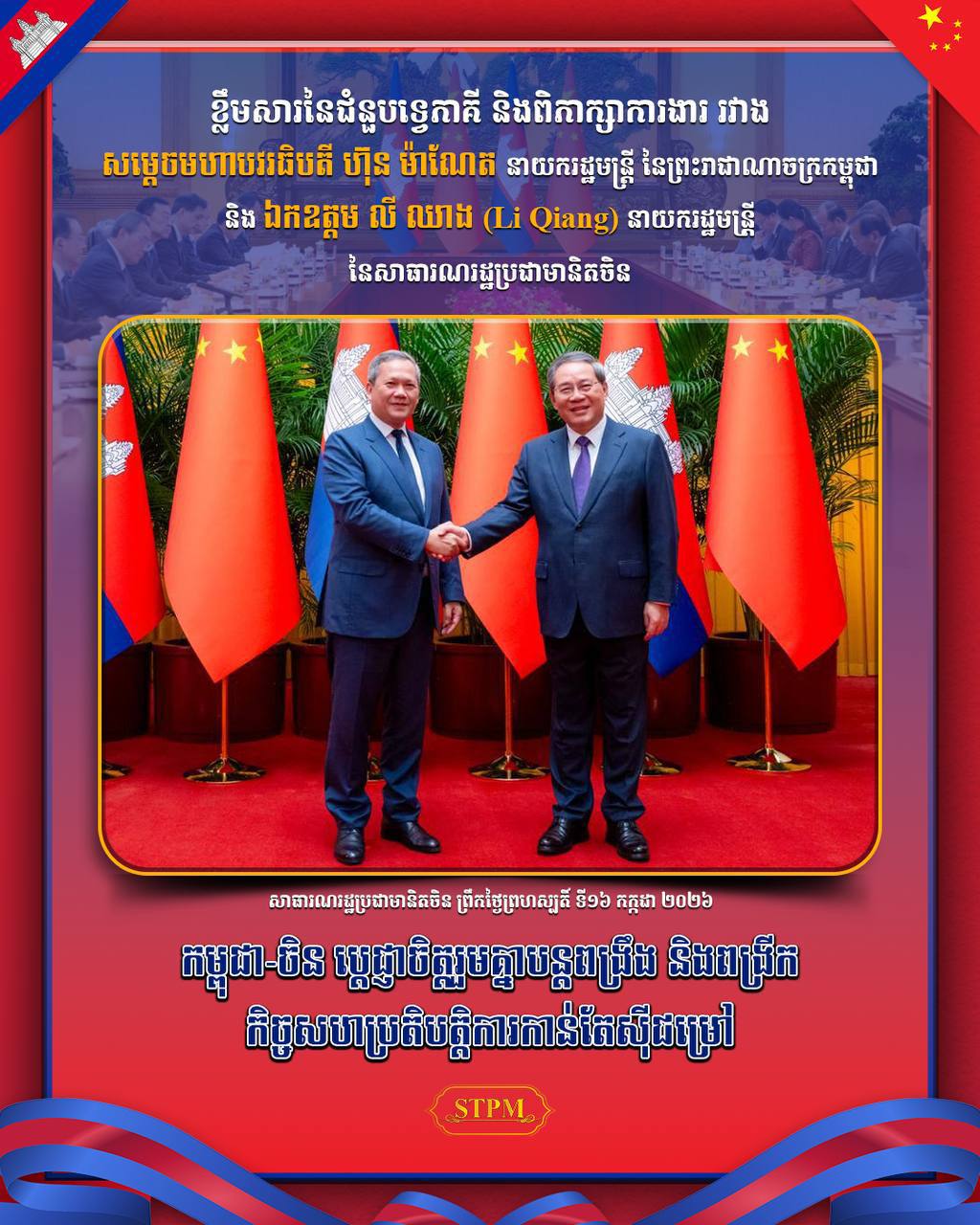
Cambodia and China Vow to Deepen 'Ironclad' Partnership, Expand Economic and Security Cooperation
Cambodian Prime Minister Hun Manet and Chinese Premier Li Qiang reaffirmed the strength of their 'ironclad' alliance, agreeing to further deepen cooperation across various sectors including politics, economy, infrastructure, and security. China considers its relations with Cambodia a diplomatic priority.
Cambodian Prime Minister Hun Manet held bilateral talks with Chinese Premier Li Qiang on July 16th local time in China, during his working visit and participation in the World Artificial Intelligence Conference. Both leaders reaffirmed the strength of the Cambodia-China 'ironclad' alliance, agreeing to continue cooperating to promote their respective modernization and address global uncertainties. Premier Li highlighted that frequent high-level exchanges and active consultations between China and Cambodia reflect the robustness of their relationship and the progress of their cooperation. He emphasized that China considers its relations with Cambodia a diplomatic priority. In response, Prime Minister Hun Manet expressed his deep gratitude for the warm hospitality extended by the Chinese government and people. He highly valued the progress of Cambodia-China relations, noting that both countries are comprehensive strategic cooperative partners and 'ironclad' friends, jointly striving to build a 'new era Cambodia-China community of shared future.' Prime Minister Hun Manet reiterated Cambodia's unwavering adherence to the 'One China' principle, considering issues related to Taiwan, Hong Kong, Xinjiang, and Tibet as China's internal affairs. The heads of government of both countries discussed and exchanged views on several new initiatives and directions aimed at further strengthening and expanding key areas of cooperation. These include politics and diplomacy, economy and trade, infrastructure connectivity, green energy, agriculture, national defense and security, and people-to-people exchanges, particularly in tourism and education. Before concluding, Prime Minister Hun Manet briefed Premier Li on recent developments in the Cambodia-Thailand border situation, emphasizing Cambodia's commitment and stance to resolve border issues peacefully, based on international law and in accordance with existing conventions, treaties, and agreements between Cambodia and Thailand. Source: AKP Khmer
多角的分析
両国首脳会談は、カンボジア経済の中国への依存度をさらに高める可能性を示唆している。インフラ接続、グリーンエネルギー、農業分野での協力拡大は、中国からの直接投資や技術移転を促進するだろう。しかし、これらの協力がカンボジアの経済的自立をどの程度強化するか、あるいは対中債務リスクを増大させるかは、具体的な実施内容と条件にかかっている。過去のインフラプロジェクトにおける中国の融資条件は、しばしば透明性の問題や返済負担の増加を招いてきた経緯がある。
今回の会談は、カンボジアへの投資を検討する投資家にとって、中国との関係強化がもたらす安定性と潜在的リスクの両面を考慮する材料となる。インフラやエネルギー分野での協力拡大は、新たなビジネスチャンスを生む可能性がある。一方で、経済が中国の影響下に置かれることへの懸念や、地政学的なリスクの増大は、投資判断において慎重な評価を要する。特に、中国の経済政策や国際関係の動向が、カンボジア国内のビジネス環境に直接影響を与える可能性がある。
両国関係の深化は、カンボジア国民の生活に間接的な影響を与える可能性がある。特に観光や教育分野での交流拡大は、文化的な相互理解を深める一方で、中国の観光客や留学生の増加が、国内のインフラや社会サービスに新たな圧力をかけることも考えられる。また、安全保障協力の強化は、国内の治安維持に寄与する可能性があるが、その実施方法によっては、市民の自由や権利に対する懸念が生じる可能性も否定できない。過去には、中国関連プロジェクトにおける労働者の待遇や、環境への影響を巡る懸念が一部で表明された事例もある。
カンボジア国民にとって、中国との関係強化は経済発展の恩恵をもたらす可能性がある一方で、国内の経済的自立性や、社会インフラへの影響といった懸念も抱かせる。特に、インフラ開発や資源開発における中国との協力は、雇用創出や経済成長に繋がる可能性があるが、その恩恵が国民全体に公平に行き渡るか、あるいは環境への負荷が増大しないかといった点が問われる。また、両国間の人的交流の活発化は、文化交流を促進する一方で、社会的な摩擦を生む可能性も考慮する必要がある。
背景・歴史的文脈
カンボジアと中国の関係は、長年にわたり「鉄の同盟」として称され、政治、経済、安全保障の各分野で緊密な協力関係を築いてきた。特に2010年代以降、中国はカンボジアへの経済支援や投資を大幅に拡大し、インフラ開発(道路、港湾、ダムなど)や資源開発において主要な役割を担ってきた。これは、中国が東南アジアにおける影響力拡大を目指す「一帯一路」構想とも連動している。カンボジア側は、中国からの投資や支援を経済発展の原動力と位置づけ、中国の「一つの中国」政策を支持するなど、外交的にも中国に足並みを揃える姿勢を明確にしてきた。今回の会談は、こうした両国間の強固な関係性を再確認し、今後の協力の方向性を具体化するものである。
原文ソース
AKP Khmer