General articles are free for 24 hours after publish.
CMC University Launches AI-Native Learning Ecosystem
Vietnam's CMC University has launched the 'CAINLE' AI-Native Learning Ecosystem, integrating students, faculty, materials, activities, and data to personalize learning and support data-driven decisions. AI aims to reduce faculty workload and enhance educational quality.
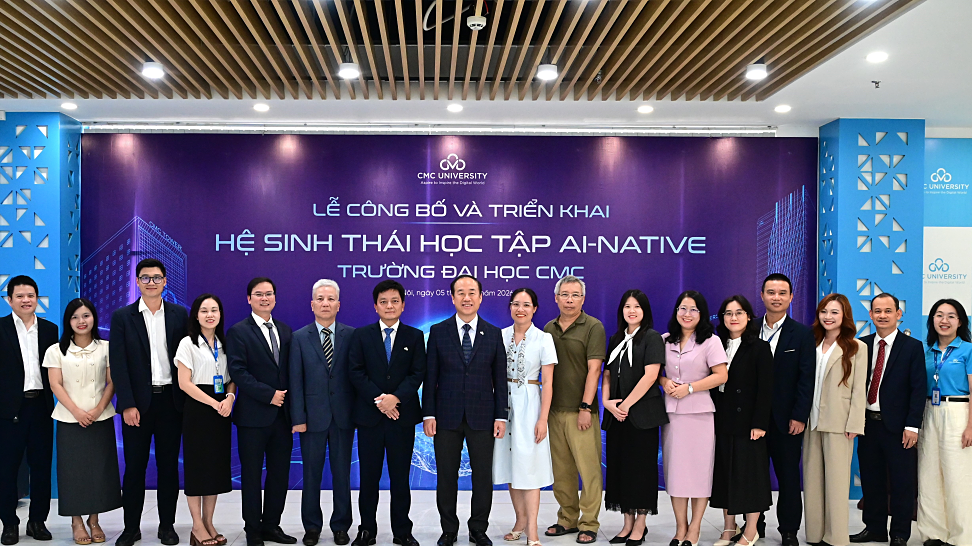
CMC University has officially launched the CMCU AI-Native Learning Ecosystem (CAINLE), marking a significant step in its strategic transformation towards becoming an AI-Native University. This initiative is designed to embed artificial intelligence as a core competency from the ground up, rather than as an add-on to existing systems. The CAINLE ecosystem serves to connect learners, faculty, learning materials, academic activities, and data into a unified and cohesive environment. According to university representatives, the system leverages data generated throughout the learning process to personalize the educational experience. It also empowers faculty and the institution to make informed decisions based on comprehensive data analysis. For students, CAINLE is designed to cultivate proactive learning habits. Before each class, learners are encouraged to study materials and complete tasks as guided by their instructors, with the system providing timely reminders. Ongoing updates on performance and feedback allow students to identify areas where they may be struggling, enabling them to refine their learning strategies. When students encounter academic difficulties, they can engage with subject-specific AI assistants or submit questions directly to their instructors. Issues requiring more in-depth clarification are logged by the system and forwarded to faculty. This approach aims to ensure that valuable in-class time is dedicated to more engaging activities such as discussions, critical analysis, and the resolution of complex problems. Faculty members are provided with data regarding student learning progress, participation levels, and specific areas where students face challenges. This information serves as a basis for faculty to adjust their teaching methodologies and organize activities tailored to the needs of different student groups. University officials have stressed that AI is positioned as a supportive tool for faculty, not a replacement. The system is intended to alleviate the burden of repetitive tasks, thereby freeing up educators to focus on higher-value activities. These include providing academic advising, inspiring students, facilitating group discussions, and nurturing students' critical thinking skills. Furthermore, every activity within CAINLE generates data that contributes to the continuous improvement of educational quality. The system aggregates and analyzes data at the student, class, and curriculum levels, assisting faculty, specialized departments, and administrative staff in identifying trends, recognizing support needs, and making necessary adjustments to educational programs. The university assures that data utilization is conducted in accordance with principles of transparency, confidentiality, and with the ultimate decision-making authority resting with human personnel. Associate Professor Dr. Nguyen Thanh Tung, Rector of CMC University, explained that an AI-Native University involves a fundamental redesign of how the institution educates, researches, and operates. AI is integrated from the initial design phase to augment the capabilities of learners, faculty, and the organization, while humans retain their central role and ultimate responsibility. CAINLE is not viewed as an isolated technological project but as an integral part of the university's journey towards realizing its AI-Native University vision. In this model, AI is identified as a core competency that works alongside humans in education, research, administration, and service delivery to learners. While digital universities focus on digitizing processes and AI-enabled universities integrate AI into existing operations, the AI-Native University model aims for a comprehensive redesign of educational, research, and operational paradigms built upon AI and data. In this framework, AI supports analysis, offers suggestions, and automates numerous tasks, but humans remain at the core of all decision-making processes. The deployment of CAINLE signifies a transition from applying AI as discrete tools to building a holistic learning ecosystem guided by an AI-Native philosophy. According to university representatives, this model seeks to personalize learning journeys, enhance faculty capabilities, and drive data-informed improvements in educational quality, thereby realizing CMC University's ambition to be an AI-Native University in the era of artificial intelligence.
Original source
VnExpress