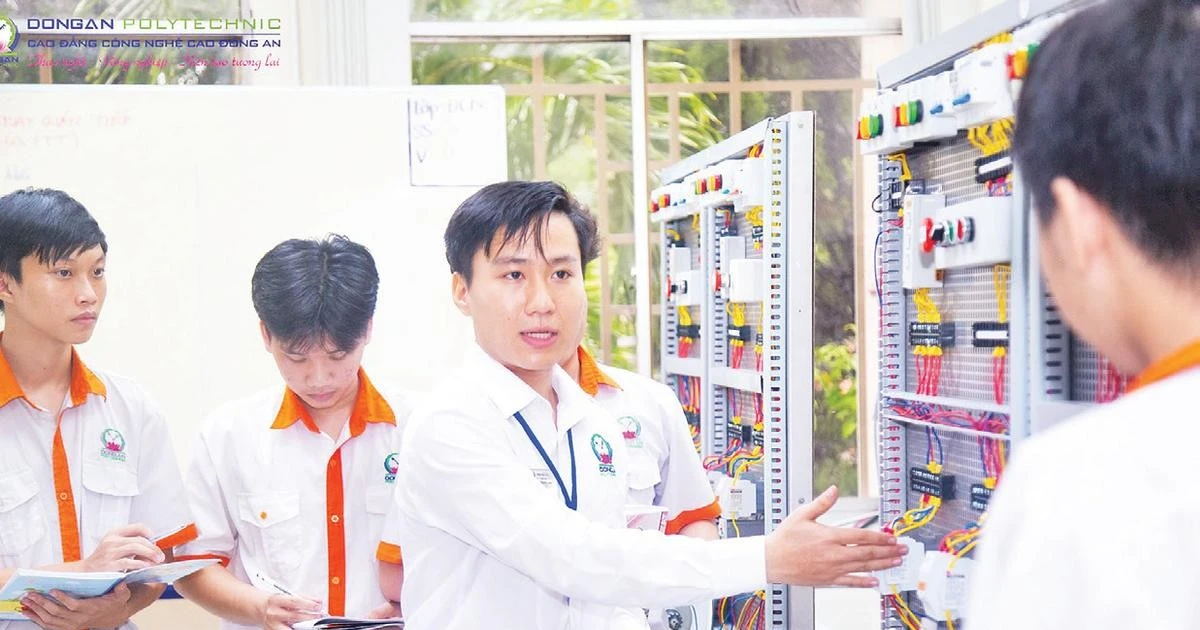
Vietnam Elevates Vocational Education Quality with Practical Focus and International Standards
Health
2026年7月20日
6
Nhan Dan
Relations
🇻🇳Vietnam🇯🇵Japan

General articles are free for 24 hours after publish.

Vietnam Elevates Vocational Education Quality with Practical Focus and International Standards

Share
AI Summary

Ho Chi Minh City prioritizes vocational education quality as crucial for human resource development. Cao Thang College of Vocational Technology is transitioning to practical, internationally benchmarked programs, adopting ABET and Japan's KOSEN models to meet evolving labor market demands.

Ho Chi Minh City has identified the improvement of vocational education quality as a top priority task in enhancing the quality of human resources. The core objective is to create a direct workforce with high quality, efficiency, and professional skills to serve socio-economic development. As one of the vocational education institutions with over a century of experience in training technical human resources for the country, Cao Thang College of Vocational Technology consistently adheres to its development goal of quality, practical learning, practical application, and international integration. According to Dr. Le Dinh Kha, the college's Rector, in the context of rapidly changing technology and labor markets, training programs cannot be a fixed set of documents but must be considered a "living entity" that is continuously reviewed, updated, and improved. The highest goal is to ensure that graduates possess the competence to work immediately after graduation, while also having the ability to adapt to technological advancements and lifelong learning. The construction and improvement of training programs are carried out by the college following a continuous improvement cycle, with the participation of all stakeholders, including lecturers, businesses, students, alumni, and industry experts. Currently, all training programs at Cao Thang College of Vocational Technology are being developed according to ABET (Accreditation Board for Engineering and Technology) standards. Adopting ABET not only aims to achieve international accreditation but, more importantly, to build an international standard quality assurance system. Accordingly, all training activities are directed towards output standards, measured by specific evidence, and continuously improved based on the assessment results of learners, feedback from businesses, and stakeholders. Concurrently, the college is adopting the KOSEN model (Japan's KOSEN model), implementing its core advantages such as innovating teaching and learning methods towards competency development. The KOSEN model emphasizes the integration of fundamental knowledge with practical skills, enhanced project-based learning, and the development of problem-solving abilities, creativity, teamwork, and self-learning capacity of learners. In the new development phase, with the requirement to improve human resource quality to serve rapid and sustainable growth, vocational education is identified as playing an increasingly important role. From this practical reality, many vocational education institutions in Ho Chi Minh City are strongly shifting from a mindset of training based on supply capacity to training based on labor market demand, using post-graduation employment rates and learner adaptability as measures of development. Educational institutions are promoting synchronous innovation in governance, training programs, facilities, and especially close collaboration between the State, schools, and businesses. Currently, the city has over 480 vocational education institutions, including 77 colleges, 77 intermediate schools, nearly 30 vocational education and continuing education centers, 74 vocational education centers, and 224 vocational education establishments. To enhance training quality, the city is accelerating investment in the vocational education institution network, striving for at least 80% of vocational education institutions to meet national standards and 20% to be equipped with modern facilities comparable to those in developed Asian countries. Simultaneously, it will select and invest in modern facilities and teaching equipment comparable to those in developed Asian countries for two public colleges under the city. Ms. Truong Hai Thanh, Deputy Director of the Ho Chi Minh City Department of Education and Training, stated that to effectively implement the set objectives, the department needs to focus on raising awareness, innovating thinking and actions, and demonstrating strong political determination to achieve breakthroughs in education and training in general and vocational education in particular. Relevant units need to build and improve sustainable systems and ensure quality at vocational education institutions. Along with that, it is necessary to reorganize public non-business units in conjunction with improving educational quality, financial autonomy, and accountability. Accelerate comprehensive digital transformation, creating breakthroughs in educational quality through the application of digital technology and artificial intelligence; build a teaching staff, facilities, and teaching equipment that meet prescribed standards and approach the advanced level of countries in the ASEAN region and the world. According to experts, vocational education can only develop sustainably when the "three-party" link—school, enterprise, and State—is built as a closely cooperative ecosystem. This should not just be a slogan or a campaign activity but must become the philosophy and long-term development strategy of each vocational education institution.

0

Original source

Nhan Dan

原文を読む