General articles are free for 24 hours after publish.
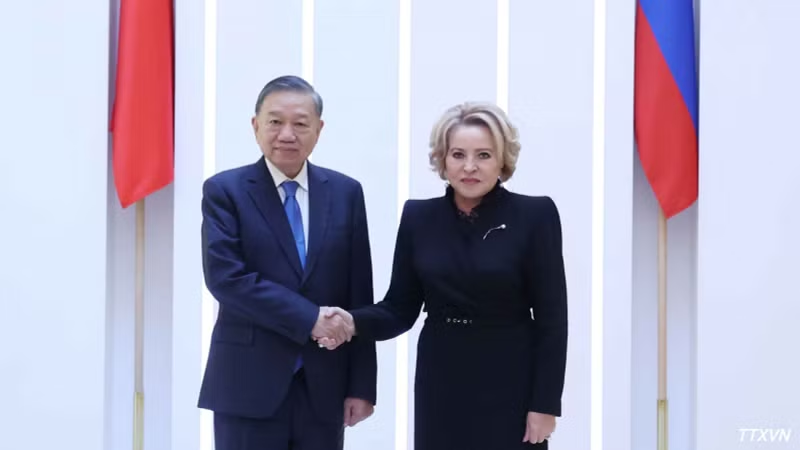
Vietnamese President Meets with Russian Federation Council Speaker, Boosting Bilateral Ties
Vietnamese President and General Secretary of the Communist Party, Tô Lâm, met with Valentina Matviyenko, Speaker of the Federation Council of Russia, in Moscow. The meeting affirmed strengthened bilateral ties and expanded cooperation in cultural heritage. During his visit, President Tô Lâm also held discussions with other Russian officials and paid respects at the Ho Chi Minh statue.
Vietnamese President and General Secretary of the Communist Party, Tô Lâm, met with Valentina Matviyenko, Speaker of the Federation Council (upper house) of the Federal Assembly of Russia, in Moscow on the afternoon of September 8 (local time, evening of the same day, Hanoi time) as part of his state visit to the Russian Federation. The meeting served as an opportunity to further deepen the strategic partnership between the two countries. Both sides reaffirmed the importance of cooperation in various fields including politics, economy, and culture. Discussions likely focused on expanding cultural heritage sharing and exchange programs aimed at fostering mutual understanding. During his stay in Russia, President Tô Lâm also met with Nikolai Patrushev, Assistant to the President and Chairman of the Russian Federal Maritime Board, potentially discussing cooperation in security and maritime affairs. He also laid wreaths at the statue of President Ho Chi Minh and the Tomb of the Unknown Soldier in Moscow, honoring the historical ties and sacrifices of both nations. This visit by President Tô Lâm underscores Vietnam's commitment to its relationship with Russia. Vietnam, while pursuing economic growth under its one-party system, maintains a foreign policy focused on diversifying and developing relations with various countries. Its ties with Russia are seen as part of this broader strategy. In the context of rising geopolitical tensions, strategic cooperation with Russia holds particular significance for Vietnam's foreign policy.
Original source
Nhan Dan