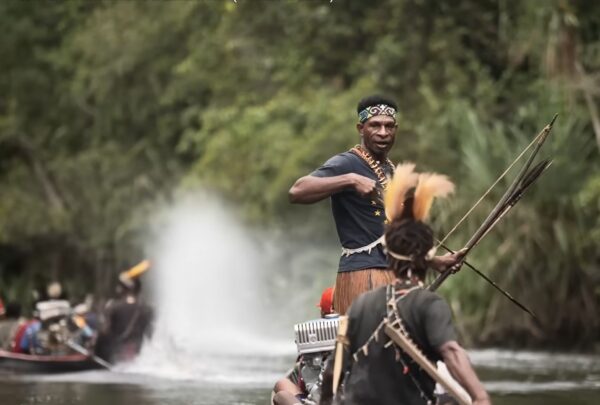
Indonesian Documentary Exposes Papuan Indigenous Plight, Sparks Government Backlash
The latest documentary, "Pig Feast: Colonialism in our time," exposes the Indonesian government's oppression of Indigenous Papuans and deforestation due to large-scale development, drawing strong government backlash. The film highlights the reality of National Strategic Projects (PSN) that disregard Indigenous livelihoods and culture.
The recent film “Pig Feast: Colonialism in our time” has elicited a strong negative reaction from the Indonesian government, as it exposes the long-standing oppression of Indigenous Papuans and the severe deforestation caused by large-scale National Strategic Projects (PSN). The 95-minute documentary, by directors Dandhy Laksono and Cypri Dale, uses interviews with Papuan leaders and villagers, along with footage of extensive destruction and loss, to highlight how the PSN has created what they describe as the "world's largest ongoing deforestation project." The film criticizes these projects for prioritizing food and energy security at the expense of Indigenous communities and ecosystems. Set against the historical backdrop of West Papua, which came under Indonesian control in 1963, the film illustrates the routine human rights violations faced by Indigenous Papuans since its formal incorporation into Indonesia following a controversial U.N.-administered referendum in 1969. It recalls periods of intense Indonesian military operations, including massacres of villagers, systematic starvation campaigns, and widespread rape and torture in 1998. While direct military action has decreased, abuses by police and paramilitary forces against Indigenous communities, particularly targeting activists, continue. Furthermore, a strategy of "Indonesianization" has been pursued, driven by a racist worldview that Malay Indonesians are better equipped to utilize Papua's rich resources than Melanesian Indigenous Papuans. This strategy has involved assimilation through the education system and media, as well as the transmigration of settlers from other parts of Indonesia. The PSN, promoted under the guise of food self-sufficiency and security, is proceeding without the consent of local Indigenous groups. It aims to convert 2.5 million hectares of Papuan forest into 1.3 million hectares of rice fields, alongside palm oil plantations and other developments. This deforestation destroys the livelihoods that serve as the Indigenous Papuans' "supermarket," "food barn," and "bank," and contributes to mass displacement, with over 105,878 reported internally displaced persons (IDPs) in West Papua by early 2026. The project is likened to "military operations other than war," involving approximately 56,000 troops. Military personnel have been involved in customary land seizures and intimidation tactics to pressure landowners into signing away rights for minimal compensation. These military forces also support powerful corporations with close ties to the Indonesian government, such as the Jhonlin Group and Merauke Sugar Group. The documentary labels the crisis in West Papua a "slow-motion genocide" but also highlights the resilience and resistance strategies of the Indigenous Papuans. Numerous red crosses and customary markers planted on sacred land serve as symbols of resistance, demarcating territorial boundaries and warning outsiders against intrusion. Source: The Diplomat Indonesia
多角的分析
インドネシア政府が推進する国家戦略プロジェクト(PSN)は、食料・エネルギー安全保障を名目に掲げているが、その実態はパプアの広大な森林を農地やプランテーションに転換する大規模開発である。これは、外貨獲得や国内市場への供給拡大という経済的利益を追求する一方で、先住民の伝統的な生活基盤を破壊し、持続可能性に疑問を投げかける。特に、バイオ燃料生産目標達成のための森林伐採は、国際的な気候変動対策の文脈からも批判されるべき側面を持つ。経済成長の恩恵が一部の企業や政府関係者に集中し、地域社会への還元がなされない構造は、インドネシア経済が抱える構造的な課題を浮き彫りにしている。
PSNは、インドネシア政府が経済成長の起爆剤として位置づける大規模開発であり、国内外の投資家にとって魅力的な機会と映る可能性がある。特に、農業、バイオ燃料、インフラ分野への投資が期待される。しかし、本ドキュメンタリーが示すように、これらのプロジェクトは先住民の権利侵害や環境破壊といった深刻なリスクを内包している。投資家は、ESG(環境・社会・ガバナンス)の観点から、プロジェクトの持続可能性と倫理的な側面を慎重に評価する必要がある。政府との強い結びつきを持つ企業(Jhonlin Group、Merauke Sugar Groupなど)への投資は、政治的リスクと表裏一体であり、透明性の欠如は投資判断をさらに難しくするだろう。
ドキュメンタリーは、パプア先住民が直面する「現代の植民地主義」とも言える状況を告発している。彼らの慣習的な土地、食料源、そして文化的アイデンティティの根幹である森林が、国家主導の開発によって奪われている。これは単なる土地収奪に留まらず、先住民の生活様式、社会構造、そして精神的な繋がりをも破壊する。特に、大規模な森林伐採は、先住民の「食料庫」であり「銀行」でもある自然環境を破壊し、食料不足とそれに伴う健康被害、さらには大規模な国内避難民の発生を招いている。さらに、軍や警察による威圧的な土地収奪や、過去の紛争における人権侵害の歴史は、先住民コミュニティに深い傷を残し、社会的な分断を深めている。映画で示される赤い十字架のような抵抗のシンボルは、彼らが文化と土地を守ろうとする強い意志の表れである。
パプア先住民の生活は、国家戦略プロジェクト(PSN)の拡大によって直接的に脅かされている。彼らの伝統的な食料源であるサゴヤシ林が伐採され、農地やプランテーションに転換されることで、食料の確保が困難になっている。これは、単に食料不足の問題に留まらず、彼らの文化や生活様式そのものの維持を危うくする。また、森林破壊やそれに伴う紛争は、多くの人々を故郷から追いやる国内避難民(IDP)を生み出しており、彼らの生活基盤を根底から覆している。軍や企業による土地の収奪は、先住民コミュニティの自治と尊厳を侵害し、彼らを社会的に周縁化する結果を招いている。映画で描かれる抵抗のシンボルは、彼らが置かれた過酷な状況下での生存と尊厳を守るための必死の訴えである。
背景・歴史的文脈
西パプアは、1963年にインドネシアの統治下に入り、1969年の住民投票を経て正式に編入された。しかし、この編入プロセスは、多くの人権侵害を伴うものであったと指摘されている。以来、インドネシア政府は、パプアの資源開発と「インドネシア化」政策を推進してきた。特に、国家戦略プロジェクト(PSN)は、食料・エネルギー安全保障を名目に、大規模な森林伐採や土地転換を伴う開発を進めている。これは、先住民の土地利用権や伝統的な生活様式を無視するものであり、長年にわたり人権侵害や環境破壊の温床となってきた。今回のドキュメンタリーは、この歴史的背景を踏まえ、現代における植民地主義的な開発の実態を告発している。
原文ソース
The Diplomat Indonesia