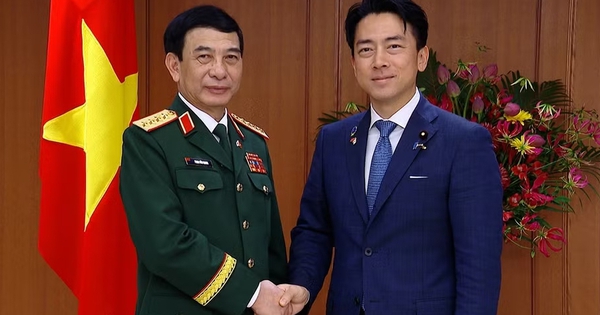
Vietnam, Japan Boost Defense Cooperation in Tokyo Talks
Vietnamese Deputy Prime Minister and Minister of National Defense Phan Van Giang met with Japanese Minister of Defense Koizumi Shinjiro in Tokyo, agreeing to deepen defense cooperation. Vietnam reaffirmed its "Four Nos" defense policy and stressed peaceful resolution of East Sea disputes. Japan recognized Vietnam as a key partner for peace and stability in the Indo-Pacific.
Deputy Prime Minister and Minister of National Defense Phan Van Giang of Vietnam held talks with Japanese Minister of Defense Koizumi Shinjiro in Tokyo on July 13, 2026. During the meeting, Giang reiterated Vietnam's consistent foreign policy of independence, self-reliance, diversification, and multilateralization, as well as its "Four Nos" defense policy. The "Four Nos" policy entails no participation in military alliances, no siding with one country to act against another, no foreign military bases on Vietnamese territory or using Vietnam to counteract other countries, and no use of force or threat of force in international relations. Giang emphasized Vietnam's principled stance that disputes in the East Sea must be resolved peacefully on the basis of international law, including the 1982 United Nations Convention on the Law of the Sea (UNCLOS). He also stressed the importance of fully implementing the Declaration on the Conduct of Parties in the East Sea (DOC) and accelerating the conclusion of a substantive, effective, and efficient Code of Conduct in the East Sea (COC). Giang expressed appreciation for the support from the Japanese government and Ministry of Defense in addressing war consequences and training military personnel. He proposed that Japan expand scholarship opportunities and increase training quotas in science, technology, and engineering for Vietnamese military cadets, while reaffirming Vietnam's readiness to host Japanese cadets at its military academies. He urged both sides to effectively implement the Memorandum of Understanding on search and rescue cooperation signed last December. For his part, Koizumi reaffirmed that Vietnam is an important partner for Japan in maintaining peace and stability in the Indo-Pacific region. He noted that promoting coordination between the two defense ministries is particularly significant amid the increasingly complex international security environment. Koizumi recalled Prime Minister Takaichi Sanae's recent official visit to Vietnam, during which the Free and Open Indo-Pacific (FOIP) Vision initiative was announced. He stated that strengthening coordination and deepening ties between the two ministries of defense provides a solid foundation for enhancing exchanges on issues of mutual concern. Japan's Ministry of Defense will work closely with Vietnam's Ministry of National Defense to effectively carry out agreed areas of cooperation, thereby advancing bilateral defense ties in line with the Vietnam-Japan Comprehensive Strategic Partnership for Peace and Prosperity in Asia and the World. Acknowledging the positive progress in defense cooperation in recent years, both sides agreed to promote exchanges of high-level delegations, bilateral cooperation mechanisms, education and training, defense industry cooperation, war legacy remediation, search and rescue, disaster response, UN peacekeeping operations, and coordination at multilateral forums like the ASEAN Defense Ministers' Meeting-Plus (ADMM-Plus).
多角的分析
ベトナムの国防費はGDP比で比較的小さいものの、軍事近代化への投資は経済成長と並行して進められている。日本からの防衛装備品・技術協力の拡大は、ベトナムの防衛産業育成と技術移転に寄与する可能性がある。これは、経済成長を支える製造業の高度化とも連動しうる。一方で、防衛協力の深化が、経済活動における特定の国への依存度低減やサプライチェーンの多角化といった、より広範な経済戦略にどう影響するかは注視が必要である。
ベトナムと日本の防衛協力強化は、両国間の信頼醸成と地域安定に寄与する。これは、日本企業にとってベトナムでの事業展開におけるリスク低減要因となりうる。特に、安全保障環境の改善は、インフラ投資や製造業への直接投資を促進する可能性がある。ただし、防衛分野への直接的な投資機会は限定的であり、間接的な経済効果に留まる可能性が高い。
ベトナムの「4つのノー」政策は、国内の政治的安定を維持し、外部からの干渉を最小限に抑えようとする姿勢を示している。これは、社会の安定と発展を最優先するベトナム共産党の一党体制の根幹に関わる。防衛協力の深化は、国民生活に直接的な影響を与えるものではないが、国家の安全保障強化を通じて間接的に社会の安定に寄与すると考えられる。また、軍人 cadet への教育機会拡大は、将来のリーダー育成という側面も持つ。
ベトナム市民にとって、国家の安全保障は直接的な生活の質に結びつく。東シナ海における緊張緩和や、災害対応・捜索救助といった協力は、市民の安全確保に貢献する。また、若手 cadet への国際的な教育機会の提供は、将来のベトナムを担う人材育成につながり、社会全体の発展への期待を高めるだろう。しかし、防衛協力の具体的な内容や、それが国民生活にどのような経済的・社会的恩恵をもたらすかについての情報公開は、市民の理解を深める上で重要となる。
背景・歴史的文脈
ベトナムは冷戦終結後、国際社会との関係を多角化し、独立・自主外交を推進してきた。特に、南シナ海(ベトナム名:東海)における中国の海洋進出に対しては、国際法に基づいた平和的解決を主張しつつ、防衛力の近代化を進めている。2016年の日越関係の「戦略的パートナーシップ」への格上げ以降、防衛分野での協力は着実に進展しており、2023年には両国は「包括的戦略的パートナーシップ」を締結した。今回の会談は、このパートナーシップをさらに具体化し、地域安全保障における両国の連携を強化する文脈で行われた。ベトナムの「4つのノー」政策は、同国が特定の国との同盟関係を避け、自国の安全保障を自ら確保するという姿勢を示しており、これは一党体制下での国家主権維持と国際社会における中立性を保つための重要な外交的原則である。
原文ソース
Bao Chinh Phu